Get Full Government Meeting Transcripts, Videos, & Alerts Forever!
Get email alerts on the Student Financial Aid topic
No spam. Unsubscribe anytime.
THECB committee approves FY2024 student financial aid report, adopts tuition-rule updates
Summary
The Higher Education Coordinating Board committee approved the agency's Fiscal Year 2024 student financial aid report, heard data on unmet need and program pathways, and adopted consolidated tuition-rule changes including a new subchapter for tuition and fees.
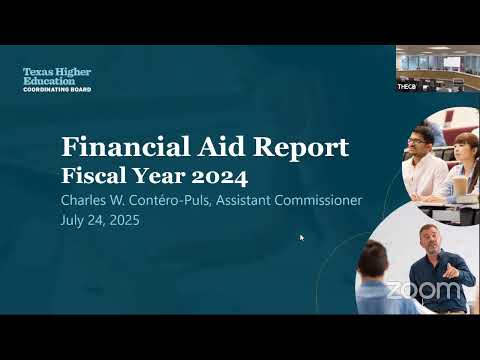
The Higher Education Coordinating Board (THECB) Committee on Innovation, Data and Educational Analytics on July 23, 2025 approved the agency's Report on Student Financial Aid in Texas Higher Education, Fiscal Year 2024, after a presentation by Assistant Commissioner Charles Contreras and a brief question-and-answer exchange with committee members.
The report, built on the THECB financial aid database, covers individual-level aid data for more than 1,500,000 students and shows that “more than 1,000,000 students received more than $13,500,000,000 in financial aid in the 2023-24 academic year,” according to Contreras. The presentation also highlighted persistent affordability gaps: even after federal, state, institutional and private aid, the average student receiving aid still faces between $11,000 and $17,000 in unmet need depending on institution type.
Committee members pressed staff about pathway and transfer data that appear in table 8 of the report. Contreras summarized that, among students eligible for the Texas Grant program in fiscal 2024, roughly 75% came through the high-school pathway, about 19% through the associate-degree pathway and about 6% through the Texas Educational Opportunity Grant (TEOG) pathway. He told the committee that students who transfer from two-year institutions and met TEOG criteria historically were underfunded: while such transfer students made up roughly 5.6% of eligible students, the agency had funded “less than 0.1% of them.”
Contreras said the 2025 legislature provided a dedicated pool of funds to improve portability for TEOG-pathway students, allowing transfer students who meet eligibility (for example, at least 24 semester credit hours and a 2.5 GPA) to receive continuity of Texas Grant funding at four-year institutions. “There will be a pot of funds specifically to ensure that those students receive a Texas grant at the 4 year institution,” Contreras said. He characterized the change as treating qualifying transfer students more like renewal students so that they are less likely to arrive at a four-year campus after funds are exhausted.
During the discussion a committee member asked whether the decline in the share of eligible students from the associate pathway (from about 24% to 18% in the table) meant fewer students were completing two-year programs; Contreras said that the table captures eligibility for Texas Grant and that determining whether completion or enrollment shifts caused the change would require additional enrollment-side analysis. He said staff could “look into” the background of those shifts.
Separately, the committee approved a set of rule changes and reorganizations on the consent calendar. Among the items adopted were noncontroversial conforming amendments and the creation of a new chapter 13 subchapter g to consolidate tuition and fee rules. Presenters said the new subchapter centralizes tuition-related definitions and reporting requirements, reduces institutional reporting burden by consolidating multiple fee definitions into one, clarifies exceptions to the expectation that tuition and fees be paid in full by the census date, and codifies an existing method for calculating the ROTC program fee. The committee also adopted an amendment to chapter 13, subchapter a, section 13.1 to clarify the definition of “census date” and to add a flexible “class day” definition allowing institutions to shift census dates after significant class disruptions.
The committee approved the consent calendar items and the financial aid report by voice votes; no roll-call tallies were recorded in the transcript. Members present during the meeting included the committee chair (unnamed in the record), committee members Stacy Hawk, Richard Klemmer, Juan Norris and Wilson, and student representative Lisa Kentu. Staff presenters included Assistant Commissioner Charles Contreras and THECB staff identified in the record as Dr. Cantero and Dr. Quintero. The meeting adjourned after the votes and a short break preceded the next committee meeting.