Get Full Government Meeting Transcripts, Videos, & Alerts Forever!
Get email alerts on the Bell Schedule Advisory topic
No spam. Unsubscribe anytime.
Petaluma schools update high‑school bell schedule; district rolls out twice‑weekly advisory to add electives and supports
Summary
District staff described a new seven‑period bell schedule and a twice‑weekly advisory at Petaluma High and Casa Grande designed to add electives, increase counseling and support, and create time for targeted help; board members and parents pressed staff on monitoring, discipline and exemptions for seniors.
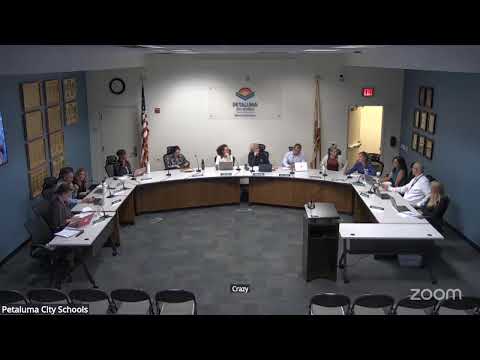
Petaluma City Schools staff presented a high‑school bell schedule update and the new advisory model at a joint school‑board meeting, describing how the schedule change created more elective opportunities and a regular “advisory” period intended for student supports and small‑group help.
Jason, identified in the meeting as a district human‑resources staff member, said the district saw staffing impacts from the schedule change: “we when we look at this section increases at both Casa Grande and Petaluma High, there was a a 8.8 FTE increase at Casa Grande and a 6.2 FTE increase at Petaluma,” and added that those FTEs include many partial‑time positions. Sandra Larson, from PFT, summarized the district’s intention for advisory: “The advisory section process I just have to say first, this was a real example of shared decision making and how it works in the district.”
Why it matters: The schedule move is meant to give students more elective options — including Career and Technical Education (CTE) pathways — and to provide a regular block of time where students can check in with a trusted adult, receive academic support or be triaged by counselors or administrators.
What staff told the board - Advisory frequency and timing: Advisory meets twice a week on “B” days after seventh period (district staff said this typically falls on Wednesday and Friday afternoons). - Structure and purpose: The advisory is intended as a predictable, smaller‑group period where students keep a relationship with a teacher for the full year, get academic help, access counseling or administrative check‑ins, or use the time for focused work. - Technology and scheduling: Staff said the district used an external scheduling workflow (exporting data from Aeries into an AI‑assisted tool and returning it to Aeries) to assign advisory groups and keep advisory sizes small. - Staffing and FTEs: The district reported it offered a small number of 0.8 or 1.2 FTE assignments in recent years to cover needs; Jason said last year the high schools had 13 fractional (1.2 FTE) assignments and this year only one. The district reported two fractional assignments systemwide (one junior high, one high school). - Special education and English learners: Sites may use advisory to meet some special‑education minutes or provide targeted English‑learner supports so students can take another elective; staff said these site plans come through shared decision‑making and teacher identification of eligible students.
Board and public questions Board members and the student representative asked specifically how advisory will be monitored and enforced, who will handle discipline if students skip advisory, and how student movement between sites will be controlled. Staff said both high schools use a software tool to manage in‑advisory movement and to limit unplanned crowding; the tool can be used to request students and to log passes. On discipline, staff said enforcement is a site‑level responsibility (coaches/athletic directors and principals) and that the district will include advisory compliance in site spot checks.
Exemptions and future reporting Staff said a narrow set of exemptions already exists for seniors doing approved work experiences or internships; those options must be signed and approved. Board members asked staff to return with data on how advisory is being used, including student and teacher surveys, counts of students using advisory to access electives, and a staffing update. Jason and Sandra said the district will report back after the bell‑schedule committee meets and after additional advisory use data are collected.
Concerns and next steps Board members and parents pressed staff on monitoring (attendance and pass systems), discipline for students who leave campus during advisory, and digital tracking of waiver forms. Staff said they will implement compliance spot checks, work with sites to digitize driver/field‑trip and waiver forms, and return with metrics at a future board meeting. The district also plans to survey students and staff and to bring a follow‑up report once more advisory practice data are available.