Get Full Government Meeting Transcripts, Videos, & Alerts Forever!
Get email alerts on the Education Antisemitism topic
No spam. Unsubscribe anytime.
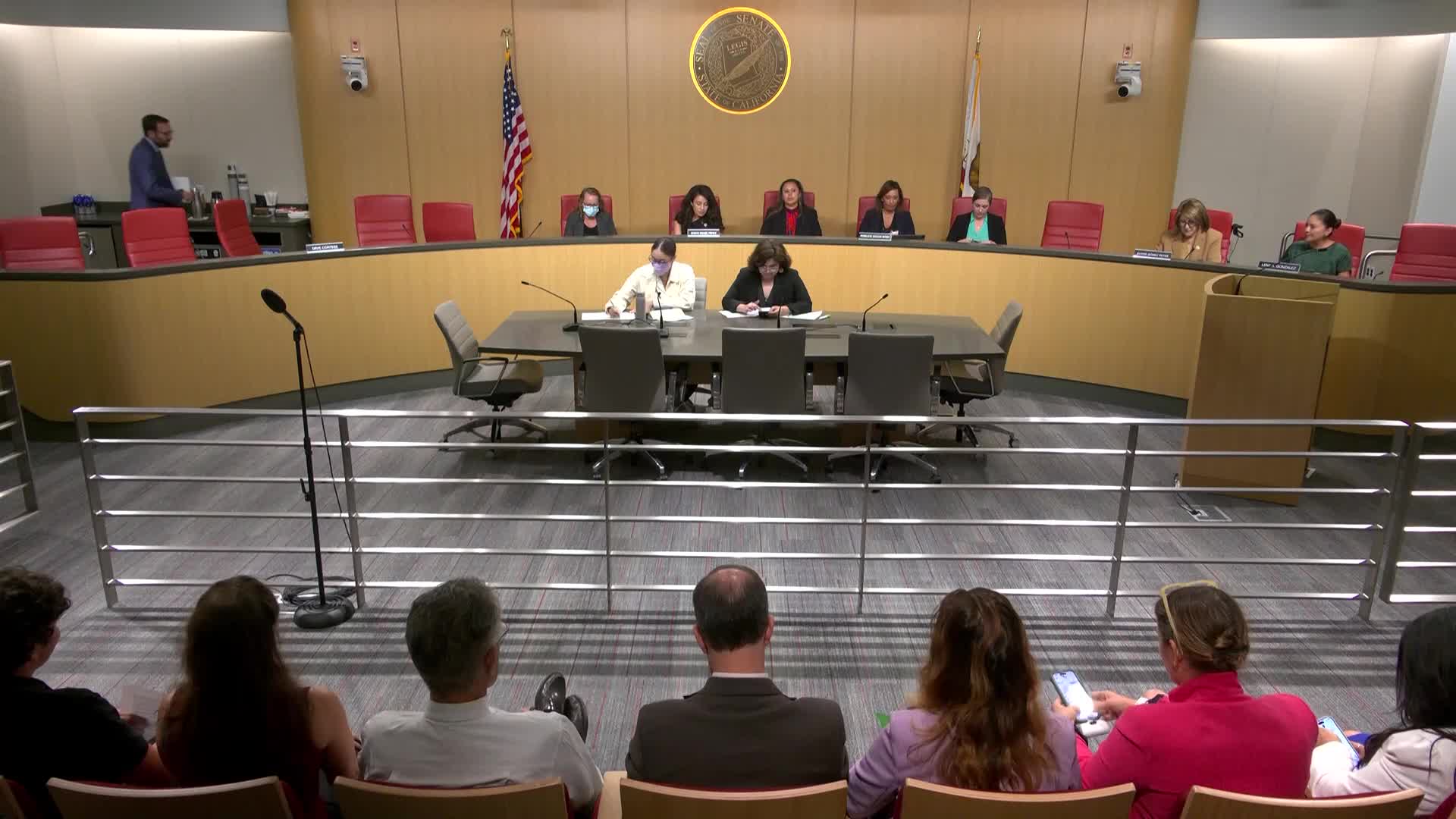
Senate committee advances AB 715 to create civil‑rights office and antisemitism coordinator after heated hearing
Summary
The California State Senate Education Committee voted to send Assembly Bill 715 to the Senate Judiciary Committee after an evening of testimony that included hundreds of public commenters and sharply divided views from education groups, civil‑rights advocates and community leaders.
The California State Senate Education Committee voted to send Assembly Bill 715 to the Senate Judiciary Committee after an evening of testimony that included hundreds of public commenters and sharply divided views from education groups, civil‑rights advocates and community leaders.
AB 715, authored in the Assembly by Assemblymember Zabir and coauthored by Assemblymember Don Addis, would establish an Office of Civil Rights at the state level and an antisemitism prevention coordinator to provide technical assistance and prevention resources to local education agencies. The committee approved the bill 6–0 with one recorded abstention and referred it to Senate Judiciary.
The bill’s authors framed AB 715 as a targeted response to a rise in antisemitic incidents in California schools. "This bill should not be controversial. This bill is about values that we all share: safety, dignity, and equality and protecting all of our students," Assemblymember Zabir told the committee, citing recent incidents and the authors’ work with education stakeholders.
Student and religious leaders urged lawmakers to act quickly. Lev Miller Ruderman, a sophomore at San Lorenzo Valley High School, described being targeted by classmates and said, "By being bystanders, they were complicit in targeting me for being a Jew." Rabbi Jacqueline Mates Munchen of Temple Isaiah in Oakland warned the committee that antisemitic tropes and intimidation have increased in local schools and said Jewish families are leaving districts because they do not feel protected.
Opponents, including the California Teachers Association and several civil‑liberties and ethnic‑studies advocates, described remaining concerns about the bill’s impact on classroom instruction and free speech. Seth Bramble of the California Teachers Association stated that AB 715 "codifies into law subjective standards for instruction under the term 'factually accurate'" and warned the phrase could be used to challenge classroom teaching across multiple subjects.
Speakers who oppose the bill also pressed the authors about an earlier version’s linkage to definitions of antisemitism that critics say could be used to limit criticism of the state of Israel. Gabriel Khan, a Jewish educator and CTA member, told the committee that the International Holocaust Remembrance Alliance (IHRA) definition has been used to label legitimate critiques of Israel as antisemitic and "has no place in our schools" if it chills speech.
Committee members spent much of the question-and-answer period on two themes: process and language. Several senators, including Senator Choi, pressed the authors on why major amendments reached the committee office on short notice; members from both parties said the late timing made it harder for stakeholders to weigh in. Senators also repeatedly returned to the bill’s language on instruction, which uses the phrase "factually accurate" to describe acceptable instruction and materials.
Assemblymember Addis said the language on standards was taken from a local bargaining agreement and inserted to give parents and districts a tool to address what the authors described as inappropriate or hostile classroom content. Addis and Zabir told the committee they were open to continuing negotiations and to technical cleanup in future sessions.
The final version approved by the committee removes a statutory definition of an "antisemitic learning environment," does not create a new statewide complaint intake or investigatory process, and leaves the existing Uniform Complaint Procedures (UCP) in place for formal investigations. Committee staff and the authors said the coordinator’s role would be to provide technical assistance, model prevention policies, and recommend steps to districts and the California Department of Education.
The hearing drew a large public turnout: supporters included Jewish communal organizations, parents and survivors who described antisemitic harassment in schools; opponents included ethnic‑studies educators, the Council on American‑Islamic Relations, student groups, and Jewish groups such as Jewish Voice for Peace who said the bill could be applied to suppress criticism of Israel or the Palestine‑Israel conflict.
The committee approved a motion to refer the bill to Senate Judiciary. The roll call recorded Assembly Bill 715 as passing the Education Committee 6–0 with one abstention; Senators Perez, Ochoa Boggs, Cabaldon, Choi, Gonzales and Reyes were recorded as voting yes, and Senator Cortese indicated he would abstain from the vote.
Next steps and outlook: AB 715 will go to the Senate Judiciary Committee. Authors and several committee members said they expect further work on the bill’s instructional language and on companion legislation that would create additional civil‑rights coordinators to address other forms of discrimination. The authors and multiple education stakeholders also said they are open to post‑session "cleanup" legislation to address implementation, statutory drafting and constitutional concerns raised during the hearing.
Votes at a glance: AB 715 — Sent to Senate Judiciary, approved 6–0 (1 abstention).