Get Full Government Meeting Transcripts, Videos, & Alerts Forever!
Get email alerts on the Enrollment And Facilities topic
No spam. Unsubscribe anytime.
Pasco staff propose Paula Smith K–8 conversion, cite West-side declines and East-side high‑school growth; Bill Smith property eyed for magnet high school
Summary
District staff told the board Pasco County is seeing both enrollment declines in parts of the county and sustained high‑school overcrowding on the East Side, and proposed consolidating nearby elementary campuses into a Paula Smith K–8 while planning a new magnet high school on the Bill Smith property.
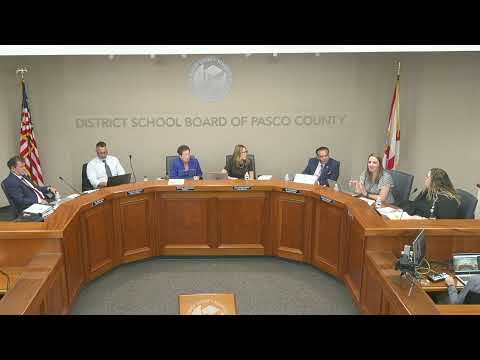
District staff briefed the Pasco County School Board on enrollment shifts across the county and presented a proposal to consolidate neighboring elementary campuses into a K–8 model while planning new high-school capacity on the East Side.
Superintendent staff opened the agenda shift by saying the county is experiencing both declining enrollment overall and significant localized growth. “Two things can be true at the same time,” a staff presenter said, noting that some west-side schools are under capacity while East Side high schools show sustained overcapacity.
Staff recommended consolidating Gulfside Elementary into a Paula Smith K–8, effective with the 2026–27 school year, and moving the district’s community‑school operations currently housed at Gulfside to a high‑school site (staff discussed Anclote High School as a likely location). The two elementary campuses are less than a mile apart. Staff said Gulfside Elementary — built in 1977 — has a permanent capacity of 577 and had 358 students at the 10‑day count (about 62 percent capacity under current configuration). Paula Smith — built in 2006 — has a permanent capacity of 1,287 and had 826 students at the 10‑day count (about 64 percent capacity).
Dr. Iles (district staff) said consolidating the two campuses into a single K–8 would preserve the community‑school model while creating instructional and operational efficiencies. Staff cited national and local research linking K–8 models to improved stability, attendance and behavior and noted that middle-school funding formulas applied in K–8s can yield additional support resources. Staff said consolidation could reduce overhead (staff estimated roughly $500,000 in overhead that could be reinvested) and avoid near‑term capital expenditures on older facilities; they also noted Gulfside sits in a geographically constrained, flood-prone area near the Pinellas County line.
Staff presented declining combined enrollment figures for the affected feeder area: total students in the combined feeder footprint fell from about 1,347 in 2021 to around 1,184 on this year’s 10‑day count, with a projected enrollment near 1,175 next year under current assumptions. The district reported a combined loss of roughly 70 students across the two campuses from last year’s 10‑day count to this year’s.
Board members asked about impacts on transportation, staff placements and building reuse. Staff said existing feeder patterns and proximity would make the transition operationally feasible, that many affected staff would be placed at nearby sites, and that the district is developing a longer-term strategic plan for underutilized buildings rather than holding vacant facilities indefinitely. Staff noted decisions about building reuse would be subject to further analysis and potential state scrutiny about underused facilities.
Turning to growth, staff identified the East Side — particularly the Wesley Chapel and Wiregrass areas — as the county’s highest-priority growth zone. Staff showed maps indicating widespread undercapacity on the West Side and localized overcapacity on the East Side. Wesley Chapel and Wiregrass high schools were reported at roughly 134 percent and 143 percent of capacity, respectively. Combined overcapacity in the two adjacent high‑school zones totaled more than 1,200 students, and the Two Rivers development (not yet fully built out) is projected to add additional students.
To address East-Side growth, staff briefed the board on the Bill Smith property (about 70–75 acres the district has owned since 2009) as a proposed site for a new magnet high school, with a planned opening in 2028. Staff said the site could support athletics and may be designed as a magnet or a 6–12 campus; initial planning grants and a planning architect will be pursued in the next months. One planning direction staff discussed was developing the school with health-care career pathways to align with nearby hospitals and industry demand.
Staff emphasized a multi-pronged strategy: preserve the community-school model by relocating it to a more accessible site, convert underused elementary/middle footprints into more efficient K–8s where appropriate, and build targeted new high-school capacity in growth corridors. They said this mix would avoid over‑building in central areas that have stabilized and focus capital investment where growth is occurring.
Board members asked operational questions about transportation savings, community access to relocated services, and the long‑term disposition of vacated buildings. Staff said transportation routing and potential bus‑service savings would be evaluated and that long‑term reuse options would be developed collaboratively with community partners.
No formal vote was taken; staff said the proposal will continue through planning and return to the board with formal agenda items, including recommended contract actions for architects and construction as timelines are refined.