Get Full Government Meeting Transcripts, Videos, & Alerts Forever!
Get email alerts on the City Budget topic
No spam. Unsubscribe anytime.
Missoula council adopts FY2026 budget with modest tax increase, approves fee changes
Summary
Missoula's City Council on Aug. 18 adopted the fiscal year 2026 budget, levies and a package of fee and assessment resolutions, approving the main appropriation 11-0 after a staff presentation and public hearing.
Missoula's City Council on Aug. 18 approved the fiscal year 2026 budget, levies and a suite of fee and assessment resolutions after a public hearing and multiweek review of revenues and expenditures. The budget package passed in separate roll-call votes, with the main annual appropriations measure approved 11-0.
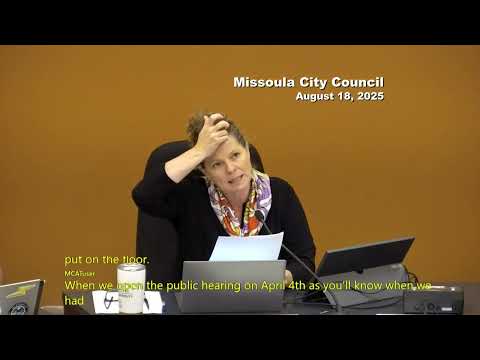
Council President Cheryl Sherrill opened the council's public hearing and turned the presentation over to Dale Bickle, the city's chief administrative officer, who outlined revenue adjustments provided by the State Department of Revenue and several changes since the mayor's executive proposal.
Bickle said the adopted package represents a 3.39% increase in city property-tax collections from existing taxpayers, equal to roughly $2.4 million in additional mill revenue for the city. He told the council the overall general fund in the adopted budget is about $88.1 million, tax-related activities total about $121 million, and the city's full operating budget (including utilities and enterprise funds) is about $200 million. "This budget is a 3.39% increase in property tax funds," Bickle said, adding that most residential property owners will see a net reduction in their city portion of the tax bill because of changes in state-assessed taxable values; he cited an approximate $257 decrease for a median-value home in the city portion of the bill.
Why it matters: The adopted budget moves the city toward its reserve goal and reduces a structural deficit, while still increasing taxes on the city's portion of property collections. Bickle said estimated fund balance for FY26 is $3.4 million (up from the adopted FY25 assumption) and the structural deficit improved from roughly $3 million to $2.5 million.
Key elements and council discussion
- Revenues and reserves: Bickle said FY25 ended with about $1.4 million more in fund balance than originally expected, and the FY26 projection raises that to about $3.4 million. He said the structural deficit fell by about $500,000 between the mayor's original estimate and the updated numbers.
- MRA remittance: Several councilors pressed on the Missoula Redevelopment Agency remittance that the city will use to help balance the general fund. Councilor Campbell asked whether the $2 million remittance and the total remittance including other taxing jurisdictions (about $6.7 million) represented a large share of uncommitted MRA funds; Bickle confirmed the amount was taken from uncommitted balances and noted future URD increments will affect those balances. Councilors expressed concern that repeated reliance on remittances is not a long-term strategy.
- Fees and permits: Councilors asked why permit fees and other user fees were increasing and how those fees relate to staffing costs. Bickle and staff explained some inspection and permitting functions are funded from restricted fee funds (for example, building inspectors are paid from the building fund) and that prior surpluses have been drawn down; absent fee increases some fee funds would run into deficit. The administration proposed modest, largely inflation-based fee increases (for many permits about 3%). Several councilors said they want to keep monitoring the balance between fees and taxes to avoid pricing residents out of services (parks fees and rental fees were mentioned specifically).
- Service and staffing priorities: The budget includes continued funding for housing-focused positions (houseless operations specialist and property engagement specialist) and salary adjustments, plus additional street maintenance staff funded by existing gas-tax resources. Bickle noted a small, targeted increase for a police digital forensics tool of $6,800 paid from general-fund balance.
Votes at a glance (council action summary)
- Item 5.1: Resolution fixing the annual appropriations and capital improvement program (full FY26 appropriations and CIP). Outcome: approved 11-0.
- Item 5.2 (assessments): Park District No. 1 levy (amount listed in packet) Outcome: approved 11-0. Road District No. 1 levy Outcome: approved 11-0. Tourism Business Improvement District room assessment ($4 per occupied room, cited under 7-12-1132, MCA): approved 11-0.
- Item 5.3 (fee schedules): Parks & Recreation master fee schedule (effective Jan. 1, 2026) Outcome: approved 10-1 (one councilor opposed). Public Works fee schedule (effective Jan. 1, 2026) Outcome: approved 10-1. Business licensing, land use and planning fees (effective Jan. 1, 2026) Outcome: approved 10-1. Fire fee schedule (effective Jan. 1, 2026) Outcome: approved 10-1.
- Item 5.4: Street Maintenance District No. 1 assessment to cover street sweeping and related services for FY26. Outcome: approved 11-0.
- Item 5.5: Special lighting improvement districts assessments for FY26. Outcome: approved 11-0.
- Item 5.6: Transition of certain voter-approved levies (open-space stewardship and fire and emergency services) to dollar-based limits in accordance with the 2025 legislative change (cited in meeting as section 15-10-421a, MCA). Outcome: approved 11-0.
- Item 5.7: Resolution levying taxes for municipal and administrative purposes for FY26 (mills fixed based on Department of Revenue values). Outcome: approved (unanimous as recorded).
Public comment and related issues
Public commenters raised concerns about property taxes, the Missoula Redevelopment Agency and transparency. Bob Moore urged the council to consider abandoning the MRA and criticized past TIF spending. Matt Lisonbee and other speakers asked for clearer public accounting of contract and consent-agenda spending and raised specific questions about vendor payments.
Housing and legal-assistance advocates attended and urged action on tenants' right-to-counsel (see separate public-comment item). Council members acknowledged those requests and said staff and elected officials would continue conversations.
What the council did not do
Council members preserved the budget's overall framework, did not approve additional council-led amendments that would materially increase or decrease the tax levy beyond the package adopted, and deferred a single downtown business improvement district adoption motion for a follow-up meeting on Aug. 20 after updated Department of Revenue figures were finalized.
Context and next steps
Bickle told the council that while the adopted budget shows progress on reserves and the structural deficit, the city remains roughly $2 million short of the fund-balance target and that reliance on MRA remittances was a policy choice to balance the FY26 package. Multiple councilors said they want continued work in the next year to reduce the budget's dependence on remittances and to revisit fee structures, particularly for parks and permit services.
The council will consider one updated motion related to the downtown Business Improvement District at an Aug. 20 meeting after the Department of Revenue posted final numbers.