Get Full Government Meeting Transcripts, Videos, & Alerts Forever!
Get email alerts on the Alternative Energy Solar topic
No spam. Unsubscribe anytime.
Board hears first read on solar proposals; staff recommends safe-harboring to preserve tax credits
Summary
Haysville district presented two solar project bids for the transportation facility and campus natatorium and discussed federal investment tax credits, safe-harbor rules and a September action deadline.
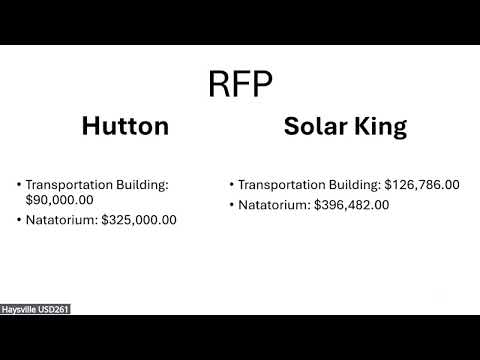
District staff presented three vendor responses to an RFP for solar installations at two district facilities: the transportation building and the campus natatorium. Staff identified Hutton as the lowest-cost bidder and described tax-credit incentives that could cut net project cost substantially.
Key points - Sites and bids: staff said Hutton submitted a bid of $325,000 (pre-tax) for a natatorium rooftop installation and a $90,000 bid for the transportation facility. Other vendors either submitted higher bids or did not respond; one named vendor did not provide a bid for either location. - Tax credit and safe harbor: staff and a vendor representative explained that current federal rules can deliver up to a 40% investment tax credit if certain domestic-content conditions are met. Staff said an entity can enter a "safe harbor" by spending at least 5% of project cost before Dec. 31, 2025, which preserves the incentive while allowing final project completion through 2029. District staff and the vendor recommended using safe-harbor steps to preserve the available credit. - Procurement and utility review: staff said Hutton would manage permitting and Evergy (the local utility) typically has up to 90 days to approve interconnection plans; the vendor said review often proceeds more quickly but 90 days is the maximum allowed. - Roof and paired incentives: a vendor rep advised the board that, in some cases, replacing roof material with a highly reflective surface and installing panels can make roofing costs eligible for a tax credit, increasing combined returns on investment for both roof and solar work. That representative also said nonprofits and public entities have a direct-pay mechanism to receive credits under the current federal program.
Board response and next steps Board members discussed timing and agreed not to take action at the August meeting. The board asked staff to place the item on the Sept. 8 meeting agenda for action, noting urgency because of the Dec. 31 safe-harbor deadline for preserving tax credits. A board member suggested possibly splitting the work and prioritizing the transportation facility if the board wanted earlier movement; staff recommended bringing both as action items on Sept. 8.
Why it matters Solar installations could lower long-term electricity costs and capture federal investment tax credits; timing matters because of safe-harbor provisions and changing domestic-content rules that affect the size of the credit. The district'staff presentation emphasized the opportunity to pair roof work and solar installations to improve cost-effectiveness.
Ending Staff will return with an action item on Sept. 8 and recommended next steps to begin safe-harboring if the board approves.