Get Full Government Meeting Transcripts, Videos, & Alerts Forever!
Get email alerts on the Road Construction topic
No spam. Unsubscribe anytime.
Clark County details two-bridge, roundabout rebuild at NE 179/NE 29; major closures to begin Aug. 25, 2025
Summary
Clark County Public Works staff on Monday laid out plans for a multi-stage reconstruction of the NE 179/NE 29 intersection that will build two bridges and a roundabout, with initial full closures at the west and south legs expected to begin Aug. 25, 2025.
Clark County Public Works staff on Monday laid out plans for a multi-stage reconstruction of the NE 179/NE 29 intersection that will build two bridges and a single‑lane roundabout with room to expand to two lanes in the future. County presenters said initial full closures at the west and south legs of the intersection are expected to begin Aug. 25, 2025, and that major construction activity could continue through spring or summer 2027.
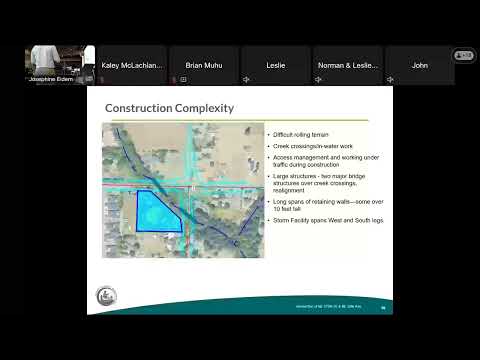
The project is intended to address long‑term safety and capacity constraints at the intersection as growth continues in the area. “Closures start on the 25th of this month,” Brian, a county project presenter, said during the public meeting. County staff said the full project includes two large bridges, retaining walls up to about 10 feet in some places, and a roundabout footprint sized to accommodate future expansion to two lanes.
County presenters said the initial construction stage will focus on clearing, utility relocations and in‑water work in the creek area, followed by bridge construction. The county described the first stage as likely lasting roughly three to four months for the closed legs, with the overall project duration “about two years,” and construction activity expected to run from summer 2025 through spring 2027. Project presenters cautioned timelines and detailed staging are not fully finalized and are subject to change.
“We’ve taken consideration with those larger trucks,” Dave Daley, engineering construction division manager, said when asked whether the roundabout will handle heavy commercial traffic. “It’s designed to accommodate passenger vehicles, recreational vehicles, heavy semi truck vehicles, oversized load vehicles.” Scott Sawyer, the county project manager, added that oversized vehicles will use both lanes through a two‑lane roundabout and urged drivers to give trucks room.
County staff described a detour pattern for the first stage that will route traffic around the closed legs using nearby arterial routes; they said specific signage and exact detour steps will be posted before closures but that the full detour routing is still being refined. “We will be monitoring the detour routes,” said Steve Gallup, the county’s transportation division manager and traffic engineer, who said the north and east legs were expected to remain open during the initial phase.
Presenters and contractors emphasized coordination with emergency services, solid‑waste haulers, school districts and the postal service. “As long as the county… is the point of contact on this project to inform us, keep us informed of our closures, we anticipate things running pretty smooth,” Jason Fritz, deputy director of operations at the county’s regional emergency agency, said, noting dispatch systems can be updated to send the closest units via alternate routes.
Contractor Cascade Bridge (project manager Kyle, on site) and county staff said they will provide a construction superintendent and a daily on‑site point of contact and encouraged residents to report damaged or confusing traffic control signs so teams can respond quickly. Joel (solid waste manager) said the county will work with haulers to maintain pickup schedules where possible and to notify residents of changes.
Residents raised repeated concerns about mail delivery, trash pickup, school‑bus stops, noise, utility outages and coordination between private development permits and the county project. County staff said they will continue outreach and that the county will act as the primary point of contact for service providers and emergency dispatch updates. “We’ve focused outreach efforts with our partners on those service areas for the very reason that things do happen, but we want to be able to react quickly,” a county presenter said.
County presenters also cited an estimated lifetime savings tied to the selected intersection configuration; the presenter described expected savings “to be about $5,000,000,” but staff did not present a detailed, line‑item budget during the meeting. Construction hours were described as typically 7 a.m. to 3:30 p.m. Monday–Friday (with the possibility of work extending to 5 p.m. on weekdays and limited weekend work only by permit).
No formal votes or approvals were taken at the meeting. County staff said the project requires additional coordination with utility companies for relocations and with state and regional partners for permits and environmental windows for in‑water work; those dependencies mean some elements of staging and access will be finalized as those approvals and relocations are scheduled.
County staff and the contractor asked residents to use the project contact points for urgent issues, to report damaged signs or access problems, and to watch the county’s project webpage and social media for staging updates, school‑bus pickup changes and service notifications. Staff said they will hold follow‑up meetings and provide more detailed phase‑by‑phase staging when utility relocations and permitting timelines are confirmed.
Residents may contact the county project team or the contractor for site‑specific questions and were told county staff would remain available after the meeting to take individual concerns.