Get Full Government Meeting Transcripts, Videos, & Alerts Forever!
Holland BPW outlines options, costs for meeting Michigan clean-energy rules; staff recommends early solar, storage and thermal planning
Summary
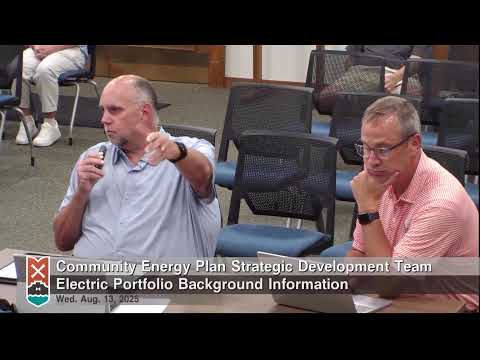
The Holland City Board of Public Works on Oct. 25 heard a detailed briefing on Michigan energy-law changes and an integrated resource plan that shows higher near'term costs under the state'mandated clean energy standard, and staff recommended early solar, battery and thermal planning.
The Holland City Board of Public Works on Oct. 25 heard a detailed briefing on changes to Michigan energy law and the utility'level implications in an updated integrated resource plan (IRP), with staff urging early action on solar and battery projects and planning for a thermal capacity addition by 2028'1035.
The discussion centered on three Michigan public acts cited by staff: Public Act 235 (clean-and-renewable energy standards), Public Act 229 (energy waste reduction and beneficial electrification), and Public Act 233 (siting approval for large renewable resources). Joel (BPW presenter) summarized the statutory compliance timelines and how utilities take credit for renewable generation through renewable energy certificates, or RECs; he said the state'level targets ramp to 50% renewable by 2030, 60% by 2035 and then transition to a clean energy standard that reaches 80% in 2035 and 100% by 2040.
"The only way that you can really take credit for that renewable energy is through an energy attribute certificate," Joel said, describing how RECs must be retired equal to a percentage of retail sales to meet the renewable requirement.
Nut graf: The IRP staff presented models for two principal scenarios — one that follows the city'endorsed Community Energy Plan (CEP) and a second that layers the new state renewable and clean energy standards onto the CEP. Under multiple sensitivities the IRP shows higher net present costs to meet the state laws, especially if Holland cannot rely on RECs associated with a large existing industrial customer. To manage that risk, staff recommends near'term procurement of solar and battery resources and preparatory work on a new thermal capacity option.
Key policy and compliance points
- Disassociated RECs: Staff said municipal electric providers may, through 2035, use disassociated RECs (RECs purchased separately from bundled energy) for compliance and may source those RECs anywhere in their regional transmission organization (for Holland, MISO, the Midcontinent Independent System Operator).
- Customer'owned RECs carve-out: The legislation allows use of RECs that large…
Already have an account? Log in
Subscribe to keep reading
Unlock the rest of this article — and every article on Citizen Portal.
- Unlimited articles
- AI-powered breakdowns of topics, speakers, decisions, and budgets
- Instant alerts when your location has a new meeting
- Follow topics and more locations
- 1,000 AI Insights / month, plus AI Chat