Get Full Government Meeting Transcripts, Videos, & Alerts Forever!
Get email alerts on the Electric Portfolio Irp topic
No spam. Unsubscribe anytime.
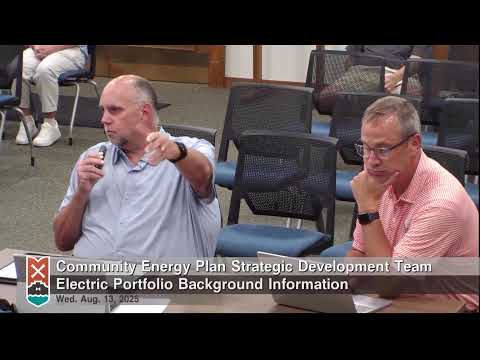
Holland BPW outlines options, costs for meeting Michigan clean-energy rules; staff recommends early solar, storage and thermal planning
Summary
The Holland City Board of Public Works on Oct. 25 heard a detailed briefing on Michigan energy-law changes and an integrated resource plan that shows higher near'term costs under the state'mandated clean energy standard, and staff recommended early solar, battery and thermal planning.
The Holland City Board of Public Works on Oct. 25 heard a detailed briefing on changes to Michigan energy law and the utility'level implications in an updated integrated resource plan (IRP), with staff urging early action on solar and battery projects and planning for a thermal capacity addition by 2028'1035.
The discussion centered on three Michigan public acts cited by staff: Public Act 235 (clean-and-renewable energy standards), Public Act 229 (energy waste reduction and beneficial electrification), and Public Act 233 (siting approval for large renewable resources). Joel (BPW presenter) summarized the statutory compliance timelines and how utilities take credit for renewable generation through renewable energy certificates, or RECs; he said the state'level targets ramp to 50% renewable by 2030, 60% by 2035 and then transition to a clean energy standard that reaches 80% in 2035 and 100% by 2040.
"The only way that you can really take credit for that renewable energy is through an energy attribute certificate," Joel said, describing how RECs must be retired equal to a percentage of retail sales to meet the renewable requirement.
Nut graf: The IRP staff presented models for two principal scenarios — one that follows the city'endorsed Community Energy Plan (CEP) and a second that layers the new state renewable and clean energy standards onto the CEP. Under multiple sensitivities the IRP shows higher net present costs to meet the state laws, especially if Holland cannot rely on RECs associated with a large existing industrial customer. To manage that risk, staff recommends near'term procurement of solar and battery resources and preparatory work on a new thermal capacity option.
Key policy and compliance points
- Disassociated RECs: Staff said municipal electric providers may, through 2035, use disassociated RECs (RECs purchased separately from bundled energy) for compliance and may source those RECs anywhere in their regional transmission organization (for Holland, MISO, the Midcontinent Independent System Operator).
- Customer'owned RECs carve-out: The legislation allows use of RECs that large customers own only if the customer existed when the law was enacted and represents at least 25% of the system's peak demand. Staff said that provision is important because it permits Holland to count RECs already procured by a qualifying large customer when calculating compliance.
- Credits and markets: Staff estimated Holland pays about $4 per REC under an existing deal and that the utility spends roughly $600,000 per year on RECs. They warned the REC market is getting less liquid.
IRP scenarios, sensitivities and results
Joe (BPW presenter on the IRP) described two baseline scenarios fed into the model: (a) the Community Energy Plan trajectory, focused on local emissions and CEP goals; and (b) the CEP plus the state's renewable and clean energy standards. Each scenario was tested against sensitivities including different growth rates for a large industrial customer (referred to in the meeting as "LG"), limits on the utility's ability to self'build large generation, the loss of federal incentives (e.g., expiration of Inflation Reduction Act incentives), and reduced costs for battery storage.
The IRP results highlighted several consistent findings across plausible futures:
- Near'term resource additions: Solar and battery energy storage are the most likely additions in the 2028'030 window under most scenarios. Staff said solar and storage could be sited on properties the BPW controls or on nearby sites that can connect to Holland's distribution system.
- Thermal capacity need: The model indicated the utility will need an additional thermal resource (a new natural gas combined cycle, a peaking unit, or a combined cycle with carbon capture and sequestration) by as early as 2028 and no later than 2035 under many modeled futures, particularly if large customer growth is high or if customer'owned RECs are not available for compliance.
- Cost impacts: In the BPW's mid'case (staff used a 60% realization of the large customer growth forecast), meeting the state law raised the IRP's net present value (NPV) cost about 8% above the CEP case. If Holland cannot count RECs associated with the large customer (a modeled 40% growth case), the NPV gap grew to roughly 30%. The model also showed the removal of federal incentives and tariffs could raise costs substantially (an 11% NPV increase for the CEP case and about 20% for the state'law case in the modeled sensitivity).
- Self'build vs market procurement: The IRP tested a "self build" sensitivity that restricted the utility to resources it could feasibly own and site locally (while still allowing market PPAs for some wind and solar). On a number of modeled outcomes, the self'build case produced only marginally higher costs compared with wider market procurement, though it shifts the mix toward more local peaking units and more solar in the near term.
Staff recommendations and next steps
Staff recommended near'term actions that hedge against multiple futures while keeping options open:
- Pursue tactical project planning and requests for proposals for solar and battery installations (small to medium scale) to put resources into the MISO queue and lock lead times.
- Continue participation with the Michigan Public Power Agency (the utility's joint action agency) in assessing options for a new thermal resource (including combined cycle options and peakers) so Holland can secure capacity when needed.
- Maintain and refine the voluntary green pricing (customer voluntary REC) program and other optionality for large customers and industrial partners.
Joe told the board that battery storage could be economic in town by 2028 for some modeled pathways and would become more attractive as storage costs decline. He and other staff said retrofitting the Holland Energy Park (HEP) with carbon capture was modeled but was not cost'competitive in the current assumptions relative to other options.
Operational details and constraints noted in the discussion
- Interconnection and MISO queue times: Staff warned that interconnection queues for large generation projects can be five years or longer.
- Siting and land needs: Staff estimated roughly 5 acres per megawatt for solar; a 5 MW solar site would occupy about 25 acres and a 30 MW site about 150 acres, increasing the likelihood of cross'jurisdictional siting conversations (Zeeland Township, Holland Township and adjacent areas).
- Energy Waste Reduction (EWR): Public Act 229 reinstates an EWR requirement (1.5% required savings beginning in 2026, with a 2% goal) and mandates that 25% of collected funds be spent on EWR for low'income residential customers. Staff flagged that Holland's sales mix (roughly 82% commercial and industrial sales) complicates meeting the low'income spending requirement.
Board and public questions
Board members asked about the liquidity and longevity of the disassociated REC market, the advisability of banking RECs versus holding them for strategic supply, and how a high growth outcome for the large customer would change the portfolio. Staff reiterated that buying RECs can help the city's decarbonization trajectory even if future legislation changes, but cautioned that overreliance on banked RECs exposes the utility to market and policy risk.
Votes and formal actions taken at the meeting
At the start of the agenda, the board confirmed a quorum and approved the minutes from the previous meeting by voice vote; the chair called the motion, which passed (all in favor). No other formal votes were taken on procurement or IRP adoption at this meeting; staff said planning and procurement steps are next.
Why this matters: The BPW's procurement and siting decisions in the coming 12'4 months will determine where Holland places solar and batteries and whether the utility secures a thermal capacity solution early enough to meet winter reliability needs and evolving state compliance rules. The timing, availability of federal incentives, the market for RECs, interconnection queue delays and growth in large industrial loads are the principal variables that could materially change cost and resource choices.
Ending note: Staff said the IRP will be revisited periodically; they recommended continued monitoring of federal incentives, MISO queue timing and the large customer's confirmed demand trajectory. The board scheduled follow'up work to review the BPW's five levers from the Community Energy Plan and to drill into 2030 tactics at future meetings.