Get AI Briefings, Transcripts & Alerts on Local & National Government Meetings — Forever.
Guam Legislature approves rollback of business privilege tax to 4% effective Oct. 1, 2026; attempts to restore or narrowly exempt large military contracts fail
Loading...
Summary
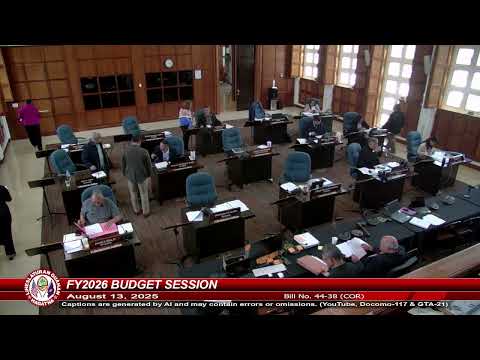
Senator Sean Gamutato, sponsor of the amendment to substitute bill 44‑38 (the FY2026 budget), secured passage of a date‑specific change to the business privilege tax that would set the BPT at 4% effective Oct. 1, 2026. The measure passed following a roll‑call vote, 8 yays to 7 nays.
Senator Sean Gamutato, sponsor of the amendment to substitute bill 44-38 (the FY2026 budget), secured passage of a date‑specific change to the business privilege tax that would set the BPT at 4% effective Oct. 1, 2026. The measure passed following a roll‑call vote, 8 yays to 7 nays.
The measure and two subsequent amendments drew prolonged debate about whether the island should return revenue to businesses now or preserve funds for public services. The body rejected a motion by Senator Chris Barnett to restore the BPT to 5% (vote 4–11) and later defeated an amendment to keep the 5% rate on military contracts exceeding $10 million (vote 7–8).
Why it matters: The BPT change affects broad swaths of Guam’s private sector and is tied directly to debate over funding for education, the Guam Memorial Hospital Authority, the Department of Corrections, and the rainy‑day fund. Supporters said the rollback honors a prior promise and would return surplus collections to taxpayers; opponents warned that reducing the rate now would force cuts to critical services and leave the government short on matching funds for federal programs.
Sponsor’s case
Senator Sean Gamutato (sponsor) said he filed a date‑specific amendment to chapter 1, section 2 of substitute bill 44-38 to “restore the 4% BPT rate” beginning Oct. 1, 2026. He argued the change would “help this branch of government to regain public trust” and quoted testimony from business representatives who urged a return to the 4% rate. Gamutato cited the legislative history of prior tax changes, including Public Law 34‑87 and the FY2019 budget law that raised BPT to 5% in 2018, and emphasized the amendment’s date specificity.
Statements for and against
Senator Parkinson opposed the rollback, saying the largest revenue contributors — a small set of very large military‑related contractors and other high‑revenue businesses — account for a disproportionate share of receipts and called for a more progressive or targeted approach. “We should not be letting this revenue leak in a misguided but well‑intentioned desire to cut taxes for our tourism industry that’s not quite recovered,” Parkinson said.
Senator Chris Barnett framed his opposing amendment to return the rate to 5% as a defense of funding for schools and other obligations, calling the proposed cut a potential “$40,000,000” hit to funds that would otherwise be used for tax refunds, rainy‑day reserves, and education. Barnett argued he favored a “meaningful, tiered” implementation rather than a blanket cut.
Vice Speaker Ada and Senator Lujan both spoke in favor of the Gamutato amendment. Vice Speaker Ada said the rollback would honor an earlier promise made when the rate was temporarily raised in 2018 and noted the government has since collected revenues in excess of projections. Lujan said the phased approach in the amendment—reducing BPT to 4.5% this year and to 4% the next—was “real progress” for businesses and consumers.
A separate amendment offered by Senator Tello Tadeewi would have kept the 5% rate for military contracts exceeding $10 million. Tadeewi argued large off‑island prime contractors profit substantially from the military buildup and should contribute to infrastructure, public safety, and mitigation costs tied to construction and population increases. The amendment’s sponsor cited the Organic Act of Guam and a line of U.S. Supreme Court decisions interpreting the authority of states and territories to tax private contractors performing federal work.
Votes at a glance
- Gamutato amendment (restore BPT to 4%, effective 2026‑10‑01): Passed, 8 yays, 7 nays. - Barnett amendment (restore BPT to 5% immediately): Failed, 4 yays, 11 nays. - Tadeewi amendment (retain 5% on military contracts > $10M): Failed, 7 yays, 8 nays.
Financial and program details cited in debate
Speakers cited several budget pressures and dollar figures during debate: a cited $40 million estimated impact from a further BPT rollback (Senator Barnett), an $18 million obligation for tax refunds, and agency estimates of significant cuts required for the Guam Department of Education (speakers cited figures in the range of $40–50 million). Supporters also cited collections data showing excess revenues in recent years; opponents urged preserving revenue for capital projects, the rainy‑day fund, and health and corrections needs.
Process and next steps
The chamber recessed at the close of the session and scheduled continuation the following morning at 8:30 a.m. The adopted amendment will be part of the FY2026 substitute budget language under discussion as the Legislature continues amendment and conference work.
Ending
Lawmakers split along lines of fiscal philosophy and constituency impact: proponents framed the change as keeping a promise to return excess revenue and to spur private‑sector recovery; opponents said the cut risks underfunding schools, health care and public safety as the government evaluates long‑term needs tied to the military buildup. Debate is expected to continue as the Legislature finalizes the FY2026 budget.