Get Full Government Meeting Transcripts, Videos, & Alerts Forever!
Get email alerts on the Music Economy topic
No spam. Unsubscribe anytime.
Portland leaders hear case to treat music as an economic priority; proposals range from ‘agent of change’ rules to a city music office
Summary
City officials and industry representatives presented new research and a package of recommendations to preserve venues, support musicians and manufacturers, and market Portland’s commercial music sector as a major economic engine.
Portland’s Arts and Economy Committee on Aug. 12 heard presentations and public testimony arguing that the city’s commercial music sector already supports thousands of jobs and billions of dollars in activity — and that a mix of targeted policies could protect venues, rehearsal space and local manufacturers while boosting tourism.
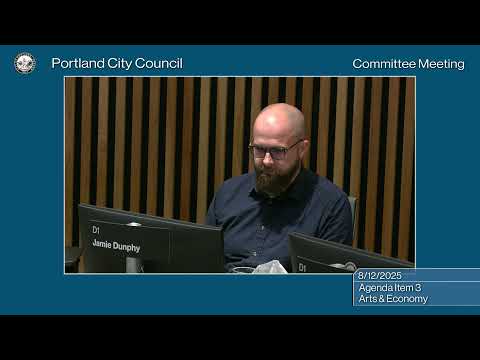
Councilor Dunphy, who led the panel, framed the discussion as the start of a series of roundtables and policy proposals that he said would culminate in a package the council could consider later this year. “Portland needs a unifying, inspiring vision for what the future of Portland is,” he said, and he identified the music industry as a ready vehicle for that vision.
The central finding presented by Mara McLaughlin, founder of Music Portland and Music Oregon, was that a newly compiled statewide economic study places the for‑profit music sector’s impact at roughly $3.8 billion and that “easily 80% of that” activity occurs in Portland. McLaughlin said the sector is undercounted by standard industry codes and that a fuller accounting shows a large cluster of venues, festivals, manufacturers and record labels concentrated in the city.
Independent venue owners and advocates urged city action to prevent closures. Jim Brunberg, owner of Mississippi Studios and vice president of the National Independent Venues Association, recounted national study findings showing many independent venues remain unprofitable since the pandemic and face higher insurance and rent costs. “For every buck a person spends on a show, they spend 12 more dollars everywhere else,” Brunberg said, describing how venue activity supports hotels, restaurants and retail.
Speakers and witnesses proposed several policy directions: an “agent of change” process to require new residential development to mitigate noise impacts near existing music venues; clearer noise‑code standards and limited time windows for home rehearsal; a certification or “check plus” path for acoustic isolation in new construction; streamlined, seasonal noise‑variance permitting for small businesses; expanded musician loading and parking programs; and creation of a dedicated office or director for the creative economy to coordinate music‑sector economic development.
The agent of change concept — a principle adopted in places such as Australia and parts of the U.K. — was described by Beverly Whitrick of the U.K. Music Venue Trust as a planning approach that makes the party introducing a sensitive use (for example, new housing) responsible for mitigating conflicts with an existing venue. Whitrick said several U.K. jurisdictions have embedded the principle in planning policy or legislation to reduce post‑occupation complaints.
On home rehearsal and noise, Derek Trost — an architect, lifelong musician and vice chair of the Music Policy Council — argued that current city exemptions for construction noise effectively permit sound levels that would be comparable to a live rock band and are therefore impractical for musicians practicing in ordinary residential settings. “This exemption…would translate into 110 decibels at the source,” Trost said, and he proposed time‑based allowances, best‑practice isolation guidance and a city certification pathway for acoustic performance of new residences.
City staff and outside experts also recommended institutional steps: appointing a time‑limited director of the creative economy, coordinating cross‑agency work with Prosper Portland and the Office of Film and Events, and exploring a quasi‑governmental nonprofit or an independent city music office to market Portland nationally and administer ongoing music‑sector grants.
Public testimony echoed the sector presentations. Philip Graham of Ear Trumpet Labs described a small Portland manufacturer employing five craftspeople and warned that a decline in local venues and rehearsal space “will die” and would take with it a cluster of world‑class builders, from amps to drum makers. Mont Chris Hubbard of Musicians Union Local 99 urged consideration of a prevailing wage for musicians. Andre Middleton, founder of the all‑ages nonprofit Friends of Noise, highlighted workforce development and youth access while describing efforts to open an all‑ages venue and music workforce center in North Portland.
Committee members broadly praised the proposals but several urged the presenters to break the package into smaller, prioritized steps and to identify funding sources. Councilor Smith asked the presenters to separate items requiring ordinance changes from those that could be handled administratively and to recommend offsetting budget adjustments where new spending is requested. Councilor Ryan urged the committee and council to align around a small set of top priorities and to sequence work so residents and businesses see near‑term results.
No formal vote or ordinance was taken at the Aug. 12 meeting. Instead, the committee directed staff and councilors to continue roundtables and stakeholder engagement, and to return with more detailed, prioritized policy options and implementation plans for future committee consideration.