Get Full Government Meeting Transcripts, Videos, & Alerts Forever!
Get email alerts on the Transportation topic
No spam. Unsubscribe anytime.
Broomfield staff outline multimodal projects, safety goals and transit updates
Summary
City and County of Broomfield transportation staff reviewed the 2016 transportation vision, local and regional projects (US 36, Colorado 7, Industrial Lane), safety targets and transit services; staff answered community questions about signals, speeding mitigation, FlexRide capacity and accessibility.
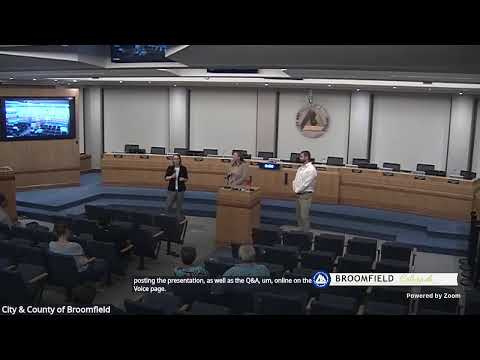
BROOMFIELD — City and County of Broomfield transportation staff on a community briefing reviewed ongoing multimodal projects, regional rail planning and a draft transportation safety action plan while answering residents’ questions about signal timing, traffic calming and transit capacity.
Sarah Grant, transportation manager for the City and County of Broomfield, said the presentation opened by reaffirming a transportation vision first adopted in 2016 that “move[s] people, not just cars,” and highlighted local projects to improve walking, bicycling, transit access and regional connectivity.
The briefing summarized regional corridor work including the US 36 multimodal corridor and Flatiron Flyer bus rapid transit, rail planning tied to the RTD Northwest Rail study and the state’s Front Range Passenger Rail initiative, and locally focused projects such as Industrial Lane, Midway Boulevard and bike/pedestrian improvements.
Why it matters: staff framed the briefing as part information and part engagement ahead of two near-term council items and plan updates. The presentation identified safety and multimodal access as priorities for managing growth, and described near-term construction and funding efforts that affect daily commutes, walking and biking access and transit-reliability for elderly and disabled residents.
Key points and supporting details
• Regional rail and transit: Grant described the state and regional planning work on rail and the Front Range Passenger Rail District created by legislation (SB 21-238). She said the state is pursuing a hybrid solution between RTD’s Northwest Rail and Front Range Passenger Rail, and that the project is being coordinated across CDOT, RTD, the Front Range Passenger Rail District and other state entities. Grant noted the Broomfield Council would receive a rail update from regional partners on Sept. 16.
• US 36 corridor and bikeway: Staff highlighted two decades of US 36 corridor work — managed lanes, bus rapid transit, and an 18-mile bikeway — and said Broomfield helped implement multimodal elements and wayfinding. Grant said Flatiron Flyer ridership peaked in 2019 (more than 3.3 million annual riders) and current daily trips are running at roughly 40% of pre-COVID levels while service is gradually being restored.
• Colorado 7 and corridor planning: Grant said Colorado 7 spans roughly 25 miles between Brighton and Boulder and that corridor planning anticipates large population and job growth corridor-wide (the presentation cited roughly 49,000 new residents and 38,000 new jobs across the corridor). A bus-rapid-transit feasibility study estimated 8,000–10,000 daily boardings on a BRT alignment; staff said corridor cost estimates are on the order of hundreds of millions of dollars and that the city has secured “tens of millions” toward implementation.
• Local multimodal projects and results: The city described a 2019 pedestrian/bicycle assessment and subsequent projects: realignment and widening of a narrow segment of the US 36 Bikeway to a 12-foot standard; pedestrian and bicycle safety improvements near Legacy High School; Nichols Street bike lanes and bike boxes; Shep’s Crossing bridge across BNSF; Industrial Lane Phase 1 (sidepath completed) and a funded Phase 2 (grant funding cited as $2,600,000) to extend connections to US 36 and Flatiron Station. Staff said they had added or improved about 31 miles of on-street bike facilities and over 50 crossings since the 2016 plan.
• Facilities, standards and maintenance: Grant said Broomfield maintains about 109 miles of off-street sidepaths and the Public Works streets division manages about 287 miles of paved streets. Standards adopted in 2022 call for 10-foot lane sections on new collectors and local streets and 11-foot lanes on arterial roadways.
• Traffic engineering and safety: Bryce Hammerton, Broomfield traffic engineer, summarized traffic-engineering functions (signing/striping, signal timing, data collection) and said the city operates about 90 signals and five roundabouts. He detailed signal warrant criteria (MUTCD warrants), described a draft Transportation Safety Action Plan with proposed goals to eliminate fatal crashes by 2040 and severe injury crashes by 2045 on Broomfield-owned roadways, and said final plan recommendations would be presented to council on Sept. 23.
• Traffic mitigation policy and thresholds: Hammerton explained Broomfield’s mitigation criteria for speeding complaints: a minimum 500 vehicles per day, an 85th-percentile speed threshold typically 7 mph over the posted limit (reduced to 5 mph adjacent to schools or parks), or three correctable crashes in a year. Education/enforcement options do not require neighborhood support; engineering measures (speed cushions, traffic circles, medians) require two-thirds support from residents within 500 feet.
• Local transit and paratransit: Grant described local services: Broomfield Senior Services’ Easy Ride (circa 20,000 trips per year) and RTD FlexRide (paratransit/curb-to-curb) which the presentation reported had about 32,000 trips last year and year-over-year ridership increases (about +26% then +17%). Staff said they continue to advocate with RTD for additional vehicles and service hours and that the city’s transit study will present recommendations to council in October.
Community questions and staff responses
Staff answered emailed and live questions from residents on signal timing, adaptive signal control pilots and fiber installation for improved coordination; the Midway/Willow Run signal (warrant met in 2022) was approved by council and a construction contract was approved in April 2025; construction is underway with completion expected this fall, and the intersection will include upgraded pedestrian facilities. Hammerton said staff are piloting adaptive signal timing and seeking to add fiber where signals now rely on radio communications.
On accessibility and paratransit, staff acknowledged capacity limits on RTD FlexRide (Broomfield’s FlexRide operates with a small vehicle fleet) and said the city continues to press RTD for a third bus in the service area; the ongoing Broomfield transit study will include recommendations to expand FlexRide capacity and hours.
Other resident concerns addressed included requests for clearer trail and sidewalk right-of-way guidance for cyclists and pedestrians; staff said open-space and trails staff are updating online guidance and outreach; and questions about converting lanes to 10-foot widths — staff noted the updated 2022 standards require 10-foot lanes on new collectors/local streets, while arterials remain 11-foot.
Ending and next steps
Staff invited ongoing public engagement through the city’s Broomfield Voice portal and said the presentations, Q&A and related project pages will be posted online. Near-term items cited in the briefing include: presentation of the Transportation Safety Action Plan to council on Sept. 23, a rail update from regional partners to council on Sept. 16, and an October council presentation on the Broomfield transit study. Residents were given transportation@broomfield.org and bikes@broomfield.org as contacts for follow-up.