Get Full Government Meeting Transcripts, Videos, & Alerts Forever!
Get email alerts on the Budget Tax Rate Election topic
No spam. Unsubscribe anytime.
Austin council lays out multiple tax-rate election alternatives, schedules budget vote and public hearing
Summary
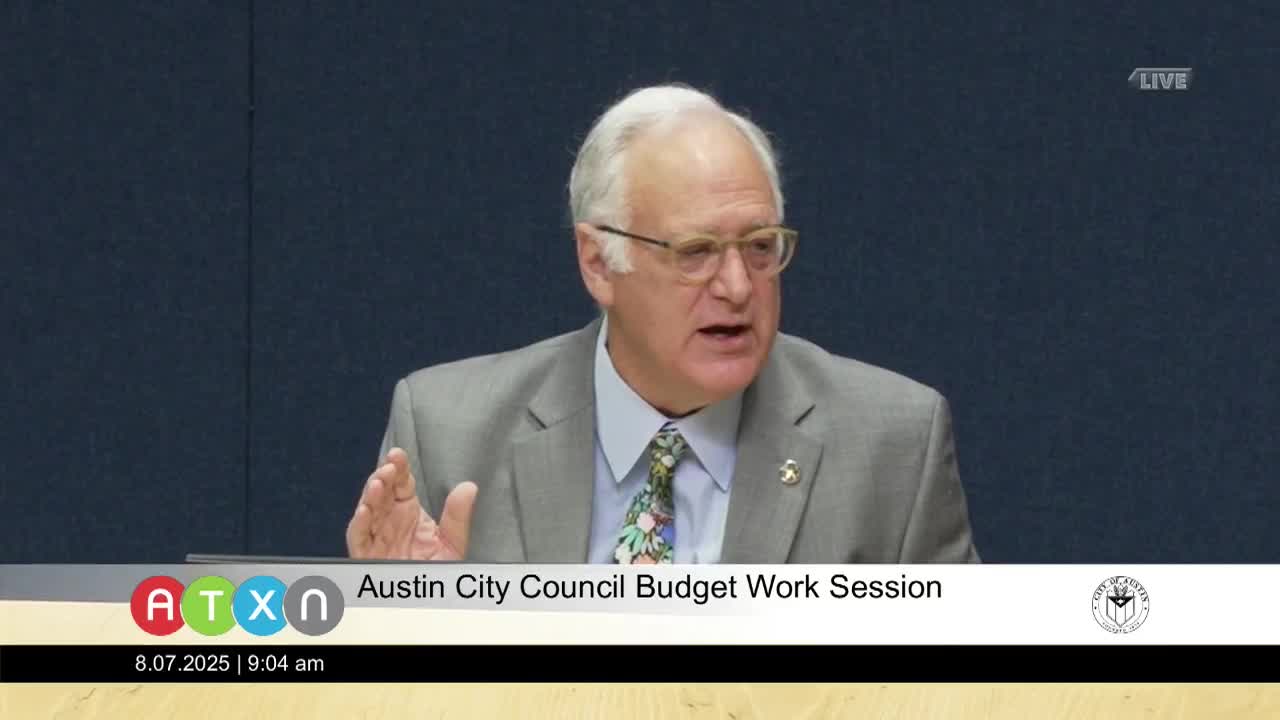
Mayor Kirk Watson called the Aug. 7 Austin City Council budget work session to order and the body heard competing spending plans that would require a tax-rate election (TRE), while the Audit and Finance Committee’s unanimous recommendation that the council conduct a TRE was read into the record.
Mayor Kirk Watson called the Austin City Council budget work session to order Aug. 7 and opened a public exchange of budget proposals that included multiple tax-rate election (TRE) alternatives and a unanimous recommendation from the Audit and Finance Committee that the council conduct a TRE.
The council discussed several competing revenue-and-spending packages that would take the final adopted budget above the voter-approval rate under Texas law and therefore require a citywide TRE. The packages presented on the dais included a 2-cent option from Councilmember Paige Duchin, a 3.5-cent proposal presented by Mayor Kirk Watson, a 5.75-cent package endorsed by a subgroup of council members representing Districts 6, 7, 8 and 9, and a 6.75-cent package offered by another subgroup (Districts 2, 3, 4 and 5). Members emphasized different priorities — from hiring and wildfire mitigation to homelessness services, parks maintenance and public health — as they explained how each package would allocate new revenue.
Why it matters: Under state law, any budget that would increase the property tax rate above the statutory voter-approval rate automatically triggers a TRE. The council’s choices now will determine what voters see on the ballot and which priorities would require public approval. At the meeting, the Audit and Finance Committee’s recommendation was read into the record and recorded as a formal committee action.
Most important developments
- Audit and Finance Committee recommendation: Mayor Watson read the committee’s motion into the record, noting that the Audit and Finance Committee “passed a resolution recommend[ing] making a recommendation to the council … [and] recommends to the full Austin City Council that a tax rate election be conducted subject to the decision of the council regarding the actual conduct of the TRE and any amount.” The committee transmitted that recommendation to the full council for consideration. The committee’s action was described in the meeting as adopted unanimously and sent to the council. (See authorities and actions below.)
- Multiple TRE alternatives presented: Councilmember Paige Duchin described a 2¢ proposal focused on restoring public-safety overtime and wildfire mitigation, among other items. Mayor Watson described a 3.5¢ scenario he had circulated and said he would add funding to fully implement the Homeless Strategy Office plan if necessary. A subgroup of council members (6–9) presented a 5.75¢ plan intended to preserve and expand community investments including parks, public health and homelessness response; another subgroup (2–5) presented a 6.75¢ plan that also prioritizes homelessness prevention, housing vouchers and parks maintenance. Councilmembers said they will continue to narrow options and asked staff to produce a consolidated comparison showing where proposals overlap and where they differ.
- Schedule and next steps: Staff agreed to consolidate the proposals and identify items that appear in all or most alternatives. Councilmembers directed staff to publish that comparison as soon as possible. The council also set a timeline for final actions: a public hearing and budget adoption are scheduled for the council meeting on Wednesday, Aug. 13, with Aug. 14–15 held as reserve dates if additional days are needed to finalize the budget and any TRE placement on the ballot.
- Process guidance requested of staff: Councilmembers asked the city manager’s office and budget staff to (a) assemble a list of items that are common across the TRE proposals, (b) highlight items that appear in three of four or two of four proposals, and (c) reconcile discrepancies in cost estimates where different proposals list materially different dollar amounts for ostensibly the same program. Staff agreed to run the analysis and post findings to the council message board.
Context and supporting details
- Single-budget principle: Several councilmembers emphasized that when the council ultimately adopts a budget it is a single document. The procedural question before the council is how to present alternatives to voters without implying some components are “optional” or lower priority. One councilmember presented a draft resolution to clarify that the council will adopt one final budget and that, if a TRE fails, staff will return with options for adjustments; councilmembers signaled they remain open to editing that language.
- Major spending themes driving TRE proposals: Homelessness response (including full funding of the Homeless Strategy Office plan and prevention/diversion programs), parks and sidewalks maintenance and construction, public health (including core grants and vaccination programs), emergency medical services staffing, and animal-services veterinary care drew repeated attention in public comment and from councilmembers when explaining priorities.
- Public input: More than 60 people provided public comment at the meeting. Speakers representing neighborhood groups, nonprofit coalitions and service providers urged the council to fund homelessness prevention and harm-reduction services, restore library and Cultural programs, reverse proposed cuts to emergency veterinary care at Austin Animal Center, and increase parks and sidewalk maintenance. Several speakers specifically urged support for a TRE large enough to fund the community investment priorities they named; others urged fiscal restraint and prioritization of core services.
What the council did not do
- No final votes were taken on any TRE level at the Aug. 7 work session. The meeting produced a set of public proposals, formal committee referral (the Audit and Finance Committee recommendation), and instructions to staff to reconcile and post consolidated options for council review before the Aug. 13 meeting.
Ending note
Councilmembers said they expect staff to post a consolidated comparison of the proposals and cost reconciliations promptly so that the public and the council have a clear starting point for amendments and refinements ahead of the council’s Aug. 13 public hearing and budget adoption vote.