
Stratford board recommends comprehensive feasibility study; single-high-school option discussed
Get AI-powered insights, summaries, and transcripts
Subscribe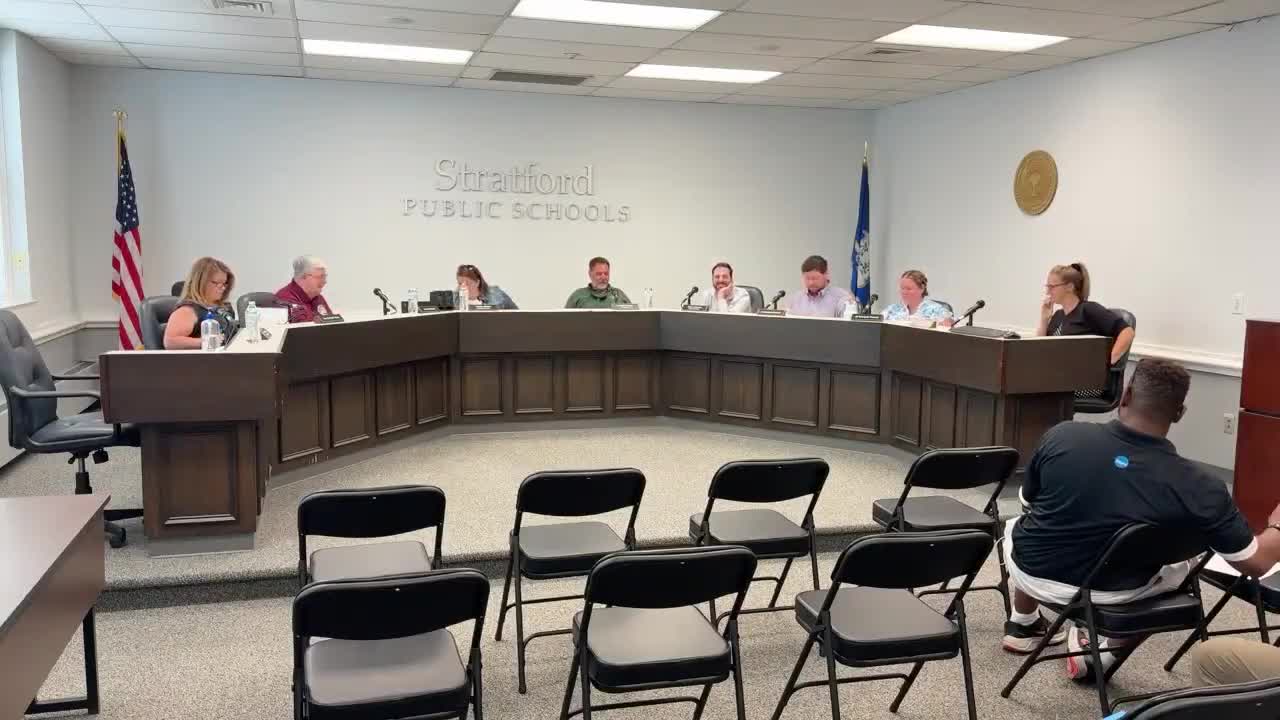
Summary
A board member opened a lengthy discussion urging the Stratford School District and town officials to consider a districtwide feasibility study rather than limit work to renovating a single building.
A board member opened a lengthy discussion urging the Stratford School District and town officials to consider a districtwide feasibility study rather than limit work to renovating a single building.
The board member said, "what we do now at Vinal is gonna have impact for the next 30 years," and called for a study that would examine both near-term renovation needs and broader reconfiguration options, including a single high school campus.
Why it matters: The choice to renovate the current high school or to pursue consolidation would shape capital spending, building use and student assignment for decades. Board members and school leaders said a broader study could clarify costs, program opportunities and which facilities to keep, repurpose or return to the town.
Discussion and proposals
Board members, district administrators and the principals from both high schools took part in the discussion. The meeting outlined a two-part proposal the board would forward to the town's Building Needs Committee: part A would define what a near-term renovation of Bunnell High School (sometimes referred to in meeting materials as the —3now—4 project) would require; part B would be a districtwide feasibility and facilities-optimization study that explicitly examines the fiscal and programmatic implications of a single high school.
Katie Grama, identified in the meeting as a principal from Bunnell, told the board, "I agree that we the feasibility study needs to include both scenarios." Board members and school administrators emphasized that a single high school could yield program benefits (expanded CTE and pathway options, a larger athletics base and more efficient use of staff) but also acknowledged strong community sentiment against consolidation.
Officials stressed the timeline and permitting reality. One participant summarized prior timeline estimates discussed with town staff: under the current schedule a renovation design process could lead to construction beginning in 2028, and adding a districtwide option could push that date into 2029. The meeting also referenced a previously cited 2022 estimate that put straightforward renovation of Vinal at about $20,000,000 (the figure was discussed as an historical estimate from 2022, not a current contract price).
Operational details and constraints
Speakers noted additional operational constraints that a study would need to examine: whether middle grades could be accommodated at a consolidated high school; how grants tied to specific programs or grade structures would be affected; equipment and HVAC life-cycle issues (speakers described major systems as 20—30 years old at several buildings); and a continuing waitlist for preschool (discussants said the district has roughly 125—150 children on preschool waiting lists, cited as context for repurposing space).
Several speakers said certain buildings (the meeting repeatedly named Flood and Worcester schools) present maintenance and configuration problems that could make them candidates for repurposing or return to town control if enrollment declines. Participants also noted that any town-funded renovation would effectively commit the district to maintaining two high schools unless a districtwide plan said otherwise.
Motion and next steps
Near the end of the agenda discussion a motion was made to send the board's recommendation to the Building Needs Committee for a comprehensive feasibility study that includes: (a) the Bunnell renovation (near-term work) and (b) a districtwide facilities and utilization analysis including the potential for a single high school. The transcript contains the motion language but does not record a named mover or seconder, nor a formal roll-call vote on that specific referral.
Meeting participants identified immediate next steps: the Building Needs Committee will receive the recommendation; district staff and a consultant would prepare study parameters; Sue Schmack (district staff) was scheduled to explain funding/self-funding details at the August meeting; and the board repeatedly said public engagement would follow the feasibility work so the community could review options.
What remained unsettled
Meeting speakers repeatedly warned that a broader study could delay near-term construction, and that public sentiment in comparable towns often resists consolidation. Several participants urged doing both: plan the near-term renovation so it can proceed if consolidation is rejected, while also commissioning a comprehensive study so the town knows all options before committing capital.
Ending
Board members closed the discussion by directing staff to forward a recommendation to the town's Building Needs Committee and to return to the board with study scoping and an anticipated schedule. No final construction contract or formal adoption of a single-high-school plan was recorded in the transcript.