Get AI Briefings, Transcripts & Alerts on Local & National Government Meetings — Forever.
HFSC board approves revised FY26 budget, hears updates on backlogs and Texas forensic apprenticeship law
Loading...
Summary
The Houston Forensic Science Center board voted unanimously to adopt a revised FY26 budget that matches the city—s allocation and approved FY25 line-item reallocations; staff reported progress and ongoing challenges on DNA, firearms and seized-drug backlogs and briefed the board on new Texas forensic apprenticeship legislation.
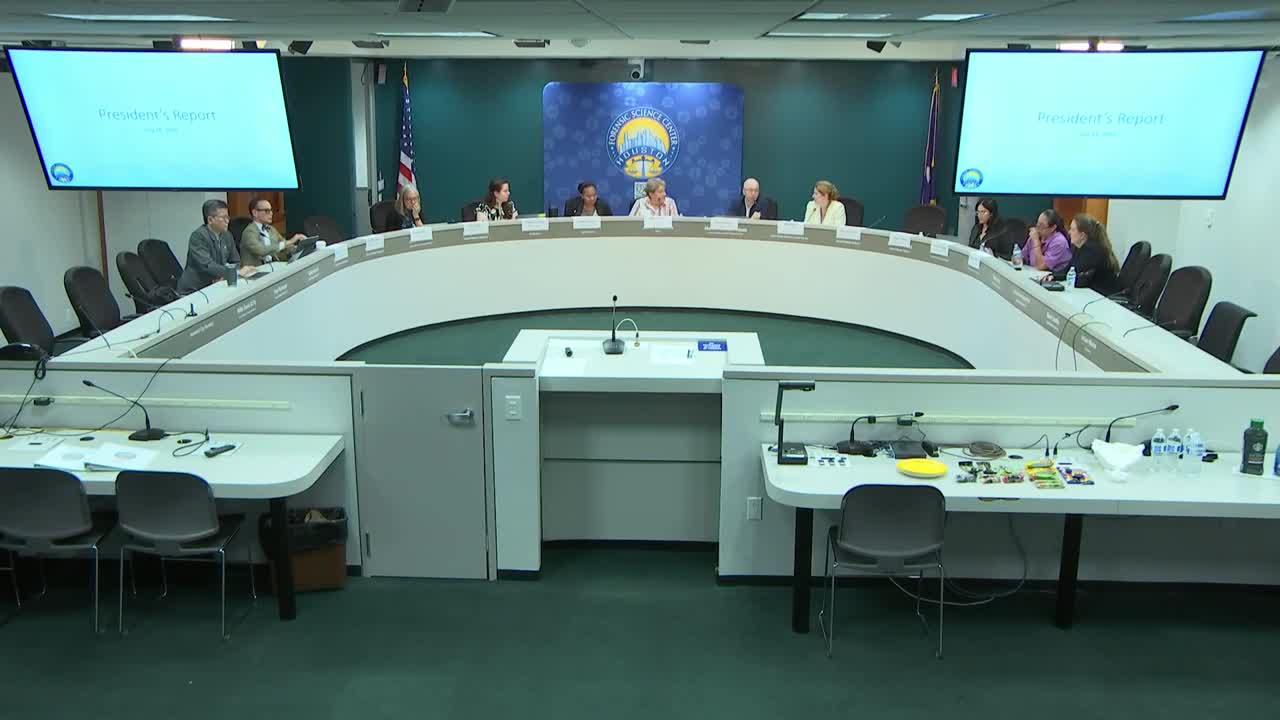
The Houston Forensic Science Center (HFSC) board unanimously approved a revised fiscal year 2026 budget to match the allocation passed by the city and approved line-item reallocations for fiscal year 2025, board members said during a special session focused on finance and operational updates.
Dr. Stout, a HFSC staff member who briefed the board on casework backlogs and laboratory capacity, told directors the DNA backlog spike was tied to a temporary pause in testing by Signature Science while the lab addressed a manufacturing error, and that backlog figures for kits over 90 days are already beginning to fall now that testing has resumed. He said seized-drug turnaround times are improving after three analysts were signed off and three more are in the pipeline.
The budget briefing explained that the city—s final FY26 allocation for HFSC was $33,920,000 and that staff expects to seek a final HFSC budget of $34,880,000 at a future meeting. HFSC—s original request was $38,000,000. The board approved the current, city-matching budget by voice vote; no roll-call names were recorded in the motion transcript and the action passed unanimously.
Why it matters: The board vote sets HFSC—s short-term spending limits while staff works to address long-standing capacity constraints in firearms analysis and to install and staff new instruments that expand seized-drug and toxicology testing. HFSC described hiring and multi-year training timelines that affect when additional capacity will become operational.
Board briefing and operational details
Dr. Stout told the board HFSC is adding analytical capacity but that firearms remains the primary bottleneck. He said HFSC plans to add three additional firearms examiners under the proposed budget, bringing the target toward 12 signed-off examiners; at the time of the meeting five examiners were fully signed off and five more were in training. Stout cautioned that newly hired examiners typically require about two years of training before reaching full production, and that the nearest new examiners likely will take six to nine months to reach productive stages.
On seized drugs, Stout said HFSC has two QTOF (quadrupole time-of-flight) mass-spectrometry instruments: one purchased with Coverdell grant funding intended for seized-drug analysis and another slated for toxicology. He said one QTOF remains unpacked pending electrical and infrastructure work on the facility—s 18th floor, and that facility electrical upgrades (a new generator panel and related work) must be completed before the instrument can be installed.
Stout also flagged aging IT equipment (firewalls and switches) and said security-risk replacements are included in staff—s planning. Capacity in the crime-scene unit (CSU) was described as under-scaled and deferred in the current budget request.
Legislative update
Stout briefed the board on recent state legislation affecting forensic laboratories. He said Senate Bill 1620 (referred to in the briefing as "SB 16 20") establishes a Texas Forensic Analyst Apprenticeship pilot, will take effect Sept. 1, and carries a roughly $5 million fiscal note to support laboratories; HFSC staff said the program aims to place 18 apprentices statewide and will be administered through the Office of Court Administration with oversight from the Texas Forensic Science Commission. Stout said both SB 1620 and a bill he referenced as SB 1660 address laboratory needs; SB 1660 focuses on retention and disposition of toxicology evidence.
Stout also discussed ongoing special-session action on THC-related bills. He said SB 3 was vetoed by Gov. Greg Abbott and that a follow-up measure, SB 5, had been filed and advanced in committee; he cautioned that if statutes require quantitation of cannabinoids rather than qualitative presence/absence testing it will raise laboratory costs and resource needs.
Formal actions and votes
The board approved, by voice vote, the revised FY26 budget that matches the city allocation and later approved the delegated reallocations to the FY25 profit-and-loss statement, with the final FY25 net change recorded as zero. Both votes were recorded as passing unanimously by voice vote.
What directors said
Chairwoman Cohen called the meeting to order and confirmed a quorum before the budget discussion. Director Hough and Director Silverman were identified earlier in the meeting as having toured HFSC—s vehicle examination facility; Hough and Silverman both described improvements at the site. A board member later thanked Mr. Leach, a HFSC staff member presenting the FY25/FY26 financial detail, for clarifying complex financial information.
Next steps
Staff said they plan to return with a finalized FY26 budget figure of $34,880,000 at a future meeting (anticipated in September) after completing a post-budget justification (PBJ) process. Staff also described ongoing implementation tasks that depend on facility electrical work and multi-year training timelines for new examiners.
Ending
The board adjourned after approving the fiscal matters and thanking staff for work on the budget, equipment installation planning and legislative monitoring.