
Ottawa County CMH details rapid growth in children’s services, autism and crisis changes
Get AI-powered insights, summaries, and transcripts
Sign Up Free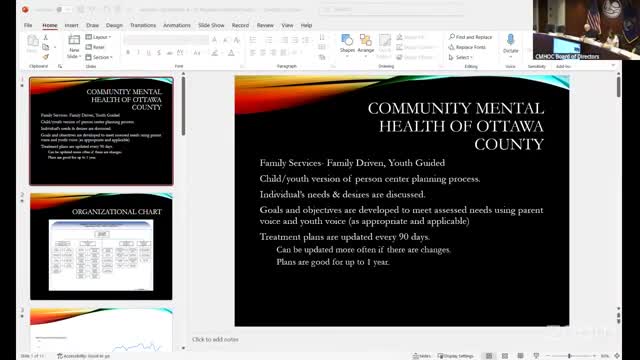
Summary
Division head presented a detailed overview of Family Services: infant mental health, outpatient therapy, home-based care, SED and children's waivers, autism evaluation and ABA services, staffing shortages, and a planned transfer of children's mobile crisis into a 24/7 CCBHC crisis program on Oct. 1.
Katie Clousing, who returned this year to lead Family Services at Ottawa County Community Mental Health, briefed the board Friday on a rapid expansion of children’s services and detailed steps staff are taking to meet demand.
In a prepared presentation, Clousing said Family Services treats the child within the family system and updates treatment plans every 90 days because needs can change quickly. "We are family driven, youth centered," she told the board, outlining four program areas: services for children with serious emotional disturbance (SED), services for children with intellectual and developmental disabilities, substance-use services for youth, and autism services.
Clousing described the SED program’s three tiers: infant mental-health services (prenatal to age 4) delivered in-home and measured with the Devereux Early Childhood Assessment (DECA); outpatient therapy for children ages 5–18 (often provided by contractors such as Bethany Christian Services, Second Story and West Michigan Psychological); and intensive home-based services with low caseloads (typically 10–12 clients) and frequent school coordination. She said the SED waiver can be a pathway to Medicaid for children whose families have commercial insurance and that waiver slots generally are available when requested.
Regarding children with intellectual and developmental disabilities, Clousing said schools often provide many services, and the agency currently has 14 children on the state children’s waiver. She said the children's waiver is harder to secure than the SED waiver, and wait times vary.
Autism services are the fastest-growing segment of Family Services. Clousing said the access process begins with a screening at intake; if a child scores above a threshold on the social-communication questionnaire, staff open the case and assign a supports coordinator while families choose among certified evaluators. "We contract with 17 different agencies right now to provide that," she said. Applied Behavior Analysis (ABA) services are authorized based on the evaluating agency’s BCBA report; ABA benefits are available up to age 21. She added that wait times and availability vary by agency, geographic area and preferred service model (center-based versus in-home).
Clousing acknowledged staffing pressures: several home-based therapist vacancies had recently been filled after long recruitment efforts, but overall vacancy rates remain a challenge. Board members and staff discussed vacancies and hiring approvals; Dr. Brashears said some vacancies remain frozen until county authorization is secured.
Clousing also outlined crisis services: children's mobile crisis currently operates evenings through midnight under a System of Care grant, but the program will move under the agency’s CCBHC crisis operations and expand to 24/7 on Oct. 1, per CCBHC requirements. She said bilingual services are available through System of Care partners, naming LaWOOP and Empowerment Solutions as collaborators.
Why it matters: Rapid enrollment and growing autism-related demand — Clousing said autism services account for roughly 60% of Family Services’ budget — are driving staffing requests, contracting decisions and budget planning. Board members asked about outcome measurement; Clousing said evidence-based practices require routine outcome reporting and the agency collects those data.
Board direction: The presentation was informational; no formal votes were taken on program changes at the meeting. Staff said they will continue recruiting for critical vacancies, track service outcomes, and move children's mobile crisis into CCBHC oversight on Oct. 1.