Get Full Government Meeting Transcripts, Videos, & Alerts Forever!
Get email alerts on the Sidewalks And Streets topic
No spam. Unsubscribe anytime.
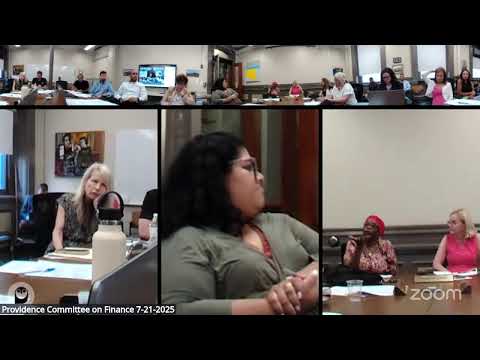
Providence finance committee approves amended CIP; DPW launches 'Make Safe Saturday' pilot to fix sidewalk trip hazards
Summary
The Providence City Finance Committee on July 21 approved an amended capital improvement plan and heard Department of Public Works officials describe their sidewalk-prioritization methodology, a pilot repair day targeting 32 trip hazards and nine tree wells, and ongoing tree/sidewalk tradeoffs tied to limited staffing and funds.
The Providence City Finance Committee on July 21 approved an amended capital improvement plan and took public testimony and a presentation from Department of Public Works staff about how the city picks sidewalks for repair, how tree roots factor into repairs, and a pilot “Make Safe Saturday” to address urgent trip hazards.
City and public works officials said the council’s decision on the capital improvement plan (CIP) clears the way for continued sidewalk and street projects in this construction season and for planned coordination with state matching funds and other grants.
Robert McGregor, a Department of Public Works official, told the committee the department uses spatial datasets and a set of prioritization criteria to direct limited sidewalk dollars where they will benefit the most pedestrians. “We use criteria such as proximity to schools, RIPTA stops, high density, housing areas and developments,” McGregor said. He added hospitals, post offices and parks are also layered into hot-spot mapping used to develop sidewalk planning areas.
McGregor described the department’s funding mix and recent grant leverage: the department has layered bond funding, Neighborhood Improvement Fund allocations (NIF), Community Development Block Grant (CDBG) money and ARPA funds. He said the city leveraged its ARPA allocation to secure an estimated $1,200,000 in state matching sidewalk funds from a Rhode Island road-and-bridge program that required a local match.
Why it matters: committee members and residents said the discussion is about safety, equity and long waits for repairs on neighborhood side streets. Several councilors pressed staff on how the city balances investment on busy corridors versus residential blocks and on how tree canopy and sidewalk repairs should be coordinated so removal or replacement of trees does not worsen neighborhood environmental outcomes.
How DPW prioritizes and responds
McGregor said the engineering division implements the capital improvement plan and larger externally funded projects (often using contractors), while the highway division handles in-house repairs and urgent trip hazards. He described the department’s methodology as an overlay of pedestrian generators and project timing: work is coordinated with upcoming utility projects where possible to avoid redoing recently completed streets.
On equity, McGregor said the CIP funds for sidewalks in the current tranche were distributed across the city’s 15 wards and an added 16th downtown section “equally” for that round of funding; he said the department is not using census-based economic equity metrics for this tranche but is aiming for ward-based distribution. Councilors pressed whether residential needs and long-standing preexisting requests are being captured and prioritized.
Residents and councilors repeatedly raised tree-root-caused uplift as a common cause of sidewalk hazards. The city’s forester (staff member not named in the transcript) participates in project planning, McGregor said, to determine whether a tree should be removed, excavated for root work, or retained with a redesigned tree well. “We have to budget and plan,” McGregor said, noting federal and grant rules (for example CDBG) and limited budgets constrain doing partial work that leaves sidewalks unusable or creates gaps in funding for complete repairs.
Staffing, cost and grant context
DPW officials said staffing and specialized skills limit in-house capacity. Sal Solomon, a highway-division staff member described in testimony, said the in-house crew has “like, kind of one guy right now who actually really knows how to do this, and he directs the work of the rest of the crew.” McGregor and Solomon said the city is pursuing recruitment and an apprenticeship program to build a sustainable in-house skillset for concrete finishing and similar sidewalk trades.
Officials gave several cost and scale figures during the meeting: the department estimates about $8,000 to fully replace a 50-foot frontage of sidewalk (average), and a mile of full-width sidewalk replacement can approach $400,000–$500,000. McGregor said the city has invested more in sidewalks since 2018 than in “probably 30, 40 years” prior, but funding remains limited relative to need.
DPW described specific program limits and criteria: the department applies an eighth-of-a-mile buffer around ADA requests, considers transit stops, schools, libraries, rec centers, hospitals and retail/commercial corridors, and flags areas with population density metrics. The department also emphasized coordination with utilities and the city forester when tree roots are involved.
Make Safe Saturday pilot
Department officials announced a pilot repair day called “Make Safe Saturday” scheduled to begin the coming Saturday. McGregor said the city identified 32 sites reported through the 311 system as urgent trip hazards that staff have assessed and photographed, and nine former tree wells where missing trees have left depressions or trip risks. “These are strictly trip hazards,” McGregor said, “not my sidewalk is ugly hazards.”
The highway division has queued crews and prepared equipment; officials said success depends on vendor availability for asphalt on a weekend and on the unpredictability of field conditions. Staff told council offices they will provide a debrief to council staff (Kyle was named as the contact) after the first Saturday to inform future cadence and criteria for additional blitz days.
311 and the asset-management transition
Councilors and residents raised the long-standing issue of an old, multi-decade sidewalk request list that grew from spreadsheets and could not be actively managed. DPW and city staff said the new 311 intake and the city’s asset-management system are being used to create an active, trackable queue. Officials encouraged residents to resubmit longstanding requests into the current 311 system so they appear in the active workflow.
Council action
At the end of the meeting the committee took a voice vote to approve the capital improvement plan as amended. The motion to approve the CIP as amended was moved and seconded during the meeting; the committee chair called “All in favor? Aye.” Earlier in the meeting staff recorded three members present and two absent. The committee approved the CIP as amended by voice vote.
What comes next
DPW staff said they will run the pilot Saturday, report results to council staff, continue to seek state and grant matches for sidewalk work, and pursue training and recruitment to expand in-house concrete and sidewalk crews. Councilors asked for regular updates on the active sidewalk list by ward and for clearer user interfaces and guidance for 311 submissions so residents can verify whether a request is in the active queue.
Ending: The committee agreed to more follow-up meetings on sidewalks and streets, and the meeting adjourned after the CIP vote.