Get Full Government Meeting Transcripts, Videos, & Alerts Forever!
Get email alerts on the Municipal Budget topic
No spam. Unsubscribe anytime.
Richland staff presents preliminary 2026 budget: $330M all‑funds, proposed hires and higher utility costs
Summary
City staff presented the preliminary 2026 budget showing roughly $330 million in all‑funds appropriations, a nearly flat general fund at about $82.5 million, several proposed FTEs, planned capital reductions from large projects, and upward pressure from wholesale power and software costs.
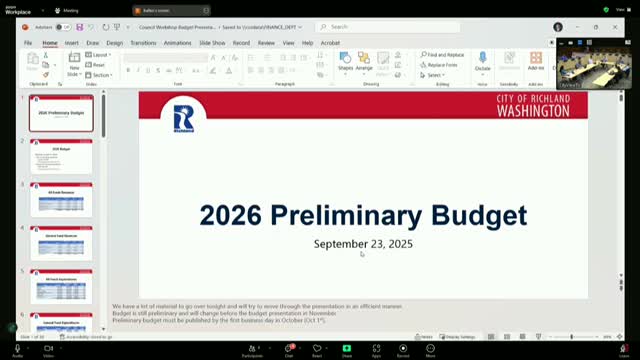
City staff presented the preliminary 2026 budget to the Richland City Council, showing an all‑funds total of about $330 million and general fund appropriations of roughly $82.5 million.
Staff described the budget as a conservative document that does not yet include the 0.1% sales tax conversion discussed earlier in the meeting. The presentation noted a $7.7 million decrease in all‑funds appropriations compared with the prior year, driven largely by large capital projects that are not repeated in 2026. Staff said the general fund is roughly flat year‑to‑year once one‑time transfers for major projects are accounted for.
Major points and highlights from the presentation: • Revenues and totals: Preliminary all‑funds appropriations estimated at $330 million; the general fund at about $82.5 million. Sales tax growth was budgeted conservatively but adjusted modestly upward because of strong current receipts and new retail additions (such as Costco) that will begin showing in monthly reports. • Proposed FTEs: Staff proposed seven new full‑time equivalents (FTEs) across funds. Examples cited in the presentation include a public records specialist in the police department, a fire training and development officer (tied to potential contracted coverage in the Hanford area), a parks construction/maintenance worker, a streets maintenance lead craft worker and three utility fund positions (landfill operator, water treatment operator, and electrical distribution engineer). Several proposed positions were enterprise‑funded and some are contingent on contracts or revenue sources. • Merchant/processing fees: Staff noted merchant service and credit‑card processing fees are substantial (staff estimated fees in the several‑hundred‑thousand to near $700,000 range annually) and said they would return to council with options to recoup some of those costs rather than continue city‑wide subsidy. • Utilities and wholesale power costs: Utilities face significant cost pressures. Staff cited numbers presented by utility staff indicating average wholesale power increases around 8.9% and wholesale transmission increases near 19.9% from the Bonneville Power Administration and market dynamics affecting non‑federal power availability. Those wholesale increases are a major driver of higher supplies/supplies costs in the utility funds. • Benefits and pension changes: The draft budget reflects recent changes in state retirement contribution rates and some favorable employer‑side adjustments that reduced projected employer pension costs; staff said these shifts provide a modest cushion that could be used in part to respond to a pending compensation and classification study. • Capital and CIP: Capital outlay declined substantially in the draft due to the substantial work on large projects in the prior year (for example, a major loop project and landfill expansion). Staff described 2026 as a "catch up" year focused on completing in‑progress projects rather than adding many new capital initiatives. • Next steps and hearings: Staff scheduled revenue hearings and preliminary levy discussions for the second meeting in October, a first reading of the budget and CIP on Nov. 4 and budget adoption on Nov. 18. Each of those meetings will include a public hearing on the budget or tax levy as required.
Council members asked clarifying questions about IT and infrastructure funding, the city’s approach to vendor contracts and data governance, staff recruiting and the proposed FTEs, and options for customers to avoid card‑processor fees (for example, encouraging ACH/eCheck). Staff said some requested items—such as a potential chief information officer role and a multi‑year IT risk management roadmap—are under consideration and that the city is working with a cybersecurity consultant to develop a road map that will inform governance and contract language.
Staff emphasized that the draft is subject to change as revenue estimates and levy decisions are refined; they said they will return with more detailed revenue assumptions and the formal budget ordinance for council readings in October and November.
(See provenance for transcript excerpts.)