Get Full Government Meeting Transcripts, Videos, & Alerts Forever!
Get email alerts on the Public Safety Fire Rescue topic
No spam. Unsubscribe anytime.
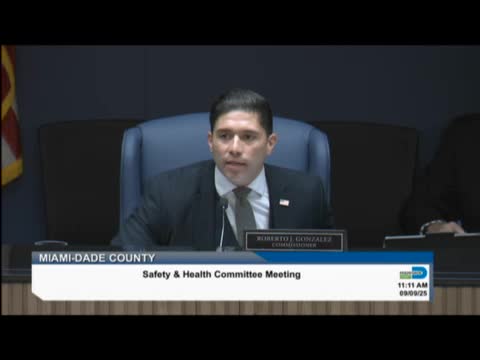
Miami-Dade officials debate fire-rescue funding, unit placement as response times rise
Summary
Commissioners and Miami‑Dade Fire Rescue leaders discussed carryover funds, the county concerns that higher response times require immediate funding and placement of new units rather than waiting years for new stations.
Miami-Dade County commissioners and Fire Rescue leaders debated whether existing carryover and capital reserves can be used to place additional suppression and rescue units into service now to reduce worsening response times.
During the commission meeting, Commissioner Higgins led questions of Miami‑Dade Fire Rescue (MDFR) leaders about how much of the department carryover is actually encumbered and whether available dollars can be used to staff units that are due for delivery in the coming months.
Why it matters: MDFR leaders and the commission said response times are increasing and that strategic station siting and new units are both necessary. Commissioners pressed for clarity on whether the county has the cash or financing capacity to put additional engines and rescues into service quickly rather than waiting years for new station construction.
Most important details
- Carryover amounts and encumbrance: Commissioner Higgins said the mayor had told commissioners there was $244,000,000 in carryover for MDFR at an earlier budget hearing. Fire Chief Ray Jadalla responded that "approximately 44,000,000" is what the department shows and that that amount is "encumbered." Chief James Reyes and OMB staff explained some of those funds are already allocated to projects and recently added units.
- Units added and need: MDFR reopened or added six units this fiscal year (four recently), the chiefs said. A department needs analysis cited in the discussion lists 24 additional suppression units as needed over a five-year horizon; commissioners and MDFR officials emphasized that many of those needs are documented and some are urgent.
- Cost and dispatch volumes: Chief Jadalla said the department receives "8 to 900 calls a day." The financial estimate given for staffing a single suppression unit 24/7 was $4,500,000. MDFR later said about 1,100 units are dispatched every 24 hours.
- Capital and financing options: David Cloud of the Office of Management and Budget (OMB) said the proposed budget includes a $21,400,000 contingency reserve in the fire district operations fund and that a first change memo returned roughly $13.08 million for air rescue. He said approximately $14,000,000 in capital reserve could be freed if the county finances capital projects instead of using cash, yielding about $49,200,000 of potential funds when combined with the other items discussed.
- Immediate placement vs. long-term station building: MDFR leadership and the public-safety chief told commissioners that station construction and land acquisition can take five to ten years, and that strategically placed stations are necessary to reduce response times. At the same time, MDFR officials and President McAllister argued there are existing stations with space to host at least 10 additional operational units in the near term when apparatus are delivered, which would reduce response times more quickly than waiting for new builds.
What officials said
"There is no new service in this budget. There is no funding for new service anywhere," said President McAllister while explaining that new units were added this year post-proposed budget and that funding for ongoing service was not in the current budget.
Chief Jadalla said, regarding carryover, "approximately 44,000,000 ... all of it is encumbered, sir." Chief James Reyes noted the department added six units beyond the two originally budgeted and said those additions "eat up some of that rollover."
"We have the apparatus coming in. We just need the funding and the will of the commission to say solve this problem quickly," said a senior MDFR official, adding that there are locations where additional units could go into service "in a matter of months" once trucks are delivered.
Actions, directions and outstanding decisions
- Discussion only: Commissioners questioned MDFR and OMB about carryover, capital reserves, and unit costs; no funding allocation was approved during the recorded discussion.
- Direction: OMB and MDFR staff agreed to continue examining financing options to free capital dollars ($14 million referenced) and to provide further breakdowns of the reserves and encumbrances. Commissioners and MDFR leaders discussed mapping high-need areas and exploring partnerships with developers to secure space for small or temporary stations.
- No formal commission action to reallocate funds or to approve financing was taken in the transcript segment.
Context and background
MDFR has repeatedly identified suppression shortfalls in its five-year plan, and commissioners referenced past planning documents (a five-year plan revised Oct. 30, 2024). Commissioners suggested zoning and development approvals could be used to require or incentivize dedicated space for fire stations in new dense developments.
What remains unclear
- The transcript records different figures for carryover (the mayor's earlier $244 million comment and MDFR's later "approximately 44,000,000"). The department described the smaller figure as "encumbered."
- No final decision was recorded on financing mechanisms or a specific timeline to move the additional units into sustained service.
Ending
Commissioners asked OMB and MDFR staff to return with more detailed funding breakdowns and maps of priority areas; the commission did not take a formal vote to reallocate capital or operating funds during the recorded exchange. The discussion is likely to continue as the budget process proceeds and as apparatus deliveries are scheduled.