Get Full Government Meeting Transcripts, Videos, & Alerts Forever!
Get email alerts on the Professional Discipline topic
No spam. Unsubscribe anytime.
Judicial branch committee adopts sanctions for multiple process-server complaints; one matter sent to closed session
Summary
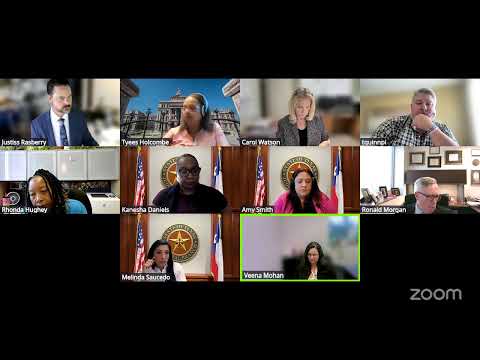
The Complaint Review Committee of the Judicial Branch Certification Commission reviewed seven process-server complaints in a virtual session, adopting staff recommendations or modified sanctions in six cases and moving one matter into closed session for legal consultation.
The Complaint Review Committee of the Judicial Branch Certification Commission met virtually and took formal action on six disciplinary matters involving certified process servers, and moved one case into closed session for legal consultation.
The committee opened with brief procedural remarks from Director Morton, who reminded members that staff recommendations are advisory and that the committee may increase or decrease suggested sanctions. Committee members then heard summaries, responses and, in some cases, brief comments from complainants or respondents before voting on recommendations ranging from additional continuing education to permanent revocation of certification.
Votes at a glance
- Agustin Azemba (Cause No. 0724): Committee found a violation of Code of Ethics 2a; the committee accepted the staff recommendation that the respondent complete continuing education within six months of the final order. The committee voted to accept staff’s recommendation.
- Belikis Afolavi (Cause No. 0743): Committee found a violation of Code of Ethics 2a. Staff recommended a two‑pronged sanction: if certified at the time of consideration, a reprimand plus a seven‑hour pre‑certification civil process service education course to be completed within six months; if not certified then a $250 administrative penalty. After oral remarks, a motion to dismiss the staff recommendation (i.e., not to adopt the recommended sanction) was made and passed by the committee.
- Ivan Hernandez (Cause No. 0747): Committee found a violation of Code of Ethics 14(h) for serving on a Sunday. The committee adopted the prosecutor’s proposed sanction of a reprimand and a $500 administrative penalty due within six months of the final order.
- Marquisha Graves Lewis (Cause No. 0749): Committee found a violation of Code of Ethics 2a. A member recused themself before the discussion; the remaining quorum adopted the prosecutor’s proposed sanction of a reprimand and a $100 administrative penalty due within six months of the final order.
- Brandy Parton (Cause No. 0758): Committee found multiple violations (Code of Ethics 2b, 2c, 2d, 10 and 14e). The committee consolidated overlapping violations and adopted staff’s recommendation of permanent revocation of the respondent’s process-server certification and a $600 administrative penalty total, due within six months of the final order. The committee noted that the address cited by the complainant was described as uninhabitable and that the respondent asserted service at the listed location.
- Mona Ricks Dixon (Cause No. 0756): Staff found violations of Code of Ethics 8 and 10 tied to failure to maintain current mailing information with the commission and failure to cooperate with the complaint investigation. The committee deliberated on the sanction level and, after discussion, increased the staff‑recommended administrative penalty from $100 to the maximum administrative penalty of $500; a reprimand was also included in the final action. Committee members noted the respondent’s certification had expired on April 30, 2025; if the respondent reapplies, the committee indicated continuing-education requirements would apply.
- Cause No. 0771 (Item 3g): The committee voted to go into closed session pursuant to the commission’s public meetings policy sections 8(a)(2) and 8(f) to confer with legal counsel and the respondent; the public was excluded from the closed session.
The committee’s actions followed staff summaries of investigative findings and the disciplinary matrix referenced by Director Morton. Several members raised concerns about the interaction between field technology (apps used by process servers to record service attempts) and what the committee can fairly enforce when an app’s workflow may require estimated or automated entries. One committee member specifically proposed dismissing the recommended sanction in the Afolavi matter because the underlying app architecture did not clearly require the disputed descriptive fields on the final affidavit.
Quotes and attributions in this report are taken from the committee record. Director Morton told the committee that staff recommendations “are advisory” and that members “may increase or decrease the severity of a proposed sanction.” Investigator Mohan and committee members discussed how some service‑tracking applications package multiple attempt entries into a final affidavit; one member summarized that feature as creating “a burden that puts extra responsibility and also extra chance for a situation like this” when the description fields are not mandatory.
The committee’s adopted sanctions will be forwarded to the judicial branch certification commission (the full commission) for final determination where required by commission procedure. Where staff or the committee noted certification had lapsed, members clarified that additional continuing education would be required if the respondent seeks recertification. The committee adjourned the open session after voting and moved one agenda item into closed session for legal consultation.