Get Full Government Meeting Transcripts, Videos, & Alerts Forever!
Get email alerts on the Board Goals topic
No spam. Unsubscribe anytime.
Tigard‑Tualatin board pares goals, prioritizes equity audit and budget stewardship
Summary
At a work session, the Tigard‑Tualatin School District Board discussed streamlining board goals, keeping a midyear retreat and self-evaluation, emphasizing the annual equity audit and behavior data for students of color, and coordinating budget priorities with academic return-on-investment amid tight finances.
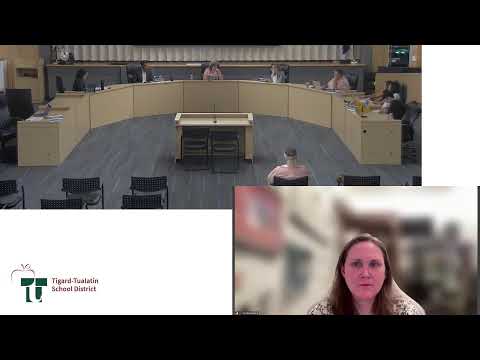
The Tigard‑Tualatin School District Board of Directors spent a work session reviewing and consolidating its annual board goals, aiming to limit objectives to a few high-priority items and to tie board evaluation more closely to those priorities. Board members discussed keeping a midyear retreat that could include board self-evaluation, maintaining attention to the district’s annual equity audit and behavior outcomes, and using academic return-on-investment (AROI) guidance for discretionary spending while acknowledging current budget constraints.
The board chair opened the session by welcoming attendees to the work session on board goals. The superintendent offered to help “co‑develop or support any development of self assessments for both individuals and the board,” a tool several members said would help the board track progress beyond an annual review.
Members agreed to narrow the number of goals within each broad area — learn together as a board; create conditions for success; hold the system accountable; and support strong relationships — and to prioritize one or two measurable goals per area rather than many specific tasks. Several directors recommended folding some detailed items (for example, professional learning or specific classroom strategies) under broader umbrella goals to avoid prescriptive direction on operational matters.
On fiscal oversight, directors discussed retaining AROI — the idea of directing additional funds to interventions with the strongest evidence of student impact — while recognizing the district’s limited budget. One director asked that any AROI emphasis be framed to first meet statutory and baseline obligations, and then use AROI to guide discretionary investments when funds allow. The group did not adopt a formal budget action during the session.
Under accountability, the board coalesced around elevating the annual equity audit and linking it to behavior data and Student Rights and Responsibilities Handbook (SRRH) outcomes. Members proposed focusing monitoring on outcomes for students of color and historically underrepresented groups, rather than listing many disparate audits. The board discussed that a full policy rewrite of the district’s policy manual is likely to be a multi‑year project and suggested the rewrite could be an explicit board goal, with the understanding implementation would require staff work and possible committee review.
On relationships and transparency, directors said they want to maintain positive relationships with classroom‑facing staff and the community and to ensure transparency around bond spending through the existing bond oversight committee. The superintendent said she would draft a revised goals document and bring it to the board’s next meeting for first reading and further refinement.
No formal motions or votes occurred during the work session; members directed staff to draft revised goal language for first reading at the next regular meeting. The chair adjourned the workshop and reminded the board of the upcoming regular session.
Ending: The board chair said the draft goals will be returned in the board packet at the next meeting for first read and further discussion; directors asked to come prepared with suggestions for measurable mechanisms of success.