Get Full Government Meeting Transcripts, Videos, & Alerts Forever!
Get email alerts on the Land Use topic
No spam. Unsubscribe anytime.
Resident urges Wake County to challenge RDU plans for Lake Crabtree Park, citing historic zoning and alleged procedural issues
Summary
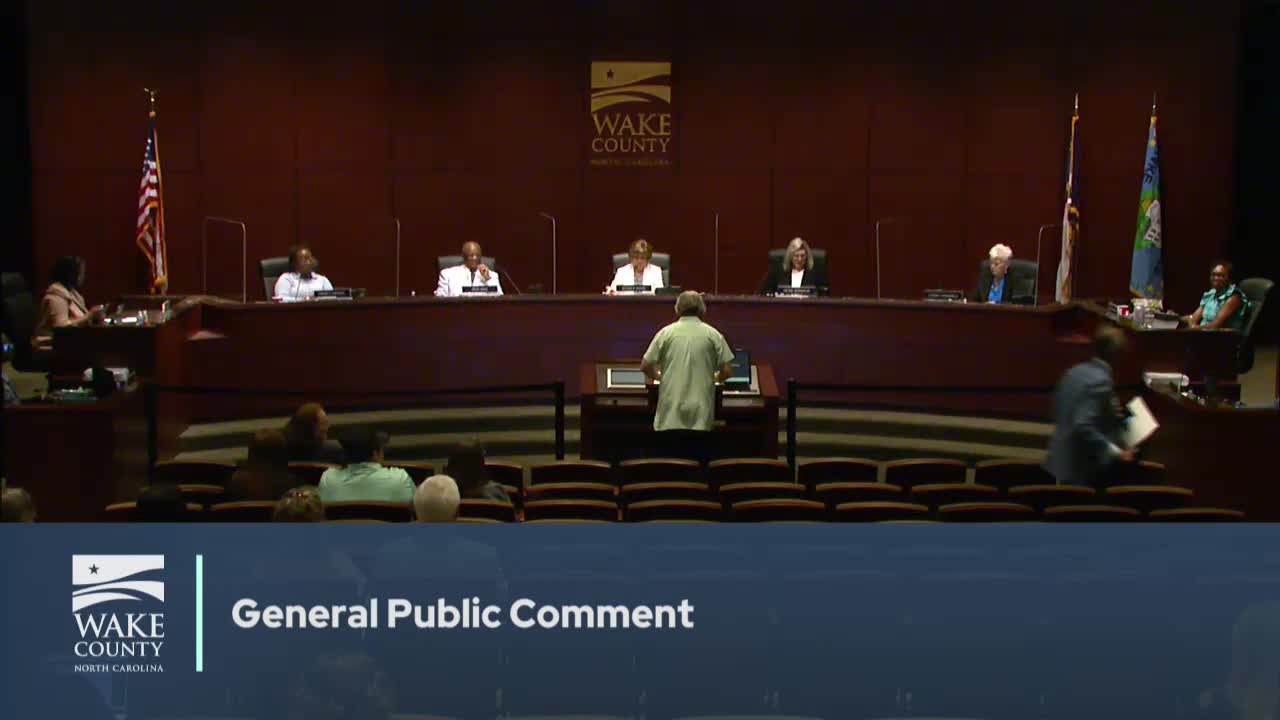
During public comment at the Aug. 18 Wake County meeting, a resident said RDU's plans to develop Lake Crabtree Park conflict with historical zoning and the RDU Authority enabling act, urged commissioners to protect the park and requested follow-up meetings with county staff.
A resident urged Wake County commissioners on Aug. 18 to block Raleigh–Durham Airport Authority (RDUA) plans she said would permit development at Lake Crabtree Park, arguing the land has long been zoned residential and that RDU’s acquisition and proposed actions violate state law and previous public‑use intentions.
Natalie Lou, who identified herself as a resident in the area, told the board the Lake Crabtree Park area was zoned R-20 when RDU took management control in 1967 and rezoned to R-40 in 1982 “to protect it from commercial development,” citing county meeting minutes. “RDU’s plans now to develop Lake Crabtree Park are not appropriate,” she said, and asked commissioners to review zoning records and meet with her to discuss her research.
Lou contended that two one‑acre tracts behind the Dunns House were privately owned at the time of the 1982 rezoning and remained zoned R-40 when RDU later took control in 1984. She said the RDU Authority enabling act permits land taking only as needed (not speculative acquisition) and accused RDU, developers and county staff of misrepresenting authorities and failing to perform needed research. The speaker asked the board to “have the courage to speak up” and protect long-term public plans for the park and nearby Umstead State Park.
Chair acknowledged Lou’s remarks during the public‑comment period; commissioners did not respond during the meeting and public comment hearings are for the board to receive input rather than to reply. The county clerk reported there were no additional online comments for the meeting.
Lou asked to meet with staff to explain her research and provided materials to commissioners. No action or formal board response was recorded at the meeting; the item remained a public comment for the record.