
After hours of questions, Timberlane board adopts updated teacher-evaluation plan
Get AI-powered insights, summaries, and transcripts
Sign Up Free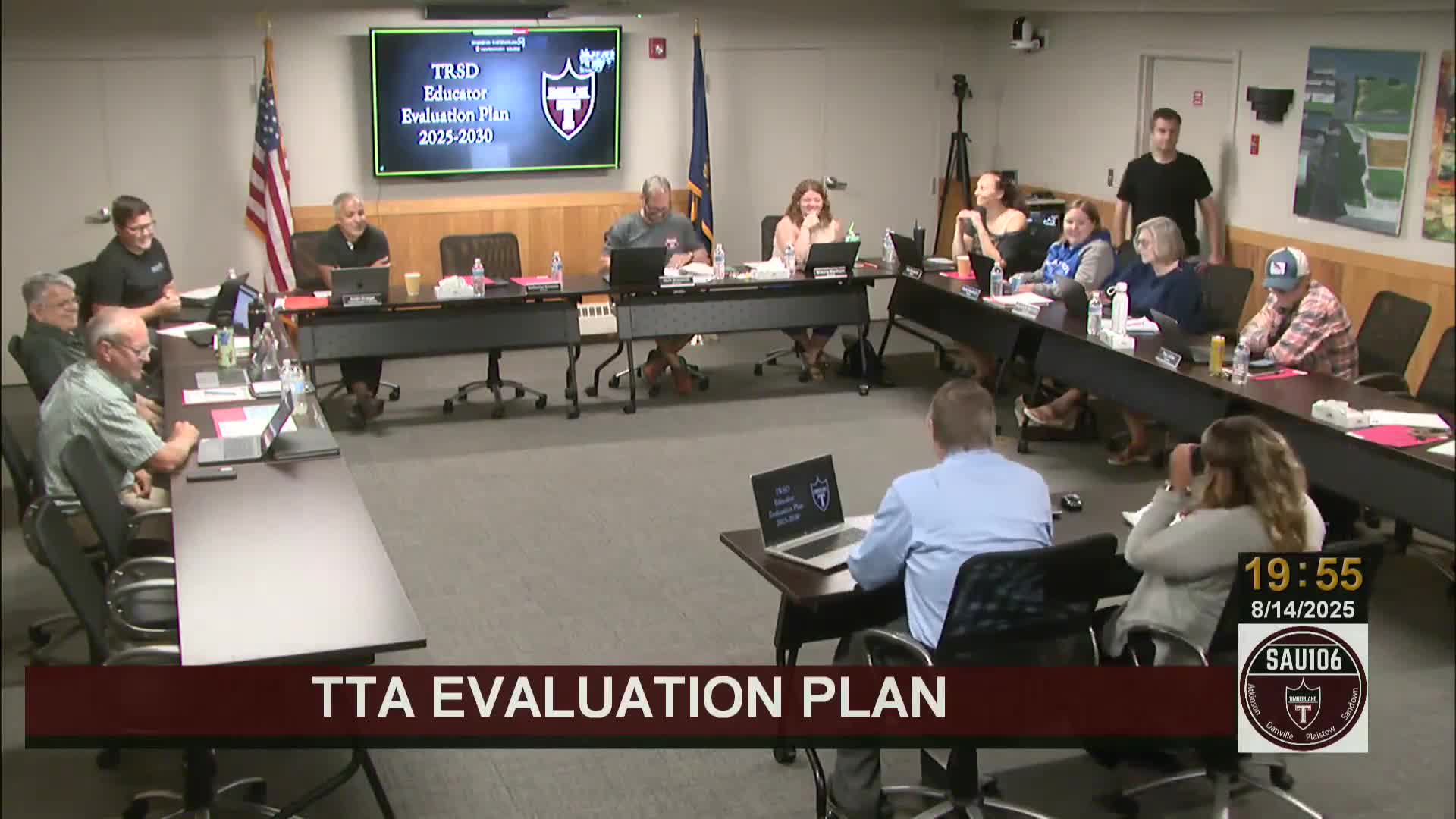
Summary
The Timberlane school board approved an updated educator evaluation plan negotiated with the teachers' union that adopts the 2022 Danielson framework, adds more frequent short "mini" observations and midyear check-ins, and clarifies conflict-of-interest and unassociated observations.
After a prolonged review and a detailed presentation from district and teacher representatives, the Timberlane Regional School District school board on Aug. 14 adopted a revised educator evaluation plan negotiated with the Timberlane Teachers Association (TTA).
Lou Broad, president of the TTA and a Timberlane science teacher, told the board the committee that rewrote the plan met through May and the summer and included teacher and administrator representatives. "We were both members of the educator evaluation plan committee," Broad said. "This was our third cycle."
Key changes the committee presented include adoption of the Charlotte Danielson 2022 framework as the rubric basis, a shift to more frequent, shorter observations called "mini observations," a requirement that new educators receive a minimum of six such observations annually and experienced educators receive a minimum of four, a midyear check-in for all educators, and greater formalization of "unassociated" observations (for activities not usually seen in classroom observations, such as participation in IEP or parent meetings).
Administrators and teachers emphasized the plan's collaborative intent while debating specific language. Dean (the superintendent) said the plan aims to increase meaningful feedback rather than be punitive. Board members pressed on specifics: whether mini observations would be announced, how many goals teachers would set (new teachers set multiple goals, experienced teachers generally set one), how refusal to engage in improvement conversations would be handled, and how documentation of support plans would be retained.
Broad said the committee intentionally made the plan more flexible and growth-oriented. "All educators set goals at the start of the year as part of the evaluation process," he said, adding that the goal-setting is tied to self-reflection against the Danielson rubric.
The board asked for clarifying language in places (for example, to capture the intent that mini observations could be unannounced but may also be scheduled when a teacher requests observation). The plan includes conflict-of-interest guidance and acknowledges grievances may still be filed under the negotiated grievance process.
The board voted to adopt the updated evaluation plan. The TTA membership was scheduled to vote on the plan on Aug. 26; the plan will be distributed to staff and paired with professional learning when school opens.
Ending: The plan replaces the prior evaluation instrument, increases the frequency of feedback loops and requires administrators to document and communicate observations and support steps. The board and union plan joint implementation with training and midyear review points.