Get Full Government Meeting Transcripts, Videos, & Alerts Forever!
Get email alerts on the Library Budget topic
No spam. Unsubscribe anytime.
Library board told state tax overhaul will shrink assessed value; 2026 budget to rely on reserves
Summary
At a special meeting the Indianapolis City Library Board heard a presentation on how recent state property-tax changes will reduce assessed valuation and erode library property-tax revenue; staff presented a proposed 2026 budget that relies on cash reserves while the board considers local-option income tax and levy strategies.
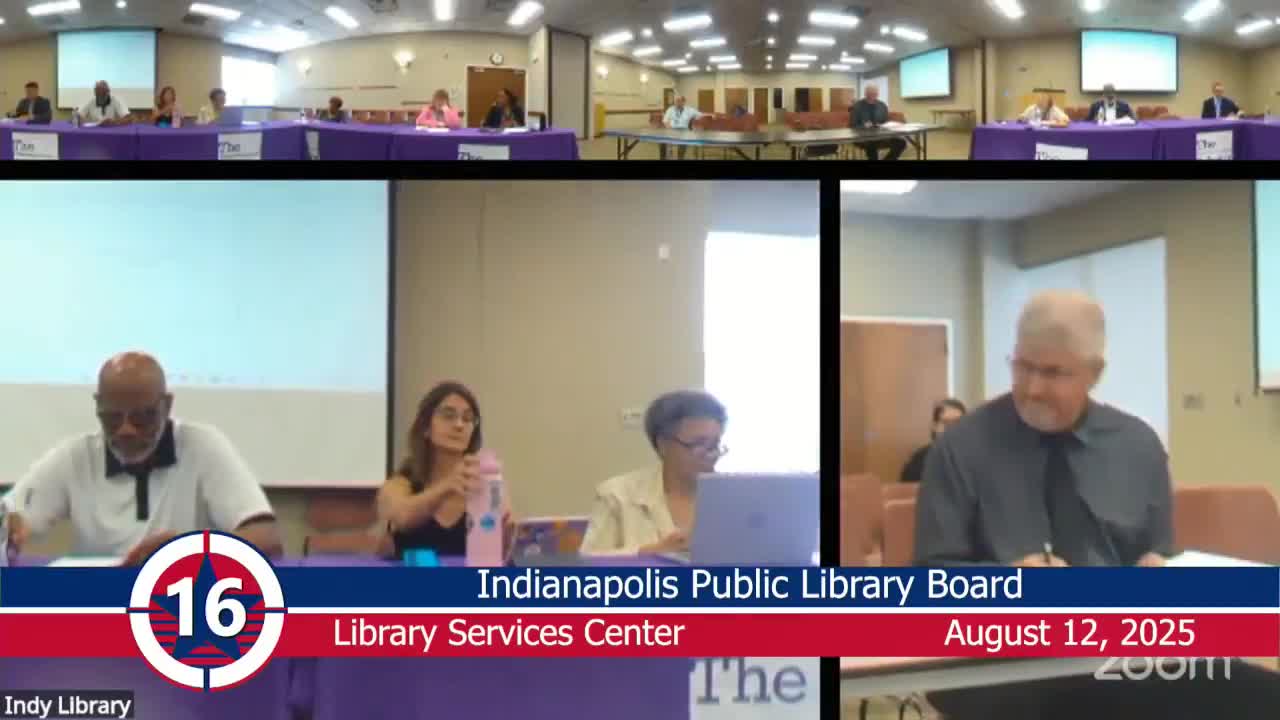
The Indianapolis City Library Board on a special meeting held a public hearing on its proposed 2026 budget and heard a long-term planning adviser say recent state property-tax legislation will reduce assessed valuation and likely lower library property-tax revenue.
Mike Rotter, introduced as a long-term planning adviser, told the board the 2025–2026 legislative session produced major changes to homestead deductions, a new homeowner credit, expansions of business personal property exemptions and a restructuring of local-option income tax distribution that together will shrink the property-tax base for local units including the library. "This feels like a train," Rotter said of the pace and scope of the session.
The changes flagged by Rotter include an increase in the homestead supplemental deduction (he said it rises from about 37.5% toward 40% next year and continues to grow in subsequent years), a new homeowner credit of up to 10% or $300, and an exemption that raises the business personal-property threshold so many smaller firms will no longer pay that tax. He also warned that the state shifted some replacement dollars toward local-option income tax (LOIT) formulas, altering how counties and libraries receive distributed funds.
Rotter and library staff emphasized uncertainty in near-term planning because Marion County had not yet certified assessed valuations by the usual August 1 deadline. Until that number is certified, staff said they will continue modeling assumptions and will provide a fiscal plan after certification.
Budget staff presented the proposed 2026 budget as a mix of operating, debt and reserve funds. The operating budget was presented at about $67.2 million and the total 2026 budget at $89,294,474, a roughly 4.6% increase from 2025 as advertised. Staff estimated potential net revenue losses tied to the state changes of roughly $2.0 million in 2026 and $1.1 million in 2027 in their current model, with a projected net gain in a later year under certain assumptions. Those figures were described as estimates and subject to revision when assessed valuation is certified.
Board presenters pointed to the library's current reserve position as a buffer. Rotter said the library ended 2024 with about $45 million in cash and his model projects the library would still have about $34 million after the modeled 2026 impacts, allowing the system time to respond without an immediate emergency cut. "You are in a strong cash position," Rotter said, adding that the reserves mean the board need not take "a knee-jerk reaction" while it evaluates policy options.
Staff identified several levers the board and county could use to address long-term revenue changes: (1) the county could adopt LOIT up to 0.05; Rotter estimated that, if Marion County adopted the full 0.05 at current figures, the library share could be on the order of $18.7 million countywide (staff estimated the county's LOIT base at roughly $757 million); (2) the board could seek to hold the library's debt levy at the same levy amount year to year so the community sees stable levy requests while rates shift because of valuation changes; and (3) the board will continue to monitor distribution formulas (population-based distributions and the current levy-freeze arrangements) because those create "winners and losers" among library systems.
Staff also described expenditure pressures built into the 2026 proposal: a scheduled pay-rate increase and additional raises, a year with 27 payroll periods that increases personnel expense, higher workers' compensation costs tied to raises, rising contracts for security and housekeeping, and a small leave entitlement created in recently enacted state legislation noted as an increase in liability. Staff said they plan to manage controllable costs by reviewing contracts, auditing invoices and deferring nonessential spending where feasible.
Capital and debt items were mentioned in the presentation. Staff said an upcoming bond for a West Indianapolis innovation project is expected to be in the mid‑teens of millions; the debt-service schedule was shown to decline over time, which staff said helps free operating dollars even as property-tax dynamics change.
During the hearing, library leadership repeated that the public hearing itself required no board action beyond receiving comment. When the public-hearing portion concluded, the board moved and seconded a motion to close the hearing; a roll call was held and the motion to close was approved. Dr. Eugene White was recorded on the roll call as approving the closing.
The board and staff said they will return with a finalized fiscal plan after the county certifies assessed valuation and noted that the board will consider levy strategy and options for LOIT participation as part of the 2027–2028 budget cycle.
The hearing drew questions from board members about contract expirations and modeling assumptions; staff responded that they will provide more detailed analyses, including a fiscal plan tied to the certified assessed valuation when available.