
Orange County advisory panel hears wide public comment on competing redistricting maps; sets new amendment deadline
Get AI-powered insights, summaries, and transcripts
Sign Up Free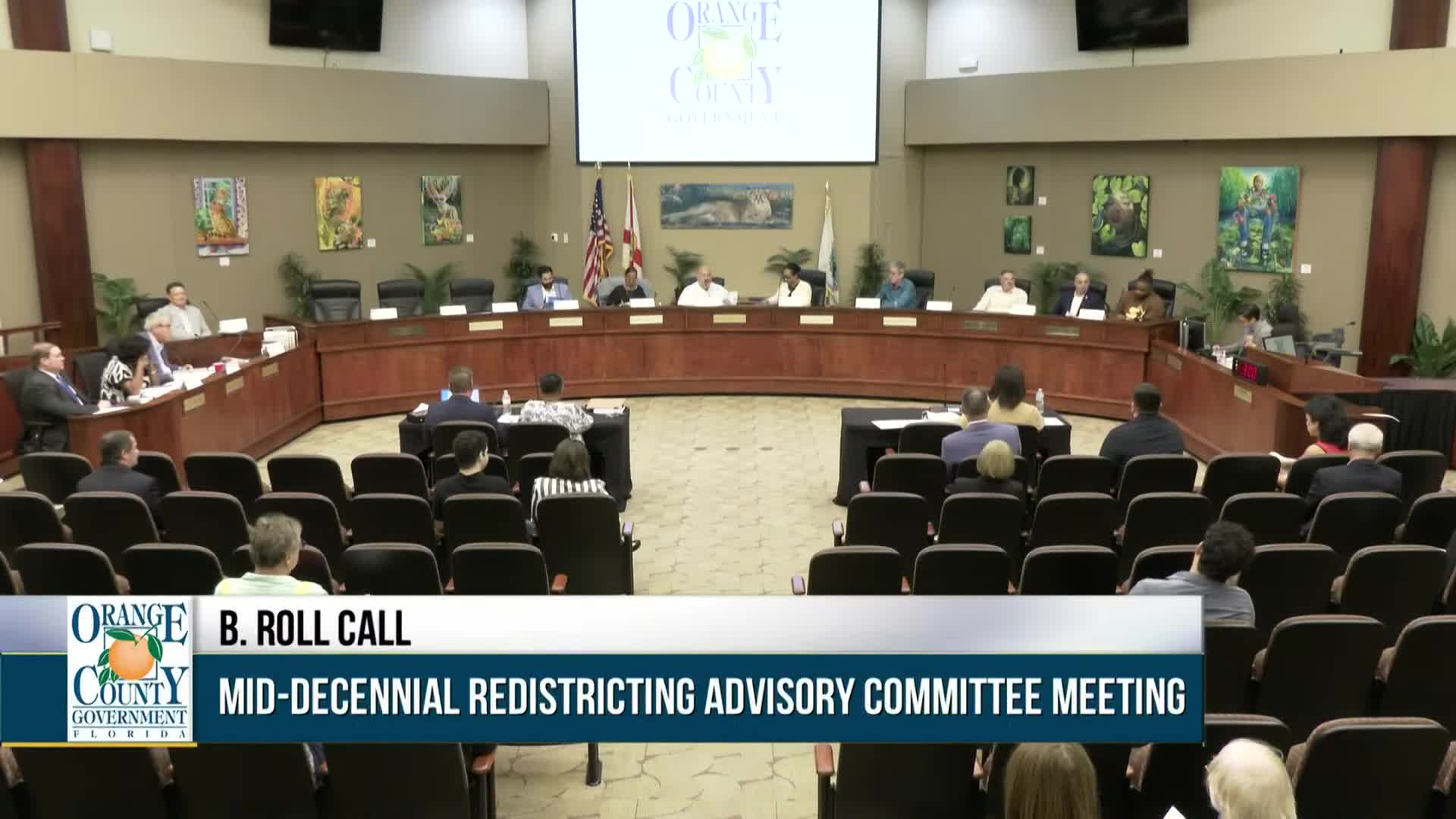
Summary
ORLANDO — The Orange County Mid Decennial Redistricting Advisory Committee spent its Aug. 12 meeting hearing public comment on seven competing draft maps and set a new deadline for written amendments as it begins a formal winnowing process to deliver recommended maps to the County Commission.
ORLANDO — The Orange County Mid Decennial Redistricting Advisory Committee spent its Aug. 12 meeting hearing public comment on seven competing draft supervisor maps and set a new deadline for written amendments as it begins a formal winnowing process to deliver one or two recommended maps to the County Commission.
The committee, chaired by co-chairs Evans and Perez, heard repeated appeals from city officials and residents to keep municipalities and longstanding communities intact, and from others who argued for new minority‑opportunity districts. After deliberations, the panel agreed to accept member and public amendments through Thursday at 5 p.m. Eastern and to use a ballot process if more than two map proposals remain by the final meeting.
Why it matters: The committee’s recommendations will shape eight county commission districts and influence local representation, resource allocation and service access for hundreds of thousands of residents. Speakers focused on whether maps keep communities of interest whole, preserve the cores of prior districts, and whether districts would leave large populations wholly unincorporated and therefore concentrated under a single commissioner.
Public comment emphasized a mix of local concerns. Orange County Commissioner Myra Uribe (District 3) urged the committee to reject proposals she said split established communities, saying the Baga and Washington 2 proposals “do a disservice to the middle core of Orange County” by dividing Pine Castle and nearby areas. Commissioner Semrad warned that “any map that places 98–100% of a population without any municipal overlay ... creates an inequitable representation of service access,” referencing concerns about disaster response and staff capacity for largely unincorporated districts.
Residents and civic organizations testified for and against multiple maps. Lehi Hodge, a former committee member, asked the panel to require disclosure when people testify at staff direction: “I think it’s important for other speakers to disclose if they were asked to be here and speak in support of a specific map and who asked them to do that.”
Representatives of municipalities urged keeping certain cities together. Ed Williams, appearing for the City of Winter Garden, recommended Washington 2, saying, “Winter Garden supplies water to Oakland. Ocoee has some of our sewer plants located in their property,” and describing longstanding interlocal service ties among Winter Garden, Oakland, Ocoee and Apopka.
Advocates for minority‑opportunity districts pushed competing plans. Felipe Sosa Lasa Vale said the Washington 2 plan keeps many municipalities whole and, he argued, preserves voting opportunity: “None of Orange County’s 39 census designated places are split,” and he said the map creates districts that comply with federal protections for minority voting strength.
Other commenters raised concerns about coordinated campaigns for public speakers and maps. Jared Cornell said he had seen evidence that “certain maps are designed with special interest in mind,” and asked the committee to be vigilant about manufactured support.
Procedure, deadlines and next steps dominated staff and committee discussion. County counsel and the committee’s attorney, Attorney White, reviewed the planned "winnowing" procedure: members may voluntarily withdraw maps; if more than two proposals remain near the end of the schedule, members will cast ballots listing their top two choices and the two maps with the most votes will advance as the committee’s recommendation. White also cautioned that population deviation matters legally: “If we’re right at the 10% threshold or over it, we have a legal issue to justify,” and urged members to account for one‑person/one‑vote equality when considering larger deviations.
After extended discussion about logistics and staff capacity, the committee agreed by consensus to extend the deadline for submitted amendments to Thursday at 5 p.m. Eastern so consultants and staff can analyze proposed changes before the next meeting. The committee also reviewed a schedule that tentatively places presentation of its recommendation to the Board of County Commissioners on Sept. 16 and confirmed its next committee meeting for Aug. 18.
Formal actions recorded during the Aug. 12 meeting were limited. Members approved a correction and then approved the minutes from a prior meeting on a voice vote. The meeting adjourned on a motion from committee member Coy Jones, seconded by co‑chair Evans.
The committee will continue public meetings through late August and early September to narrow the field of maps. Staff and consultants asked members to notify them in advance if they intend to propose substantial cross‑map amendments so statistical evaluations can be prepared for the committee’s consideration.