Get Full Government Meeting Transcripts, Videos, & Alerts Forever!
Get email alerts on the Drainage topic
No spam. Unsubscribe anytime.
Barry County holds Drain Code 101: commissioners briefed on districts, assessments, permits and lake levels
Summary
County attorneys and consultants gave an extended presentation on Michigan's Drain Code, covering how drainage districts are formed, how costs are apportioned, recent changes to maintenance limits, permitting and exemptions, and the process for setting legal lake levels and financing large projects.
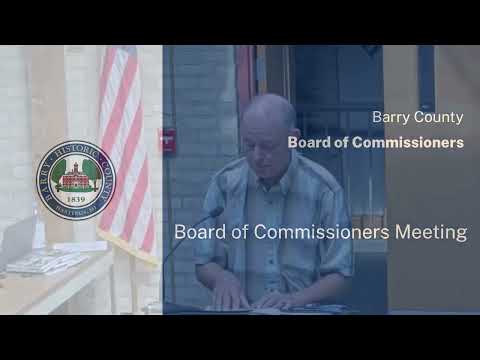
Barry County held a special Board of Commissioners meeting July 29 for an extended presentation on Michigan's Drain Code and related water-management topics, including drainage districts, assessment apportionments, permitting, and the process for setting legal lake levels.
The presentation was led by Doug Kelly, an attorney at Clark Hill who described himself as a drain attorney with more than 25 years'experience working with drain commissioners, and by Jim Bridal (presenter/staff member), who walked commissioners through practical steps for maintenance, petition projects and financing. Public commenters included Ted DeVries of Prairieville Township and Rick Moore, harbormaster of the Podunkle Cuts Club.
"The drain code of 1956 is an exceedingly complex statute, the provisions of which are apparently known by few in the profession and understood by far fewer," Kelly said, summarizing the statute's arcane history and the practical challenges counties face when implementing it.
Why it matters: The Drain Code governs how counties and drain commissioners manage stormwater, flood control and water-quality projects, how they create drainage districts, and how they apportion the cost of repairs and improvements through special assessments. Changes in lake levels, large repair projects and inter-county drains can trigger multi-million-dollar work that affects property values, township budgets and public health services (for example, access for emergency vehicles), presenters said.
Key points from the presentation
- Drainage districts and authorities: Kelly explained that a drainage district is a statutory public body corporate that can acquire property, enter contracts, borrow money and levy special assessments. The drain commissioner serves as the administrative officer for a district; for inter-county drains, a drainage board of the affected drain commissioners governs the district (Kelly).
- Three project paths: presenters described three primary approaches: routine maintenance; a "resolution to exceed" maintenance limits (where townships that represent at least 20% of an assessment can authorize work that exceeds maintenance caps); and petition projects or new drains that require engineering design, easement acquisition and often permitting. Bridal highlighted that petition thresholds and procedural differences (for example, the board of determination and the notices required) vary by the section of the code used.
- Maintenance-dollar limit change: Bridal and Kelly said the statutory maintenance limit that could be spent without a petition was recently raised. "It used to be $5,000 a mile up until this last year. Now they bumped it to $10,000 per mile plus the cost of living," Bridal said. Presenters explained the limit is applied per mile (rounded) of drain and does not include consultant costs (engineers, attorneys, wetland specialists).
- Apportionment principle: Assessment rolls are based on the "benefit derived" principle; there is no single mathematical formula and the drain commissioner or drainage board must use sound judgment. Factors considered include land use, impervious surface area, proximity to the drain and localized topography.
- Permitting and wetlands: Presenters emphasized environmental permits under Michigan's Natural Resources and Environmental Protection Act (NREPA, formerly MDEQ) and the federal Clean Water Act are often required. Kelly warned permit timelines can be lengthy for wetland work: "You can take a spoon you can take the dirt out if you want, but the minute you take a spoonful of sand and put it in, you need a permit," he said.
- Exemptions: Certain maintenance activities restoring a drain to its original contours and many tile replacements are typically exempt from state permitting; other work (bank stabilization below the ordinary high-water mark, new fill in wetlands, larger culvert replacements) will usually require permits. Presenters noted exemptions can be constrained for drains classified as "mainstream" or for work on drains permitted after certain dates.
- Lake levels and county role: Kelly outlined the two primary ways a lake-level project begins: (1) a petition that must be signed by owners of two-thirds of the lakefront land (a high threshold); or (2) initiation by the county board through a feasibility study and, if supported, a court petition to set a legal lake level and assessment district. "The other way to start a lake level project is by a motion to the board of commissioners," Kelly said. He also noted that court proceedings set the district; the county later confirms the assessment roll.
- Financing: Large projects are commonly financed by bonds or other borrowings and paid through special assessments on the drainage district. Kelly and Bridal gave local examples: a Thornapple-area project was described as a roughly $300,000 contract spread over 10 years; presenters said the Watson District benefitted from a MDOT arrangement that they estimate saved landowners approximately $1.4'$1.5 million. Kelly noted lenders favor borrowings backed by the county's full faith and credit and that interest rates vary by deal (he cited a 20-year loan at about 1.8% for one project and near 4% for another in past years).
What commissioners and the public asked
- Several commissioners and attendees pressed for clarity on how assessment boundaries are drawn (engineers use lidar and onsite verification to trace where runoff flows) and how multiple parcels owned by one person are treated for assessments (presenters said the county typically assesses each parcel individually when the parcel conveys separate rights).
- Commissioners asked about the county's role on specific lakes discussed in public comment, including Pine Lake, Pleasant Lake, Crooked Lake, Mud Lake and Glassby (Glaspie) Lake. Presenters said Pine Lake has a long history of study without a final county decision on a lake-level project and that Pleasant Lake had pending work with permits and court steps that staff expected to bring back to the board for confirmation.
- Questions about the scope of district rolls, townships assessed and the financial impact on small townships were raised; presenters acknowledged that assessments can be large relative to small township budgets and that prior decisions have led to contentious local effects.
Ending note
Presenters said the session was intended as education and that staff would return to the board when specific projects move toward formal petitions, court proceedings or county confirmation of assessment rolls. Kelly closed by noting there is a wide range of technical, legal and permitting constraints tied to drain and lake-level work and that follow-up action typically requires engineers, counsel and coordination with state agencies.