Get Full Government Meeting Transcripts, Videos, & Alerts Forever!
Get email alerts on the Health Centers topic
No spam. Unsubscribe anytime.
St. Thomas East End Medical Center urges $2.5 million GVI appropriation, seeks $2.5M one‑time infusion for legacy debt
Summary
St. Thomas East End Medical Center told the Legislature it has stabilized operations after restructuring but still carries $3.7 million in legacy accounts payable and requests the Governor—s Virgin Islands (GVI) FY2026 appropriation of $2.5 million plus a one‑time $2.5 million infusion to retire prior debt and preserve services.
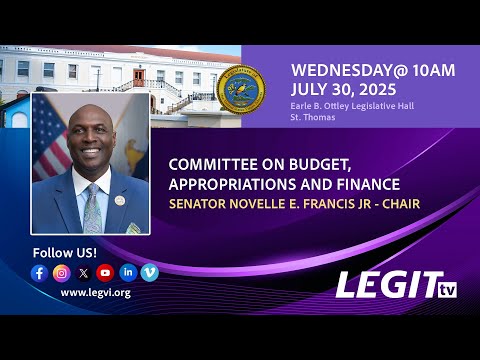
St. Thomas East End Medical Center Corporation (STEAMCC) asked the Committee on Budget, Appropriations and Finance on July 30 for a $2.5 million GVI appropriation for FY2026 and a separate one‑time infusion of $2.5 million to reduce legacy accounts payable and restore fiscal equilibrium.
The request was presented by Tess Richards, STEAMCC executive director, who described the health center—s recent recovery and ongoing financial pressures. "Our testimony today is a reflection of 2 years of grit, sacrifice, and hope," Richards said, adding that the center has closed a $300,000 monthly shortfall and ended FY2025 with a small surplus.
Richards told the committee STEAMCC has rebuilt patient trust, expanded services and improved operations through staff restructuring and revenue cycle changes, but continues to face growing uncompensated care and lingering liabilities. She said the center now serves a patient population with 99 patients below the federal poverty line and that self‑pay patients have grown from 29.5% to 34% of the payer mix, contributing to rising uncompensated care.
Nut graf: The center presented a FY2026 operating budget of $8,456,000 and requested a $2.5 million annual GVI allotment (roughly level with the current appropriation) to cover personnel, facility and operating costs. Separately STEAMCC asked the Legislature to authorize a one‑time $2.5 million capital infusion to amortize prior accounts payable—identified in testimony as about $3.7 million—so the center can avoid service disruption and invest in growth.
Most important facts and details
- FY2026 operating budget requested: $8,456,000; projected total revenue: $8,328,860 (yielding a $280,283 deficit in the operating budget). - Requested regular GVI appropriation: $2,500,000 (about $100,000 above the current appropriation cited in testimony). The governor—s proposal later appeared as $2.7M during the hearing. - Requested one‑time public infusion (source suggested by STEAMCC: Epstein funds and Medicaid cost report reimbursements): $2,500,000 to materially reduce accounts payable and legacy debt (testified accounts payable ~ $3,700,000). - Reported FY outcomes: STEAMCC said it reduced a $2.6M inherited deficit (Feb 2023) to nearly break even in Feb 2024 and to a $103,000 surplus in Feb 2025. - Visit volumes: 17,814 (02/2023); 24,041 (02/2024); year‑to‑date 14,547 as of 6/30/2025 (positioning the center to exceed prior year totals).
Supporting details and context
Richards summarized major operational changes: rightsizing staff from 103 to 58 employees (Feb 2023), restoring salaries after a temporary 8% reduction (July 2024), introducing a dedicated revenue cycle team, resuming an in‑house laboratory (3,334 lab draws in 2025 to date), expanding dental and specialty services, and launching a new foundation (VI Help). She said grants and program income now make a larger share of revenue: program income $3,587,280 and HRSA cluster grants $1,461,580 projected for FY2026.
Committee questions focused on: the outstanding accounts payable, federal drawdown timing (STEAMCC told the committee it expects $1.461M annually from federal sources), the composition of revenue and payer mix shifts (fewer Medicaid patients, more self‑pay and commercial insurance), staffing and vacancies, and the timing/availability of proposed one‑time funds.
Ending: Richards urged the committee to act quickly to prevent disruption to the FQHC on St. Thomas and St. John that serves a large low‑income population. "We are asking for enough," she said. The committee recorded questions and asked STEAMCC to supply follow‑up documents including a detailed breakdown of program income, dental and lab revenues, and accounts receivable.
Speakers quoted
- "Our testimony today is a reflection of 2 years of grit, sacrifice, and hope." — Tess Richards, executive director, STEAMCC - "Our appropriation must reflect both the rising cost of health care and the growing burden of uncompensated care that we provide each year." — Tess Richards
What the committee took away
Committee members praised operations improvements but pressed for documentation: monthly allotments received, federal drawdown timing, and a line‑item breakdown of how any requested local funds would be spent. Several senators asked STEAMCC to supply updated revenue and accounts receivable reports before the committee advances any appropriation.
Ending note
STEAMCC—s request combines a recurring GVI grant to help cover ongoing operations and a one‑time debt service appropriation to clear legacy payables. The committee asked for follow‑up financial schedules and the center—s answers will be used in budget deliberations this fall.