Get Full Government Meeting Transcripts, Videos, & Alerts Forever!
Get email alerts on the Streetlight Infrastructure topic
No spam. Unsubscribe anytime.
Council backs a data‑driven approach to expand street lighting; staff to prioritize safety and propose CIP options
Summary
Council discussed results of a public survey on street lighting and asked staff to prioritize safety‑critical locations, leverage survey data, and return with a plan for capital funding and phasing; staff flagged high per‑light installation costs and recommended addressing lighting in road rehabilitation projects where possible.
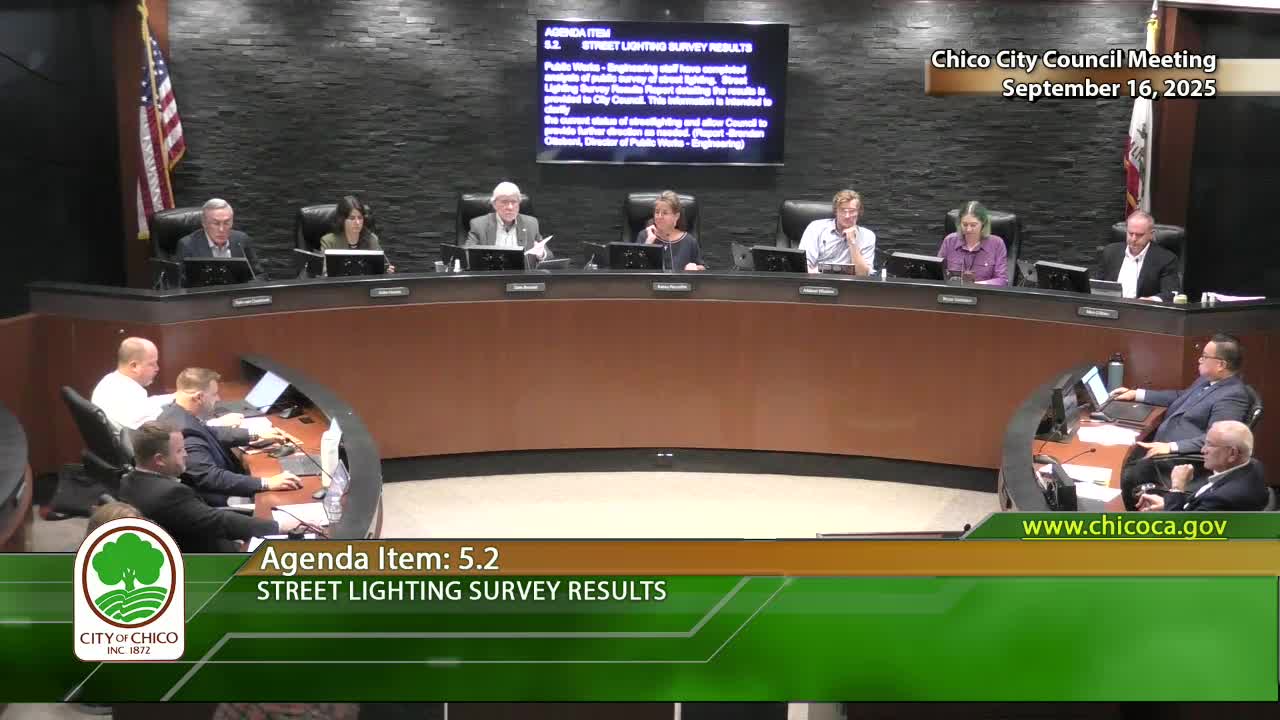
The City Council reviewed results of a public street‑lighting survey on Sept. 16 and asked staff to use the survey responses and council district priorities to identify high‑need locations and funding approaches for future capital planning.
Public Works staff told council the city received 147 survey responses identifying clusters of dark streets, especially in older neighborhoods and recent annexations. Staff highlighted cost variability for installing new street lights — including PG&E electrical‑service connection costs and trenching — and estimated a per‑light install cost in the range of $15,000–$20,000 depending on site conditions.
Councilmembers and members of the public framed the issue as primarily about safety: council members urged staff to prioritize locations where pedestrian and bicycle travel occurs at night, school intersections and recent annexations lacking lighting. Staff suggested the most cost‑efficient approach is to pair lighting installations with planned road rehabilitation projects (complete‑street retrofits) where underground work can be scheduled and unit costs reduced.
Council discussed options including establishing a capital project (CIP) for street lighting, starting a small pilot program, or awarding micro‑grants to residents in locations where a PG&E pole can host a new fixture. One councilmember proposed a $25,000 pilot — staff and the city manager noted some funding sources are restricted (for example, PEG funds allocated for council‑chamber technology) and that any pilot would require clearly identified funding.
Council directed staff to analyze the survey data by district, propose a prioritized list of candidate locations focused on safety (intersections, transit routes, and school corridors), estimate costs and funding options (including CIP approaches) and return with recommendations during the upcoming budget cycle. Council emphasized safety as the principal criterion when setting priorities.