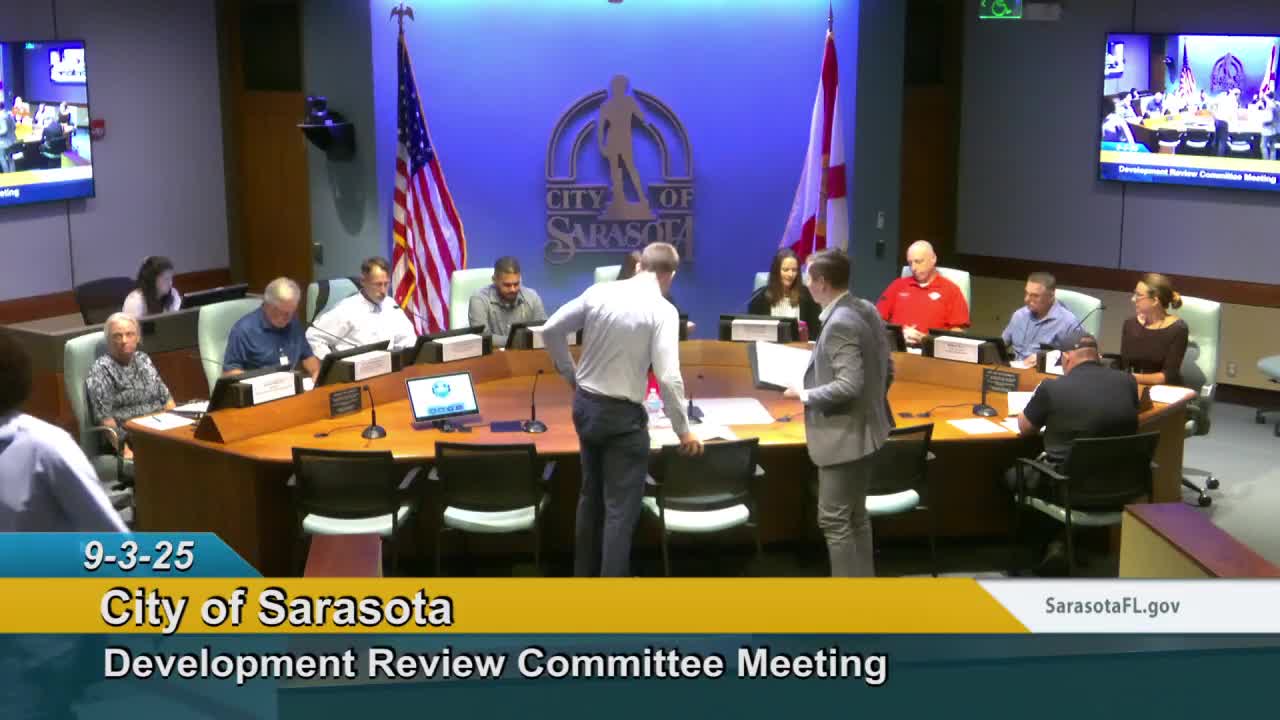
Pre‑application for 333 Coconut Avenue proposes 11‑story mixed‑use tower; city issues technical requirements and will send letter of understanding
Loading...
Summary
An 11‑story mixed‑use development proposed for 333 Coconut Avenue will require an administrative site-plan application, frontage/height calculations, public-parking agreements and several street and utility improvements before formal submittal; city staff will issue a letter of understanding.
A pre-application conference Aug. 3 covered an 11-story mixed-use proposal at 333 Coconut Avenue in downtown Sarasota. The development team presented plans for 18 residential units, 1,500 square feet of ground-floor retail and two levels of structured parking concealed behind a 21-foot-high liner building, and city staff provided extensive technical comments.
Why it matters: The proposal seeks downtown height incentives tied to providing public parking and must meet downtown frontage, setback, glazing and pedestrian standards before formal approval.
Rebecca Webster, the certified planner, confirmed the project will require an administrative site-plan submittal and asked the applicant for a host of clarifications: a site data table with required and proposed development standards; a boundary/topographic survey dated within six months; a roof plan labeling and dimensioning roof structures; and calculations supporting the height incentive tied to providing dedicated on-site public parking.
Webster also asked the team to dimension the required 12-foot tower recess on the upper floors, provide glazing calculations for first-floor facades (30% glass for nonresidential frontages, 15% for residential frontages), and label rooftop mechanical equipment so total building height can be measured from finished grade per Table 6-1003. She reiterated that transformer and mechanical rooms do not count as habitable space and that an administrative adjustment may be necessary if mechanical areas exceed allowed percentages.
Traffic and public-works reviewers told the team to show milling and resurfacing on adjacent streets, add ADA ramps at corners and provide turning templates. Alisa Thomas, traffic concurrency, outlined required streetscape elements on Fourth Street and Coconut Avenue (sidewalk widths, planting-strip minimums, tree spacing, lighting and curb radii) and noted Coconut Avenue’s classification as a major collector with a feature right-of-way width of 75 feet (current ROW adjacent to site is 60 feet; staff said dedication is voluntary but desired).
Utilities staff explained how connection timing with an adjacent, planned CID/FDOT project could affect whether the project must connect to an existing 4-inch main or a proposed 10-inch main; the requirement depends on which construction occurs first.
Other technical items included:
- Public-parking incentive mechanics: The team said dedicating 2,850 square feet of public parking would allow a floor-area bonus equal to three times that amount (8,550 sq ft) and enable the 11-story height. Planning staff requested an agreement guaranteeing the public parking will remain available for the life of the development, recorded in the county land records prior to site-plan approval. - Waste and recycling: The Public Works Waste & Recycling reviewer requested a narrative describing refuse, recycling and special-waste handling, a 12-foot wide dumpster access opening, and turning templates to verify service-vehicle access. - Fire and life-safety: The Fire Department requested fire-flow calculations, identification of hydrants and backflow preventers on the master utility plan, and turning templates showing fire apparatus access. Fire staff also noted that sprinklers can extend required apparatus reach from 150 feet to 450 feet if the building is fully sprinkled.
The applicant asked whether records from a prior, similar approval could be used; staff said administrative adjustments are possible for some items (for example, mechanical allocation under 25% would be an administrative adjustment) and that previous application materials can be requested for reference. The city said it will issue a letter of understanding that summarizes the pre-application comments.
Next steps: Applicant to supply the required survey, technical plans, turning templates, utilities coordination and a recorded public-parking agreement demonstrating hours and maintenance obligations prior to formal site-plan approval.