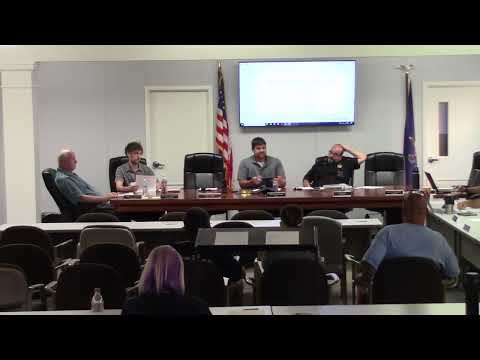
Sunbury leaders cite police staffing shortage and explore grants, co-responder and authority options
Loading...
Summary
Council and staff said the police department is operating under staffing shortages, discussed a possible COPS grant, co-responder mental-health support, and the legal/structural option of a separate emergency-services authority to fund services by fee.
Sunbury City councilmembers and staff discussed police staffing shortages, the city’s pursuit of grant funding to offset hiring costs and possible structural options for funding emergency services.
Officials said the police department is short of full staffing and that call volume has increased, creating operational strain. One speaker summarized recent call volume from the 911 center as “800 calls” for a recent period and described lengthy investigations that limit officers’ availability for other responses.
Grant and staffing options
City staff described a grant approach discussed with staff identified as Derek that would provide $50,000 tied to three officers over five years; officials characterized that funding stream as potentially covering up to $150,000 if fully awarded, but they cautioned the city must budget for the full cost in case grants do not materialize.
Mental-health co-responder
Councilmembers asked about a police co-responder model to place a mental-health or behavioral-health professional on calls alongside officers. Staff said the program model discussed is not a standalone grant but rather a service element that can be folded into other grant applications. Staff said the co-responder would not carry a weapon and would focus on follow-up and referrals; multiple participants described the program as reimbursable over some years depending on grant terms.
Authority/fee option and legal questions
Several participants raised the possibility of creating a separate emergency-services authority that would levy a fee (somewhere compared in discussion to $5–$10 or a $10-per-household model referenced elsewhere) to pay for emergency services rather than increasing general tax rates. Staff and councilmembers said the legality depends on the municipality’s classification and state law; one staff member said they do not have a “concrete answer” yet and that Joel and others would research whether a third-class city can create such an authority or whether a separate authority would be required.
Operational context
Staff and councilmembers repeatedly framed public safety costs as among the largest drivers of budget increases. Speakers noted that some mutual aid arrangements cannot routinely divert neighboring departments to cover daily calls, and that specific major incidents (robbery at gunpoint, multiple homicides) have strained available officers.
Ending
No policy was adopted at the workshop. Councilmembers instructed staff to continue grant research, report back on legal options for fee-based authorities, and provide updated staffing and cost figures for the formal budget process.