Get Full Government Meeting Transcripts, Videos, & Alerts Forever!
Get email alerts on the Legal Public Comment topic
No spam. Unsubscribe anytime.
Civil rights advocates deliver notice alleging unconstitutional charging practices at Allegany County meeting
Summary
Two Washington, D.C.-based civil rights advocates told Allegany County commissioners they plan litigation and provided a notice asserting Maryland prosecutors and law enforcement charge by "information" rather than grand jury indictment in violation of the U.S. Constitution, the speakers said.
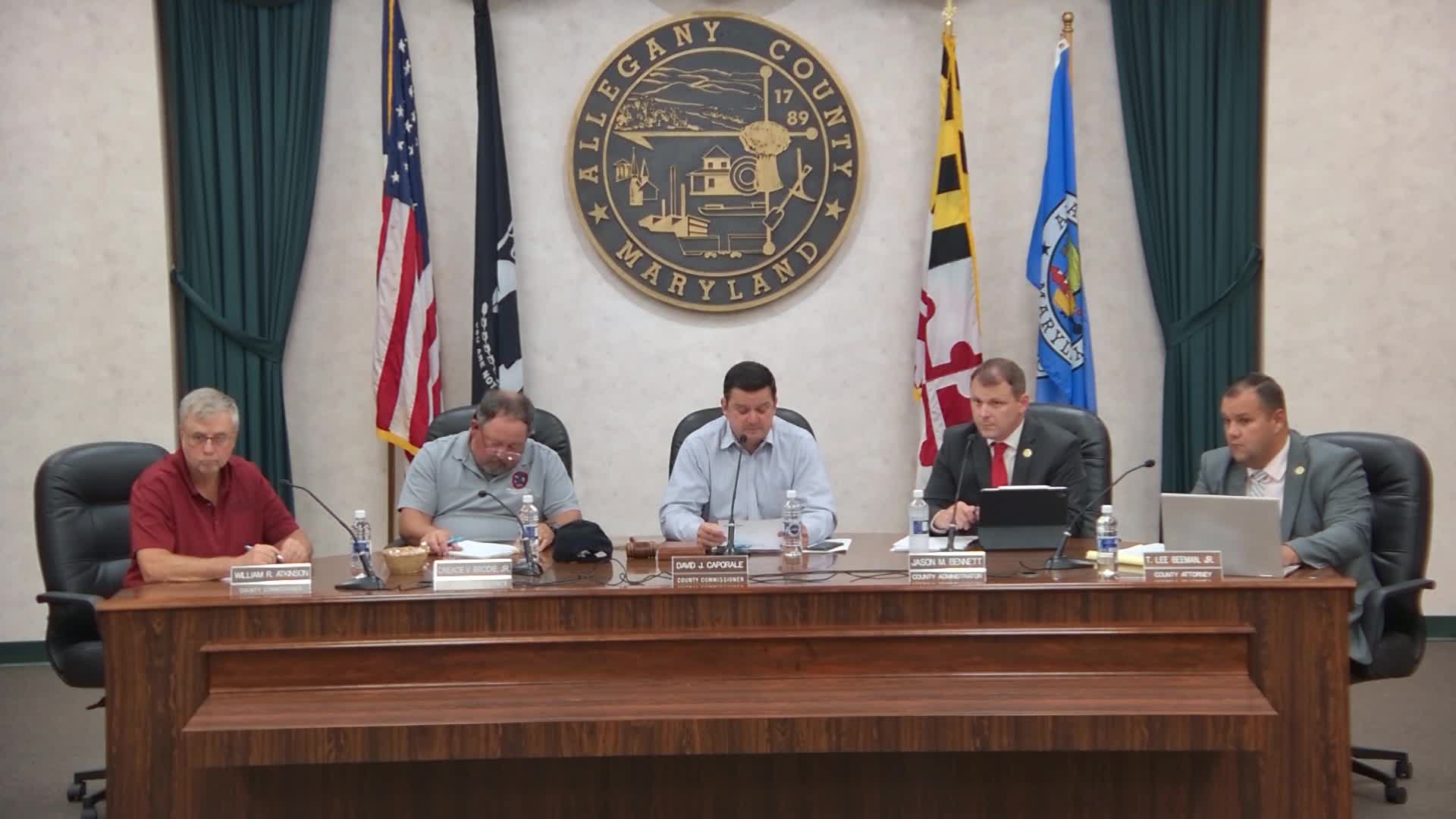
Two civil rights advocates from Washington, D.C., spoke during public comment at the Allegany County commissioners meeting, delivering a formal notice alleging that Maryland prosecutors and law enforcement are improperly using charging by information instead of grand jury indictments and urging county officials to stop paying for what they described as unconstitutional actions.
Jessica Saxton, who identified herself as a civil rights advocate and litigator, said she was providing public notice "in accordance with USCS rules of civil procedure, as well as rule 17 and rule 20 of the United States Supreme Court," and cited the U.S. Constitution in support of her assertions. She said the state of Maryland has enacted legislation that permits charging by information, which she described as inconsistent with Clause 1 of the Fifth Amendment and the Fourteenth Amendment. "States cannot enact their own alternative legislation and substitute that for the guarantees of the Constitution," Saxton told the commissioners.
Tanner Wianne, who identified himself as a civil rights litigator, said he and his colleagues had assembled affidavits and notices and were seeking to obtain remedies before pursuing further litigation. He said they had identified roughly 22,000 criminal affidavits and claimed the matter could implicate federal criminal statutes. "We have to provide this notice to try to get remedy before we move into any further litigation," Wianne said.
Both speakers named statutes and constitutional provisions during their remarks and said litigation may proceed to the U.S. Supreme Court. They referenced 18 U.S.C. §242 (deprivation of rights under color of law) and another federal provision as possible bases for criminal liability; they also cited a Supreme Court case, Hurtado v. California (1884), as part of their legal discussion. The speakers asked county officials to "discontinue paying for crimes to be committed" by public officials or to educate and direct local agents to comply with the Constitution, according to the meeting record.
County attorney Attorney Beaman responded that the speakers' comments and materials would be included in the meeting record but said the commissioners did not waive statutory rights for service or process. No county action was taken on the assertions during the meeting.
The presenters said they were representing clients and referenced a named litigant preparing to bring matters forward to higher courts. The commissioners did not debate or take action on the legal claims; the matter was presented as public comment and recorded in the meeting minutes.