Get Full Government Meeting Transcripts, Videos, & Alerts Forever!
Get email alerts on the Fare Policy topic
No spam. Unsubscribe anytime.
Indigo board approves fare policy changes after equity analysis; paratransit increase delayed to July 2026
Summary
The board approved updates to Indigo’s fare policy, including a base fare increase and related product changes, accepted a federal Title VI fare equity analysis that found a disproportionate burden for the reduced 31‑day reduced fare product, and amended the implementation date for paratransit fare increases to July 1, 2026.
The Indigo Board of Directors approved updates to the agency’s fare policy and accepted the related Title VI fare equity analysis, while adopting a board amendment to delay the paratransit (Indigo Access/ADA) fare increase until July 1, 2026.
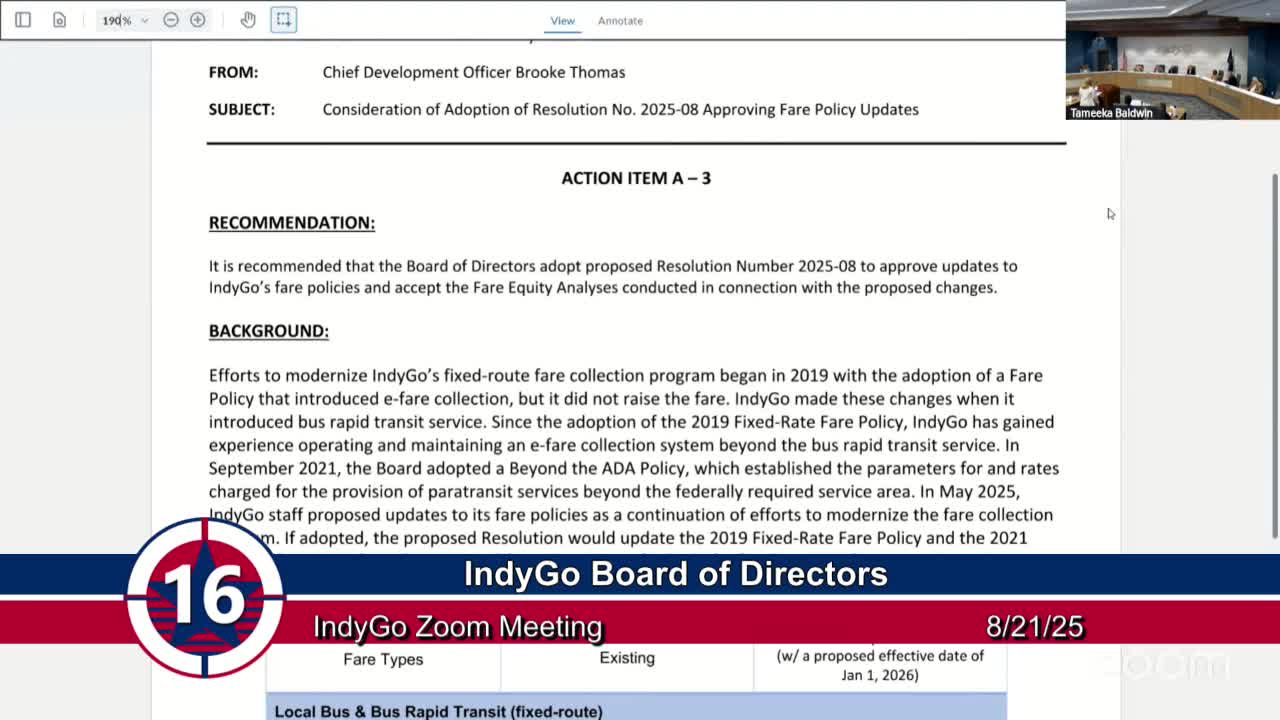
Staff recommended the board adopt Resolution No. 2025-O8 to implement a revised fare policy that would, as proposed, increase the fixed-route base two-hour fare from $1.75 to $2.75 effective Jan. 1, 2026, revise related MyKey fare products and discontinue legacy magnetic-stripe 31-day paper passes. Staff presented a federally required fare equity analysis; the analysis identified a potential disproportionate burden (for low-income riders) tied to the reduced 31‑day pass product. After board discussion of mitigation measures, Director Gardner moved to approve the fare policy updates with one change: delay the implementation date for Indigo Access (ADA and ADA-area paratransit) rate increases to July 1, 2026. The motion, which also authorized the president and CEO to make non-substantive technical edits to finalize the policy documents, passed on a roll-call vote.
Chief Development Officer Brooke Thomas framed the proposed fare changes as a response to long-term inflationary pressure and programmatic changes since the agency’s last base fare adjustment. Thomas said Indigo has not adjusted its fixed-route base fare in more than 15 years and noted that the average fare actually collected under current discounts and programs is about $0.80 on a $1.75 base fare. Thomas outlined staff’s proposal to remove the $2 fee for ticket-vending-machine transactions, to confirm continuation of fare-capping and transfer protections in the MyKey system, and to revise Indigo Access fares and premium fares consistent with the base-fare increase.
Ryan Wilhite, manager of special projects and regional mobility integration, summarized the Title VI fare equity analysis required of federally funded transit agencies when proposed fare changes are made. Wilhite said staff used onboard survey and farebox data to analyze per-trip impacts across fare products and payment methods. He reported that the combined-impact analysis found no broad disparate impact for minority or low-income riders but that the reduced 31‑day reduced‑fare pass showed a potential disproportionate burden for low-income riders. Wilhite said staff evaluated mitigation alternatives and concluded there were no feasible alternatives beyond the proposed policy package; staff proposed mitigation through enhanced outreach and by continuing to accept existing reduced 31‑day passes beyond the effective date.
Chief Public Affairs Officer Carrie Black described an extensive outreach campaign—more than 25 events, more than 220 pieces of formal feedback, distribution of over 7,000 bilingual information cards, and more than 18,000 website views—intended to inform riders about MyKey, fare capping and the product changes. Board members acknowledged the outreach but also raised concerns about impacts on low-income riders and asked staff to submit a detailed fare enforcement and mitigation plan with metrics for measuring outcomes.
Director Gardner moved to approve the fare policy update with the single amendment delaying implementation of the Indigo Access (paratransit) rate increase from Jan. 1, 2026 to July 1, 2026 and granting the president and CEO authority to make non-substantive technical corrections to the final policy documents. The motion was seconded and passed by roll call; the board adopted Resolution No. 2025-O8 as amended.
Staff said the effective date for most fare changes remains Jan. 1, 2026 if the amended resolution is approved, with sales of discontinued paper passes to end July 1 and acceptance of those passes to continue for a time as described in the final policy materials. Staff also committed to publish a mitigation and enforcement plan that addresses fare-eligibility programs, MyKey reliability, outreach and technical support for low-income and paratransit riders.