Get Full Government Meeting Transcripts, Videos, & Alerts Forever!
Get email alerts on the Water Quality Public Health Goals topic
No spam. Unsubscribe anytime.
La Habra staff says city water meets state and federal standards in 2025 public health goals report
Summary
City staff presented the 2025 Public Health Goals report and the council voted to receive and file it. Staff said La Habra's drinking water meets or is better than all state and federal legal limits and cited routine testing and a recent citywide lead test with no detections.
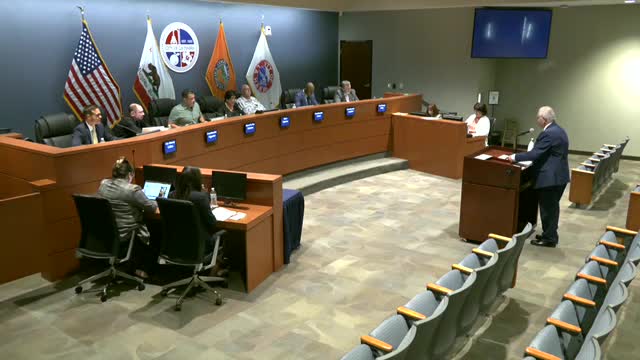
La Habra city staff on Aug. 18 presented the city's 2025 Public Health Goals (PHG) report for drinking water and the City Council voted to receive and file the report following a public hearing.
"The most important takeaway out of this report is our water it meets or is better than all state and federal legal limits. And our drinking water is very safe," a water-system staff member said during the presentation. Staff described the PHG report as a transparency exercise required by state law and explained that PHGs are nonbinding health-based goals while maximum contaminant levels (MCLs) are the enforceable legal limits.
Staff told the council that La Habra samples daily for total dissolved solids (TDS) and chlorine residuals weekly, tests for bacteria and other constituents on required schedules, conducts quarterly PFAS testing, and annually tests for the 126 contaminants listed under Title 22 to comply with state regulation. The staff member reported that the city's drinking water system had no detections of the chemicals the staff mentioned by name (PFOS/PFAS, chromium-6, PCE, TCE) at levels above MCLs and that the system remains in full compliance with mandatory health-based drinking-water standards.
Councilmembers asked whether the city compares its water-quality metrics to other jurisdictions. The staff response was that there is no centralized comparative index for cities' water quality; staff noted that differences in source water can affect metrics such as TDS. The staff said La Habra's TDS is around 400 milligrams per liter (below the MCL of 1,000 mg/L and below the PHG target noted in the presentation) and that the city mixes and treats water to meet goals.
Councilmembers also raised the cost of treating certain contaminants if present: staff quoted a range for advanced treatment (ion exchange and reverse osmosis) in a prior study, saying it could range from approximately $4.66 million to $28 million, and clarified that the city currently does not detect those contaminants at concerning levels.
Staff noted a recent lead study in which city personnel tested house laterals at meters across the city and reported no detections of lead in those samples. After a public comment period with no speakers, the council voted unanimously to receive and file the 2025 Public Health Goals report.
The staff said the PHG report is required by state law once a water system exceeds 10,000 service connections; La Habra reported about 12,500 service connections during the meeting.