Get email alerts on the Eviction Prevention topic
No spam. Unsubscribe anytime.
Douglas County holds work session on eviction prevention, hears limits of current programs
Summary
Douglas County commissioners held a work session to review eviction prevention and diversion efforts, hearing from legal aid, court, housing and public-health partners about timelines set by Kansas law, strained rental-assistance funding and the limited reach of mediation and legal counsel programs.
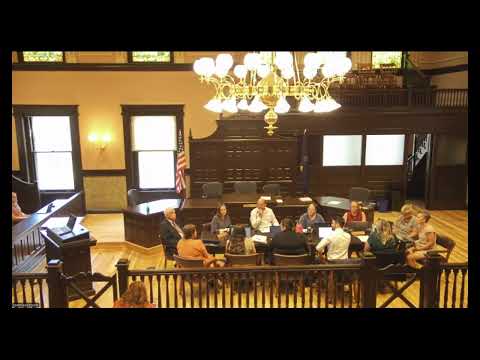
Douglas County commissioners convened a work session focused on eviction prevention and diversion initiatives, hearing from legal service providers, court staff, housing officials and public-health partners about how local programs currently operate and where gaps remain.
Brynn Blair, managing attorney for the Topeka office of Kansas Legal Services, summarized the eviction process for commissioners and staff, saying, “when the landlord serves tenant a written notice, the tenant ... has the chance to resolve the issues within the time frame outlined on that notice.” Blair and other panelists emphasized that when those initial notices are not resolved, the landlord may file an eviction complaint and the court process proceeds from there.
Adelaida Mendoza, eviction resolution coordinator at the district court, described how her office most often encounters tenants at the answer docket, a pivotal moment in the process. “We tend to have the most interaction with tenants when they appear at the answer docket,” Mendoza said, adding that court staff refer tenants to community resources at that time.
Panelists explained key timing rules under Kansas law often cited in filings: a common three-day notice for nonpayment of rent, longer notices for lease violations or terminations (14-day or 30-day variants), and that, following a judgment and writ of restitution, tenants typically have 14 days to vacate before the sheriff enforces removal. A small carve-out from the CARES Act was noted for certain federally backed properties during the COVID period.
Krista Negan, Douglas County Housing and Human Services program manager, described local rental- and utility-assistance funding and limits on impact. County general fund support for rent and utility relief was identified in the session as $350,000 annually; panelists said demand significantly exceeds that amount and the county currently can serve only a small portion of applicants.
Panelists discussed several prevention strategies and barriers. Kansas Holistic Defenders and Kansas Legal Services detailed how brief legal help at the answer docket, full representation for selected cases and pre-filing outreach can prevent evictions or reduce harms (for example, by negotiating payment plans or arranging agreed move-out dates that avoid forcible removals). Sam Allison Natale of Kansas Holistic Defenders described a funding source for eviction work in Topeka, saying, “I don’t remember the exact number. 85. Let’s say, 85,000, which covers ... about 90% of the salary benefits and overhead for 1 attorney.” He said that targeted funding in Topeka expanded the scope of clients served there compared with resource constraints in Douglas County.
Panelists highlighted mediation as an intervention with mixed uptake: some programs (for example, a Johnson County court-ordered mediation pilot) reported positive outcomes, especially for single female-headed households, but mediation depends on landlord participation and, in many cases, landlords are represented by attorneys. Local self-help and mediation referrals were said to be underutilized when landlords decline to participate or when tenants seek help only after arrears have grown.
Speakers also discussed structural issues that limit county options. Several panelists noted that local government authority is constrained by state statute in several areas of eviction timing and landlord-tenant law. Other policy tools — tenant right to counsel, expanded rental licensing and court-ordered mediation — were discussed as options to consider but no formal action or decisions were taken during the informational session.
Commissioners and panelists discussed operational steps to improve outreach and capture better data, including improved tracking of which filings are for nonpayment versus lease violations, more proactive public education so tenants know to seek help before filings, and coordination with the city rental-licensing database to reach landlords. Panelists said current data collection is being improved and that the county should expect clearer metrics in the coming months.
The session was informational only; no votes or formal policy changes were taken. Commissioners directed staff to follow up with additional data and potential policy options for future meetings.
AI generated
The text on this page is AI generated. Summaries, highlights, analysis, and video transcripts are all produced from the original source material.
AI can make mistakes, so if you spot one, and we will fix it for everyone.
Note: the source content is unaltered by us. Any content source we link to, be it a video, an audio recording, or a document, is presented exactly as its publisher released it. That publisher is usually a government body, sometimes an individual official or another organisation.