Get Full Government Meeting Transcripts, Videos, & Alerts Forever!
Get email alerts on the Mwsbe Policy topic
No spam. Unsubscribe anytime.
Houston OBO unveils MWSBE policy changes after disparity study; new tools aim to boost small firms
Summary
Director Silinthia Hoard outlined recommendations from the city’s disparity study, proposed aspirational participation caps based on market availability, and announced new programs (small business reserve, mentor‑protégé, financing expo) intended to increase participation by minority, women and small businesses.
Silinthia Hoard, director of the City of Houston Office of Business Opportunity (OBO), presented proposed policy changes informed by a recent disparity study and a rollout schedule aimed at increasing participation by minority‑owned, women‑owned and small businesses in city contracting.
Hoard said the city currently lists about 3,644 MBE firms, 2,145 WBE firms, 142 PDBE firms and 71 LGBTBE firms in its certification directory, and that the active directory stands at roughly 5,100 firms after a recent cleanup. “In FY '25, the city awarded over $500,000,000 to our minority firms and our women firms here in Houston,” Hoard told the committee.
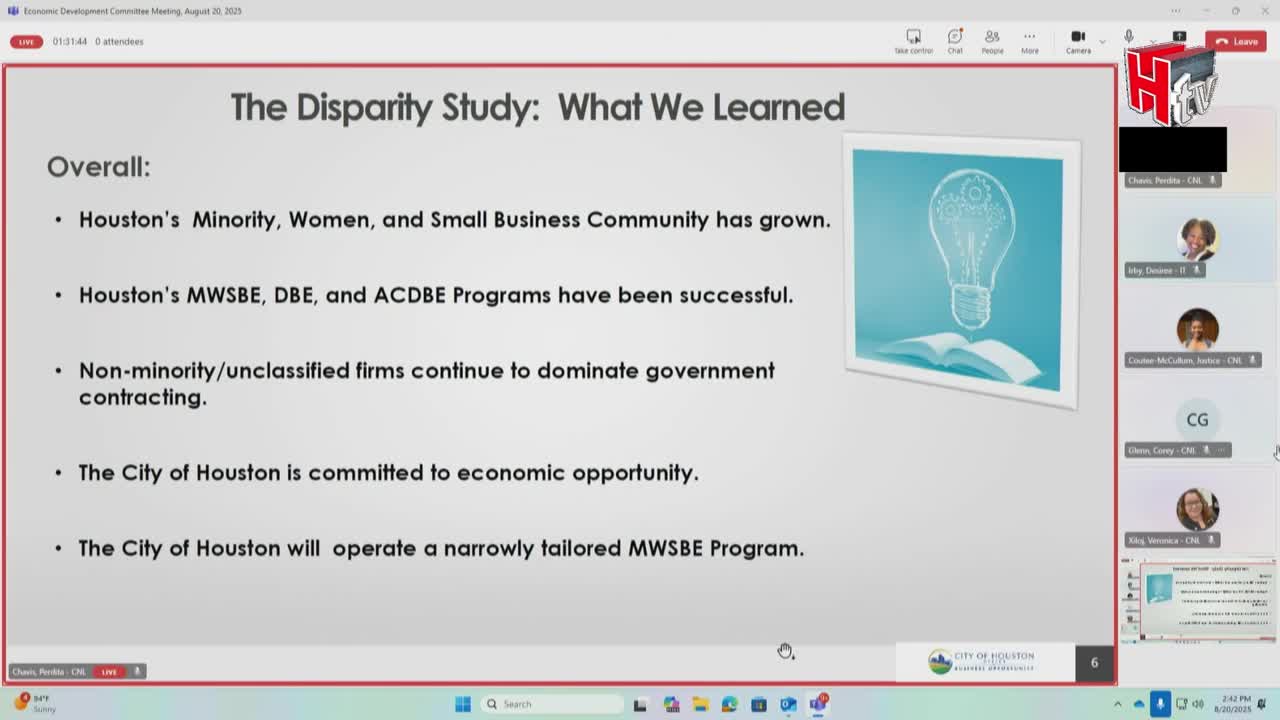
OBO described its study (conducted by MGT Consulting, using FY2018–FY2022 data) as covering construction procurement, professional services, goods and services, and inclusion of DBE/ACDB programs. The office said it used a nine‑county market area for availability measures and that consultants recommended an availability‑based, aspirational goal approach where certain groups showed no statistical disparity but the city still sets participation caps aligned with market availability.
Hoard presented specific proposed caps that mirror the study’s market‑availability tables: for example, a Hispanic construction cap at roughly 16% and professional‑services caps for Asian Americans and Hispanics at about 6% and 7%, respectively. OBO said groups with demonstrated disparity will retain full participation targets. Hoard explained that the availability‑based approach is intended to be “narrowly tailored” and defensible under relevant case law (she cited Croson and a 2016 case, referenced in the presentation).
To address the community’s feedback and operational barriers, OBO proposed several new or expanded programs: a Small Business Reserve (SBR) that would allow departments to reserve up to 20% of procurement dollars for certified small firms within a contract‑value band (being evaluated at $100,000–$500,000); a citywide small‑contractor rotation program to let small firms act as primes on recurring contract types; an expanded SBE certification rollout (MBE/WBE firms automatically migrated to SBE counting beginning Jan. 1); a veteran/disabled‑veteran certification tied to SBA credentials; a mentor‑protégé program with private‑sector partners; a financing expo and relationship‑building events with banks, CDFIs and bonding agents; and a “meet the primes/subs” pilot to improve subcontractor‑prime connections.
Hoard said OBO will add an awards dashboard and enhanced data tracking on its website and will continue quarterly and annual reporting on participation and awards. The program rollout timeline calls for policy finalization in September, intensive departmental trainings this fall (starting with Houston Public Works), stakeholder outreach through December, and a target implementation date in January.
Council members praised the outreach and asked for additional data. Council Member Ramirez requested the underlying appendices and award tables that support the proposed caps; Hoard said she would provide the specific appendix and tables from the MGT report and the quarterly/annual awards report. Council Member Davis committed to help organize a financing symposium (October) to connect small firms with banks and bonding resources. Several members emphasized retaining the program amid litigation challenging the city’s MBE program; Hoard said the study provides current statistical evidence to support the program as the city awaits a court date.
No formal changes to ordinance language were adopted at the committee meeting; Hoard said some policy items can be adjusted after rollout, but changes to the city ordinance would require a different process and more time.