Get Full Government Meeting Transcripts, Videos, & Alerts Forever!
Get email alerts on the Tirs Budget topic
No spam. Unsubscribe anytime.
Houston staff outline $205 million proposed TIRZ budget, say implementation can take years
Summary
Assistant Director Jennifer Curley presented the proposed 2026 Tax Increment Reinvestment Zone (TIRZ) budget, described the project development process and schedule, and answered council questions about timelines, bond capacity, affordable-housing set‑asides and an outside Ernst & Young review.
Assistant Director Jennifer Curley of the mayor’s Office of Economic Development presented the proposed fiscal 2026 Tax Increment Reinvestment Zone budget and the schedule for sending TIRZ (tax increment reinvestment zone) budgets to City Council, saying the current FY2026 submission totals about $205,000,000.
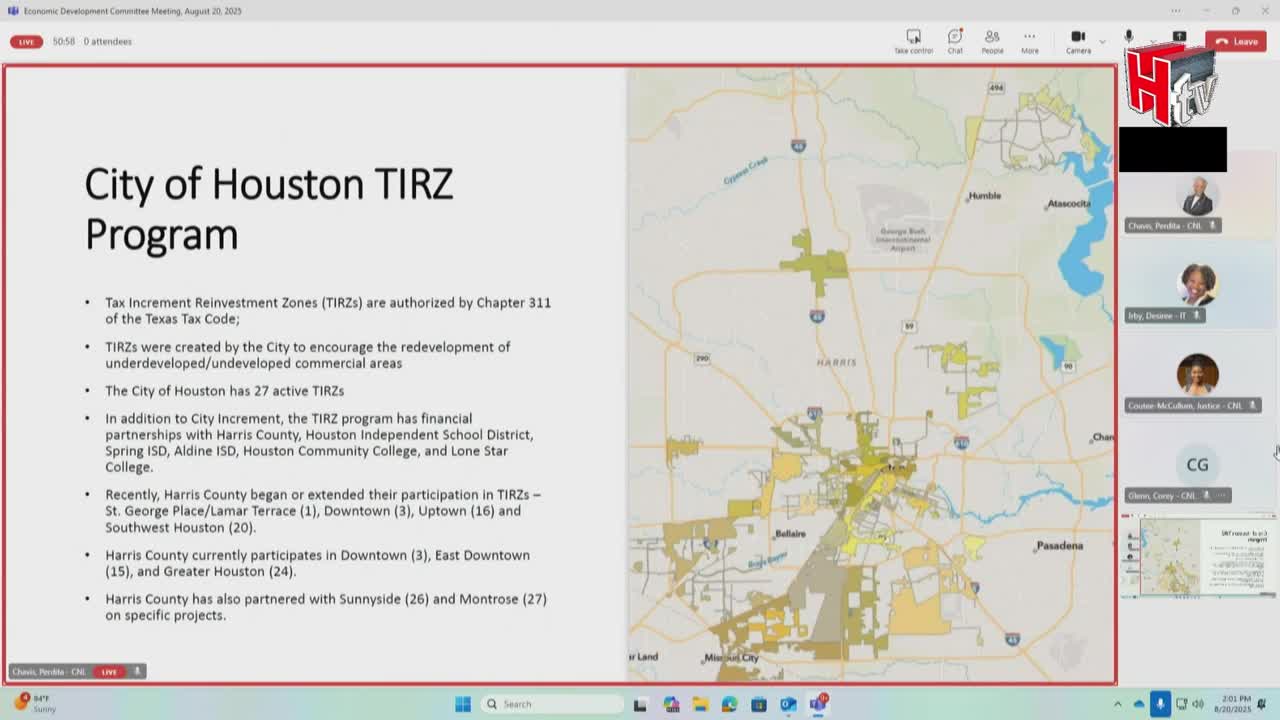
Curley told the committee: “Tax increment reinvestment zones are authorized by Chapter 311 of the Texas Tax Code.” She outlined the development process for TIRZ projects, which includes study and coordination with Houston Public Works, meetings with district council members and a multi‑step design-review (30%, 60%–90%, 100%) before bidding and construction, which she described as “typically… about a 2 year process.”
The TIRZ program, Curley said, comprises 28 zones created by the city (27 active) and has financial partnerships with Harris County, Houston Independent School District, Spring ISD, Aldine ISD, Houston Community College and Lone Star College. She said Harris County has recently begun participating in several zones and renewed an interlocal agreement with the Downtown TIRZ through 2043; that interlocal for downtown had an earlier term that ends Dec. 31, 2025.
Curley presented line‑item allocations in the FY2026 proposal: about $96,500,000 for street projects, $44,600,000 for flood remediation, $22,600,000 for pedestrian infrastructure, and roughly $21,000,000 for parks and green‑space projects. She said the five‑year total for all TIRZ projects in the plan is approximately $936,300,000.
Council members pressed Curley on several implementation issues. Council Member Castillo asked whether TIRZ dollars can pay for public facilities or affordable housing; Curley replied that those expenditures must be included in a zone’s project plan and that Chapter 311 requires a project plan and a reinvestment financing plan before a TIRZ may spend. “If a TIRZ does not have affordable housing in its project plan, it cannot contribute any dollars to affordable housing,” she said.
Council Member Flickinger asked about annexations and extensions; Curley said the program currently has a 25% cap on annexation (by value) and teams evaluate requests by whether the added taxable value is right‑of‑way or taxable property and by project priority. Curley said extensions lengthen the zone’s ability to capture increment over time and must be justified by planned projects over the extended term.
Council Member Martinez asked how often zones request additional bonding capacity for large projects. Curley said it varies by zone and project; she estimated “maybe 1 or 2 a year” requests across different zones and said economic development evaluates available capacity and requires a project list and financial-advisor analyses before granting additional bonding authority.
On streamlining, Curley acknowledged council concerns about long schedules where right‑of‑way acquisition or property purchases slow projects. “When you have to acquire that property for projects, it does take a—it's not unusual,” she said, adding the office is working with Houston Public Works and consultants to coach engineers and try to move projects faster where possible.
Council Member Alcorn asked whether Curley’s office was involved in an Ernst & Young review of TIRZ spending. Curley said she had not been directly involved but would follow up with the finance department; she noted the city auditor already publishes detailed spending reports in the TIRZ audit and said she would help secure any Ernst & Young updates the committee requests.
Public comment during the meeting included one resident who urged the committee to consider distributing TIRZ dollars more broadly across the city before proposing new fees or tax changes.
The committee did not record formal votes on TIRZ items during the meeting; Curley said the office will offer at‑large council members meetings this year (historically they met only with district council members) and will follow up on outstanding questions about audits and specific board compositions.