Get Full Government Meeting Transcripts, Videos, & Alerts Forever!
Get email alerts on the Public Media Funding topic
No spam. Unsubscribe anytime.
Houston councilman announces $50,000 contributions to Houston Public Media and KTSU
Summary
Councilman Edward Pollard said his office will present $50,000 checks to Houston Public Media and KTSU to help offset recent federal funding cuts to public broadcasting.
Councilman Edward Pollard announced that his office will contribute $50,000 each to Houston Public Media and KTSU FM 90.9 to help the stations weather recent federal funding reductions.
Pollard said the contributions are meant to “invest in education and democracy in our city” after what he described as a national reduction in federal support for public broadcasting. “This drastic cut is devastating for many public broadcast stations across the country, including right here in Houston,” Pollard said.
The payments are intended for each station’s resiliency fund, Pollard and station managers said. Jason Adams, general manager of Houston Public Media, said the station’s annual appropriation is about $2.2 million — roughly 10 percent of its budget — and that the resiliency fund will help bridge gaps caused by rescinded federal dollars. “Houston Public Media is here for the city of Houston,” Adams said, adding that the station provides news, weather alerts and other public-service programming.
Ernest Walker, general manager of KTSU, said the station — which broadcasts from Texas Southern University’s Third Ward campus and has operated for more than 50 years — relies on public dollars for a significant share of its budget. Pollard said KTSU’s federal funding accounts for roughly 20 to 25 percent of its annual budget; Walker estimated that the cut equates to about $200,000 to $250,000 a year for KTSU.
Pollard said his office reviewed eligibility with the city administration and underwent a legal review before the checks were approved. “My staff and I discussed this a few months ago,” Pollard said, describing the timeline from idea to approval as taking only a few months because of the review process. When asked how large the nationwide reduction in public-broadcasting funding was, Pollard cited reports that about $1.1 billion in federal funding had been cut.
Pollard framed the local payments as a targeted use of district funds to support local information needs. He noted the stations serve seniors, college students, commuters and residents who rely on public media for straightforward information and emergency alerts. Adams said the funds will go to the resiliency fund so the station can “still thrive” despite reduced federal support. Walker thanked Pollard and the city for the contribution and described it as support for KTSU’s mission to serve underserved communities.
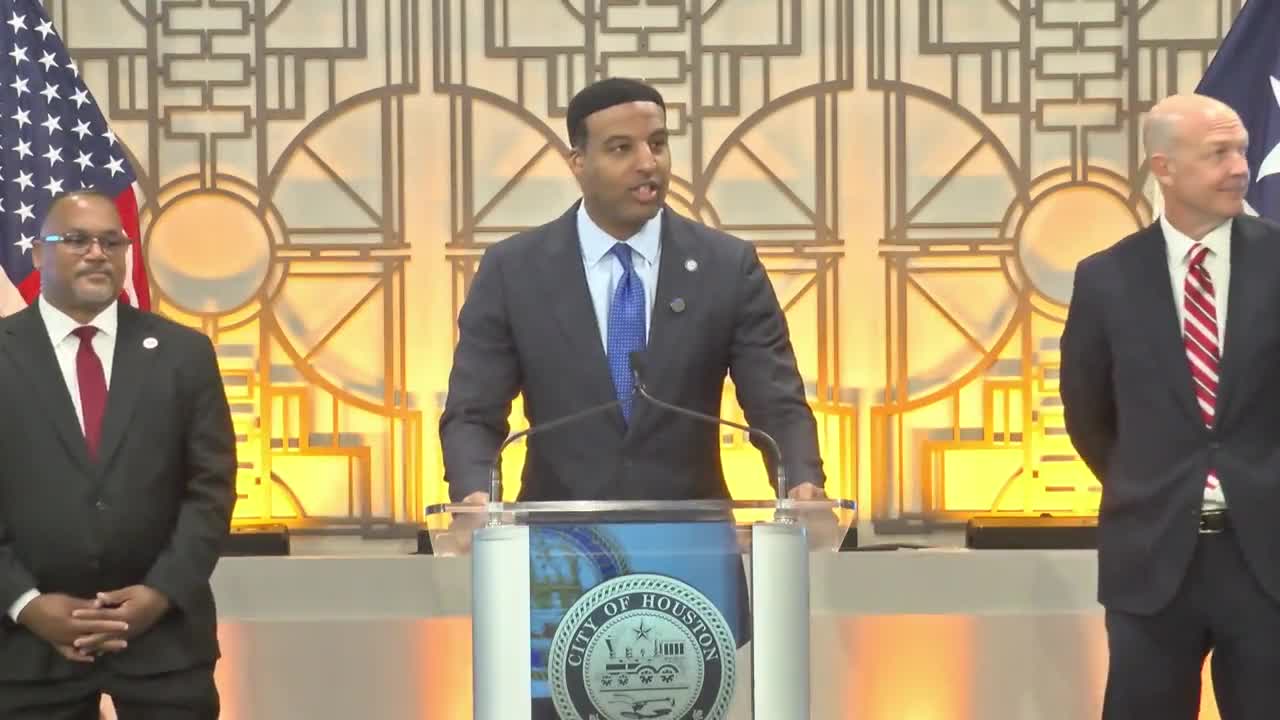
Pollard closed the remarks by encouraging others to support public media and then presented the checks in a brief ceremony with the stations’ managers.