Get Full Government Meeting Transcripts, Videos, & Alerts Forever!
Get email alerts on the Pavement Management topic
No spam. Unsubscribe anytime.
Inver Grove Heights budget presentation shows $19.1 million in pavement management revenue, $22.3 million in projected 2026 spending
Summary
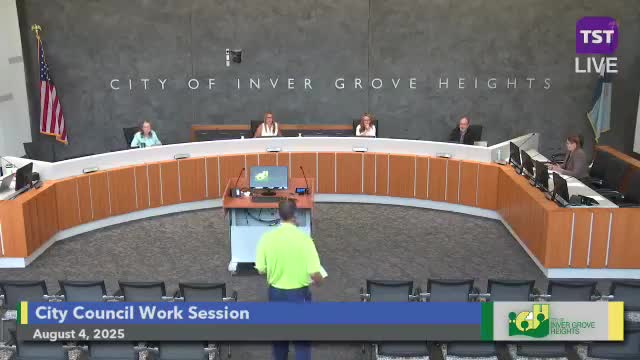
Public Works Director Brian Connolly told the City Council the pavement management program for 2026 will rely on dedicated levy dollars, special assessments and bond proceeds and will run a projected $3.1 million gap between revenues and proposed expenditures.
Public Works Director Brian Connolly told the Inver Grove Heights City Council that the city’s 2026 pavement management program expects about $19.1 million in total revenue and roughly $22.3 million in expenditures, leaving a projected shortfall of about $3.1 million.
Connolly said the fund’s recurring, city-dedicated revenue sources include the pavement management tax levy (just over $3 million), franchise fees (about $1.1 million), state aid for maintenance (about $550,000), Transportation Advancement Aid (about $100,000) and interest on past special assessments (about $380,000). “Our revenues for our fund basically comes from city dedicated funding as well as funding that’s external to the city,” Connolly said.
Project-specific funding will account for most 2026 receipts, Connolly said, with proposed special assessments of about $3.8 million, bond proceeds just under $5 million and state-aid construction funds for state-aid roadways in town. Utility-driven work accompanying pavement projects was listed at about $2.8 million, bringing project-specific funding to about $13.9 million.
Connolly said local pavement projects for 2026 total just over $21.5 million; other preventative maintenance activities such as broad-area patching, crack sealing, pavement rejuvenation and traffic-calming work are also paid through the program. He noted $57,500 of operating costs tied to software and professional services and just under $300,000 in principal and interest paid on debt for special assessments.
Council members asked for detail on operating-cost line items. Connolly said the pavement program pays licensing for project-management software (about $3,000) and contracts annually for pavement ratings that assess the condition of every street on a three-year cycle. Finance Director Amy Hov will present detailed financial modeling and bonding recommendations later this summer and into the fall, Connolly said.
The director highlighted program structure that affects assessments: full reconstruction projects are assessed at 35% of cost, reclamation at 55% and overlays at 80%. He said assessment caps and benefit analyses frequently reduce homeowner assessment amounts for high-cost reconstruction projects, requiring the pavement fund to subsidize the remainder. Assessment payback terms vary by project and value, commonly 10 or 15 years but sometimes 5 years for small assessments.
Connolly said the pavement management fund carried a June 2025 balance of about $19.6 million; council will see a finance model that recommends bonding levels and taps into fund balance as needed before the council must set its preliminary levy in September.
The presentation noted a limited set of partnership projects in 2026, including a county-led Seventieth Street right-of-way cost participation estimated at $450,000 (city share) and a MnDOT noise wall near Barber Avenue with a $210,000 city contribution to be paid from state-aid funds that flow directly to MnDOT.
Connolly and staff stressed that year-to-year revenue and expense totals will vary by mileage and project mix as the city seeks between roughly 6 and 7 miles of work annually. For 2026, the program includes nine separate project areas and is a higher-dollar year based on the scope of planned reconstruction work. Finance staff will return with refined bonding recommendations and cash-flow models.
The council did not take action on the pavement program at the meeting; Connolly said more detailed financial models will be presented later this summer and in the fall.