Get Full Government Meeting Transcripts, Videos, & Alerts Forever!
Get email alerts on the Committee Charter Oversight topic
No spam. Unsubscribe anytime.
Portland school committee refines charter to emphasize oversight, teacher voice and equity
Summary
Members of the Portland Public Schools Teaching, Learning and Enrollment Committee discussed a proposed committee charter on Aug. 14, 2025, focusing on clarifying the committee’s oversight role for curriculum, enrollment and boundaries, emphasizing educator voice and equity, and identifying monitoring duties for board goals and state reports.
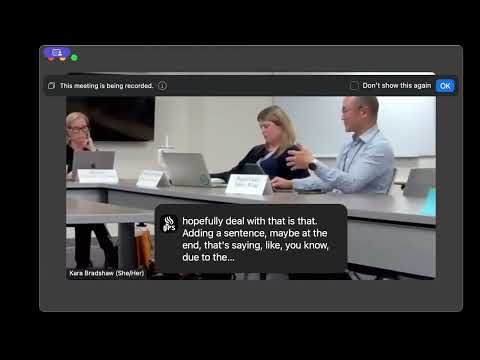
Michelle Chase Miller, director for Zone 4, opened the Teaching, Learning and Enrollment Committee meeting Aug. 14 by outlining the committee’s work and presenting a draft charter that would guide the committee’s role on curriculum, enrollment and school boundaries.
"The purpose of this committee is to guide, advise, and represent the purpose of the community's interests in curricular initiatives and school enrollment and boundary work with the outcomes of advancing the district's academic goals and improving outcomes for our students and ensuring access and opportunity for all of our kids," Miller said.
Committee members spent most of the hour discussing how the charter should describe the committee’s authority and typical duties and how it should surface educator voice and equity concerns before matters reach the full Board of Education. Members emphasized that the committee’s role should be active and deliberative, not merely a place to “rubber stamp” staff proposals.
"The word teaching is also in the committee title. And I feel like ... we just don't really mention anything related to teaching in the purpose or, like, incorporating educator voice," said Christie Splitz, a committee member who represents Zone 1. Splitz urged the charter to memorialize a role for educator perspective in the committee’s work.
Members and staff also discussed specific areas the committee should monitor or receive deeper briefings on, including curriculum adoptions and the state adoption cycle, Division 22 reporting to the Oregon Department of Education, enrollment trends and school boundary planning, high school course forecasting and access to advanced coursework, charter school oversight as required by statute, and special education programs and pilots such as neighborhood inclusion programs.
Christina Howard, senior chief of academics, explained how curriculum adoptions typically proceed and suggested the committee could host a "deep dive" on proposed curriculum adoptions and foreground teacher feedback during the review process. Howard noted the district aligns with the state curriculum adoption cycle and that deeper committee review could surface more teacher voice than is sometimes visible at the full board presentations.
The committee debated the verb used in the charter language: many members preferred stronger wording than simply "review." Members proposed language that would capture active oversight: reviewing, asking detailed questions, elevating teacher voice and providing recommendations to the full board before final action.
Committee members also asked staff how the committee could be used as a public forum for engagement on enrollment and boundary planning so that draft proposals and outreach strategies could be vetted with the public and board members before the board approves final maps. Staff said work on dual-assignment and related catchment discussions is under development and should appear for committee consideration in the fall.
Several members asked that the charter explicitly incorporate monitoring responsibilities tied to board-adopted goals (including postsecondary readiness and pathway offerings), and that the committee serve as a venue for periodic updates on the district’s strategic continuous improvement plan, workforce development and professional learning, and any education-related grants the district uses to reach board goals.
Members agreed the charter should remain a “living document” that can be amended as priorities and urgent issues arise, and that the committee would not vote on the charter at the Aug. 14 meeting but would refine language and return the charter for adoption through the regular board process.
The meeting closed the charter discussion by asking staff and the committee’s legal liaison to draft revised language reflecting the group’s suggested edits and to return a clean copy for the board packet.
The committee is scheduled to meet again Sept. 18, 2025; staff indicated several items discussed would be scheduled for deeper review in coming months, including Division 22 reporting and enrollment/boundary work.