Get Full Government Meeting Transcripts, Videos, & Alerts Forever!
Get email alerts on the Sewer Infrastructure topic
No spam. Unsubscribe anytime.
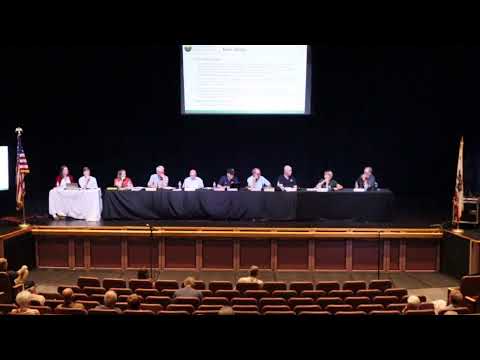
Paradise council adopts hybrid sewer plan, directs staff to pursue funding reallocation
Summary
The Paradise Town Council voted unanimously to advance a locally scaled sewer project that combines gravity mains and septic-tank-effluent pump (STEP) connections, with aerated lagoons and land discharge ponds, and directed staff to begin environmental review and seek reallocation of CDBG-DR funds to cover a funding shortfall.
The Paradise Town Council adopted Resolution No. 202567 on Tuesday, approving a locally scaled sewer plan that uses a hybrid gravity/STEP collection system, aerated lagoon treatment and land-discharge percolation and evaporation ponds, and directed staff to begin the subsequent programmatic environmental impact report and to pursue a reallocation of Community Development Block Grant – Disaster Recovery (CDBG‑DR) funds to cover a remaining capital shortfall.
The move, passed by a 5-0 roll call during agenda item 2a, implements the recommendation of a five‑member ad hoc committee and follows months of public meetings and outreach. Mark Maddox, the town’s public works director and town engineer, presented the proposal and told the council, "this is the most affordable, basic, reliable alternative available to us." He said the plan was unanimously recommended by the ad hoc committee that included council members and representatives from the Paradise Irrigation District and consulting staff.
Why it matters: council and staff said the locally focused option narrows the project scope in order to deliver a constructible solution before one-time recovery funds expire. Maddox said the town has secured about $84,800,000 toward the project and is estimating total phase‑1 costs at $114,000,000, leaving a roughly $30,000,000 shortfall. Council direction authorizes staff to seek to shift $36,700,000 of CDBG‑DR infrastructure funding from other locally funded recovery projects to close that gap and to coordinate with state and federal funding partners on feasibility.
Key elements and timeline
- Collection: The recommended system is a hybrid of gravity trunk mains for higher‑elevation streets (Skyway, Clark and Pearson were cited) and STEP or STEG (septic tank effluent pump / septic tank effluent gravity) connections for low‑lying parcels. Maddox said the hybrid lets trunk mains be installed at shallower depths and reduces the need for large central lift stations in the initial service area.
- Treatment and dispersal: The town recommends aerated lagoon treatment with land discharge to percolation/evaporation ponds. Maddox estimated a startup facility footprint for the initial permit as about 5 acres, with up to 17 acres the team estimates for full buildout of the first phase (0.1 MGD, or 100,000 gallons per day).
- Funding: Maddox listed secured funds the town is counting on: $30,000,000 for design from state Housing and Community Development (HCD) allocations; $35,000,000 budgeted in the town’s CDBG‑DR allocation toward sewer projects; a $1,750,000 EPA community grant; and a verbal state Water Board SRF commitment of $28,000,000. He also said the U.S. Army Corps Section 219 program has $50,000,000 authorized for the project but not yet appropriated. Maddox said the town aims to fund capital primarily with grants and minimize loan or assessment burdens on property owners.
- Operations and rates: The council previously set aside a town subsidy concept to limit rates. Maddox said the town would establish an operations assistance program that the council previously scoped at an upfront operating reserve of $1,200,000 and annual assistance of $526,000 for the first 10 years (a $6,460,000 total commitment was cited) to keep early user rates closer to market levels while the customer base grows.
- Schedule: Maddox said a subsequent programmatic EIR could take 6–12 months, right‑of‑way and land acquisition 12–18 months (some work can occur in parallel), and construction roughly two years, with a target to start construction in 2027 and complete in 2029 if direction and funding proceed as planned.
Public input and interagency comments
Speakers at the public comment portion raised technical and policy questions about STEP vs. gravity, treatment site selection, mosquito control, beneficial reuse ("purple pipe" recycled water), and costs passed to individual property owners. Several commenters urged the council to include smaller‑diameter gravity (STEG) and effluent‑only alternatives in the EIR so those options receive formal analysis.
Mark Sulick, a Paradise Irrigation District (PID) board member who served on the ad hoc committee, said PID supports the town’s recommendation and described three priorities the district pressed for: affordability, expandability and permitability. "It needs to be affordable," Sulick said, and added the committee valued visiting operating facilities to learn operator perspectives.
Clint Snyder, assistant executive officer for the Central Valley Water Board, told the council the board "permits thousands" of facilities like the proposed aerated lagoon/land‑discharge plants and that the board finds the simple, proven approach easy to permit and operate.
Mosquito control and public health concerns were raised repeatedly. Matt Ball, district manager for the Butte County Mosquito and Vector Control District, urged early coordination with his agency on pond design and operation to reduce mosquito breeding and long‑term vector control costs.
Council action and direction
The council voted to adopt Resolution No. 202567 (agenda item 2a), which: (1) selects the ad hoc committee’s Alternative 1 (hybrid gravity/STEP collection, aerated lagoon treatment and land discharge ponds) as the recommended path; (2) directs staff to immediately commence and resume the environmental review and design activities required to advance a constructible project; and (3) directs staff to pursue formal revisions to the town’s CDBG‑DR infrastructure allocation plan to provide additional funding to the sewer project and to coordinate with impacted funding agencies. Council member Lang moved the resolution; council member LaSalle seconded. The roll call recorded aye votes and the motion passed.
Votes at a glance
- Resolution No. 202567 (Agenda Item 2a): Approve ad hoc recommendation (Alternative 1: hybrid collection, aerated lagoon treatment, land discharge ponds) and direct staff to advance EIR and funding reallocation. Motion by Council member Lang; second by Council member LaSalle. Recorded voice vote: unanimous (5–0). Outcome: approved.
What remains unsettled
Maddox and commenters emphasized that site selection for the treatment/disposal facilities has not been decided; it will be evaluated as part of the subsequent programmatic EIR and will include public review of location alternatives. The council also did not decide final rate structure, connection requirements or specific contract awards for construction; staff will return with more detailed contract and funding actions and environmental documents for future council decisions.
The council’s direction to staff to pursue reallocation of $36.7 million in CDBG‑DR funds to the sewer project also raises timing and risk questions: staff must work with the California Transportation Commission and other fund administrators to avoid de‑obligating awarded funds for other local projects, such as the Railroad/Oliver Curve phases, or to retool existing awards if possible.
The council’s vote moves Paradise into the design and environmental phase for a locally permitted wastewater option. That direction begins a sequence of technical, fiscal and permitting steps — and additional council decisions — before construction can begin.