Get Full Government Meeting Transcripts, Videos, & Alerts Forever!
Get email alerts on the Tourism Study Committee topic
No spam. Unsubscribe anytime.
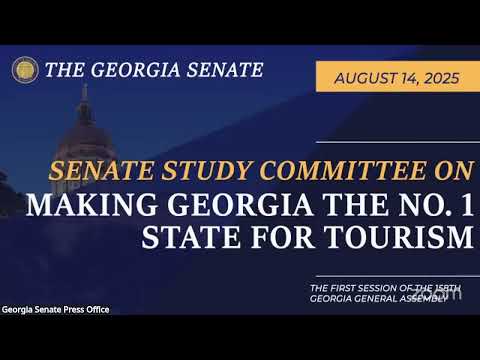
Senate tourism study committee holds inaugural meeting in Gainesville; industry urges more state support
Summary
The Georgia Senate's newly formed study committee on tourism held its first listening session in Gainesville, where industry leaders and local officials highlighted public'private partnerships, requested targeted tax incentives and infrastructure investment, and pressed for better data on how state and local dollars are spent.
The Georgia Senate's study committee on tourism opened its first public session in Gainesville on Oct. 25, convening state lawmakers, local officials and tourism industry leaders to discuss ways to grow and coordinate travel promotion across the state.
Sen. Drew Echols, chairman of the study committee created by Senate Resolution 323, told attendees the panel will seek practical, incremental ideas rather than a single large bill: "We don't have to leave here in November and pass a huge, big, beautiful tourism bill," Echols said, describing the committee's charge as identifying "small nuggets" that can improve marketing, product development and workforce training.
Why it matters: Tourism in Georgia is a major economic sector that committee speakers said supports hundreds of thousands of jobs and generates billions in spending and tax revenue. Industry representatives pressed the panel for clearer, faster tools to support projects'from tax incentives to coordinated marketing'and for continued local control of how tourism dollars are spent.
Presentations and industry requests
Matthew Bowling, who runs Lake Lanier Islands Resort with his family, framed his presentation as a case study of a long-standing public'private partnership. He traced the property's history from state park to privatized resort and highlighted the role of the Lake Lanier Islands Development Authority (LIDA) in stabilizing shoreline, upgrading wastewater and road infrastructure, and approving private capital projects. Bowling said the resort attracts more than 1,000,000 visitors annually and estimated an annual economic impact of about $113,000,000 linked to resort operations.
Stacy Dixon of the Lake Lanier Convention & Visitors Bureau urged the committee to restore a product-development program within the Georgia Department of Economic Development, saying the state's earlier product-development grants helped communities plan museums, downtown revitalization and other attractions. "Our industry is at a very fragile crossroads," Dixon said. "We have suffered through a fever dream the last 5 years." She also asked the committee to study short-term rental compliance and suggested Hall County's ordinance regime as a model for other jurisdictions.
Jay Mark Walter, director of tourism at the Georgia Department of Economic Development (known publicly as Explore Georgia), provided statewide data and described current marketing efforts. Walter said Explore Georgia's total tourism division budget is $11.8 million, with roughly $5.3 million allocated to marketing. He reported the 2023 statewide tourism numbers showing nearly $80 billion in total economic impact, roughly 463,000 jobs supported statewide and about $5 billion in state and local sales and use tax collected from visitor spending. Walter highlighted the Ready, Set, Georgia branding campaign and described plans to promote the state as a "home base" for international visitors during the 2026 FIFA World Cup.
Developer perspective and tax incentives
Developer Jeff Payne, who has redeveloped historic downtown properties in Gainesville and proposed hotel projects in Athens and at Lake Lanier, urged legislative attention to the practical barriers developers face. Payne reviewed local and state incentive tools such as tax allocation districts (TADs), payment-in-lieu-of-tax (PILOT) agreements, empowerment zone provisions, state job tax credits and federal Opportunity Zones. He described how federal and state historic rehabilitation tax credits (federal 20%; Georgia state credit currently capped) and the state's tourism tax credit program can be essential to making projects financially feasible. Payne recommended better education and technical assistance for smaller communities and proposed removing the annual cap on Georgia historic tax credits to accelerate projects.
Research and comparisons across the region
Tyler Rineagle, director of research and policy for the Council of State Governments Southern Region, told the committee that tourism is a high-return investment in the region: research suggests every dollar invested in tourism generates materially larger amounts in spending and tax revenue at the local level. Rineagle also summarized regional funding models: most Southern states organize tourism under economic development departments, while a few use stand-alone tourism agencies or public'private destination marketing organizations. He highlighted vulnerabilities, including the severe fiscal shock during the COVID-19 pandemic and sensitivity to economic cycles, and noted that Georgia's state-level tourism appropriations rank relatively low compared with some peers when measured solely at the state level (not including local bed taxes or park budgets).
Questions and follow-up requests
Committee members repeatedly asked for comparative metrics: how Georgia's state-level tourism funding and effective tax rates on overnight stays compare with neighboring states, and how much of tourism dollars benefit rural counties versus metro areas. Walter said Explore Georgia and his team can supply county- and region-level impact reports and that some commonly cited metrics come from national sources such as the U.S. Travel Association. Senators also asked staff to compile an aggregate picture that combines state marketing dollars with the local hotel/motel excise taxes collected by counties and cities.
No formal committee votes or legislative actions were taken at the meeting. Committee members set the next meeting for the week of the governor's tourism conference in September in Savannah and asked staff to return with more detailed comparative data on funding and per-capita measures.
What attendees said
- "We want leaders that lift us as they climb," Stacy Dixon told senators, urging a collaborative approach that restores product-development support.
- Matthew Bowling described Lanier Islands as "a front porch for North Georgia tourism," emphasizing the site's mix of lodging, attractions and event business and urging continued state support for infrastructure and partnership with LIDA.
- Jay Mark Walter summarized the state's strategy: "We are the sales and marketing arm for the state of Georgia," and said Explore Georgia will continue to build campaigns, research tools and sports-event recruitment to drive visitation.
Looking ahead
The committee's work will continue as a listening and fact-finding tour. Senators asked Explore Georgia and staff to provide comparative state-by-state funding and marketing data, county-level economic-impact detail and a clearer accounting of how local hotel-motel excise taxes are being used across Georgia. Lawmakers indicated interest in legislative options ranging from expanded technical assistance for localities to adjustments in tax-credit programs and targeted incentives for product development and convention infrastructure.
Ending note
Committee Chairman Drew Echols thanked Hall County and local hosts and closed the meeting after a scheduled break; no legislative votes were taken. The committee's next meeting is expected to include additional industry testimony, a deeper review of county-level data, and a session timed to the Governor's Conference on Tourism in Savannah.