Get Full Government Meeting Transcripts, Videos, & Alerts Forever!
Get email alerts on the Udc Amendments topic
No spam. Unsubscribe anytime.
Planning Commission briefed on 2025 UDC amendments to reflect new Texas laws; effective date Sept. 1
Summary
Development Services staff briefed the Planning Commission on proposed UDC amendments prompted by several 2025 Texas laws and said the package will proceed to the zoning commission on Sept. 2 and city council on Sept. 4, with the state statutes taking effect Sept. 1.
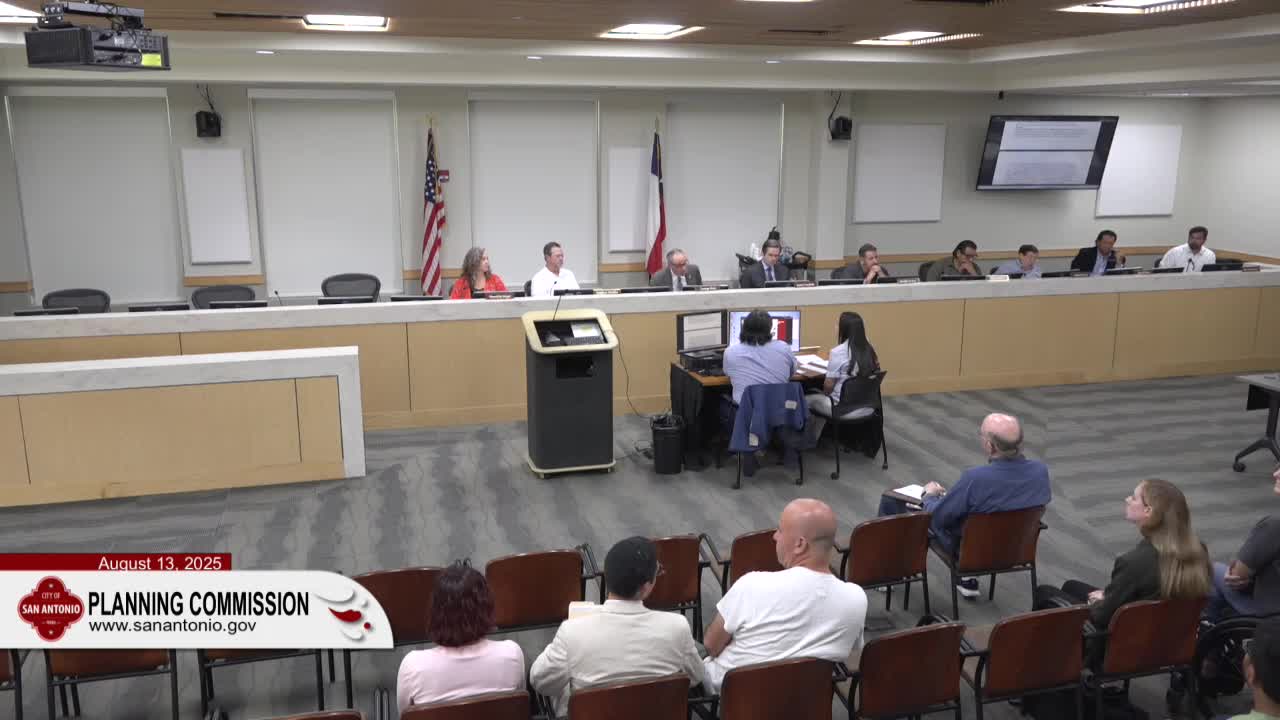
On Aug. 13, 2025, Development Services staff briefed the San Antonio Planning Commission on a suite of Unified Development Code (UDC) amendments intended to implement changes passed by the 89th Texas Legislature. Staff said the amendments respond to several state bills and will be processed through the city’s standard UDC amendment procedure, with a zoning commission briefing and action scheduled for Sept. 2 and a city council hearing scheduled for Sept. 4. The statutes discussed take effect Sept. 1, 2025, staff said.
Development Services staff (presenter identified in the record as Logan) said the 2025 UDC amendment program is intended solely to align local code with state mandates from the legislative session. The presentation summarized multiple bills that would require changes to local practice and the code, including provisions that affect permitting, notice and signage, use regulations, allowable densities and utility requirements.
Key points presented by staff:
- County-owned facilities and third-party certification: Staff summarized House Bill 3234 (as presented) as exempting Bexar County from the city’s building-permit requirement for county-owned facilities; work on those facilities must still meet city building codes and must be certified by a licensed engineer or architect. Staff said the city’s long-standing interlocal agreements with Bexar County and involvement of the county fire marshal mean they do not anticipate a wholesale change to established processes, though the UDC applicability section will require amendment. Staff also said the city may request copies of certification letters from the design professional but the statute does not create a city inspection right in lieu of the third-party certification.
- Rezoning notice and signage (House Bill 24 as presented): The law increases the required size of rezoning signs from 2 by 3 feet to 2 by 4 feet, clarifies where signs may be placed for owner-initiated versus city-initiated large-area rezonings, and clarifies that the city is not required to mail notice to every property owner when the UDC is comprehensively amended. Staff also explained a change to the protest threshold language affecting whether city council must approve rezoning over a protest by supermajority; the law’s wording is complex but staff said it generally lowers barriers for rezonings that increase housing units.
- Home-occupation changes (House Bill 2464 as presented): Staff said the state bill removes the ability to prohibit on-site employees for certain home occupations; however, local governments retain authority to regulate on-site parking, noise, and compatibility with neighborhood character. Staff noted the law makes parking generated by a home occupation a local-enforceable limit (on-street parking is not allowed for such activities).
- Small-lot development and height (discussed as part of SB 15 / state small-lot provision): Staff described a state provision that limits a municipality’s ability to require minimum lot sizes greater than 3,000 square feet on unplatted parcels zoned single-family; it also establishes “small-lot” flexible standards (e.g., maximum front setback of 15 feet, rear setback of 10 feet) and permits up to three full stories (superseding local “half-story” definitions). Staff emphasized exceptions, including restrictions within 3,000 feet of a military base or an airport and other proximity limits tied to clear zones.
- Multifamily/mixed-use by-right and conversion rules (Senate Bill 840 as presented): For tracts zoned commercial, office, light industrial, or similar special districts, staff said the law requires municipalities to allow multifamily development at the greater of 36 units per acre or the highest multifamily density offered by the city (locally up to 65 units per acre). The law also allows conversion of existing buildings (occupied for at least five years) into multifamily or mixed-use without requiring a traffic-impact analysis, off-site construction improvements, utility upsizing beyond the needs of the project, or compliance with design standards except in historic or culturally significant areas. Staff noted further limitations, including prohibitions near heavy industrial uses and airports/military bases.
Staff described implementation steps and outreach: briefing the zoning commission Sept. 2 and taking the package to city council Sept. 4, with the intent to be ready on the statutes’ effective date of Sept. 1. Staff said they had already met with SAWS (San Antonio Water System) and other utilities to discuss how the prohibition on required utility upsizing applies and that those agencies are aware of the changes.
Commissioners asked multiple technical and implementation questions. Questions and staff responses included:
- On county exemptions and oversight, Commissioner (name recorded as) Arass asked what oversight remained if the city does not issue permits; staff replied the bill relies on the certification of a registered design professional and the city’s recourse is limited to requesting inspection notes and documentation, though the city’s existing interlocal agreements may preserve some local review in practice.
- Commissioners asked whether the small-lot provisions would affect established central-city neighborhoods; staff said the provisions are most likely to apply to greenfield or larger undeveloped tracts (five acres, unplatted, single-family zoned) and likely would have limited impact in well-established neighborhoods near downtown.
- Commissioners asked about coordination with SAWS on utility upsizing; staff said SAWS staff had been briefed and involved in prior presentations.
Staff and commissioners noted other open questions that may require additional legal review, including how the county exemption applies to projects with complex ownership or ground-lease arrangements and how accessibility/registered-specialist reviews are handled under the new law.
No formal action or vote was required or taken at the meeting on the UDC amendments; the presentation served as a briefing. Staff indicated the formal amendment package will proceed through the zoning commission and city council in early September.