Get Full Government Meeting Transcripts, Videos, & Alerts Forever!
Get email alerts on the Surveillance And Privacy topic
No spam. Unsubscribe anytime.
Residents urge Hays County to reject expansion of Flock automated license-plate readers
Summary
Dozens of residents told the Hays County Commissioners Court that Flock Safetyautomated license-plate readers (ALPRs) create mass surveillance, threaten privacy and target marginalized communities; speakers urged the court to cancel contracts and reallocate funds to social services and a public defender program.
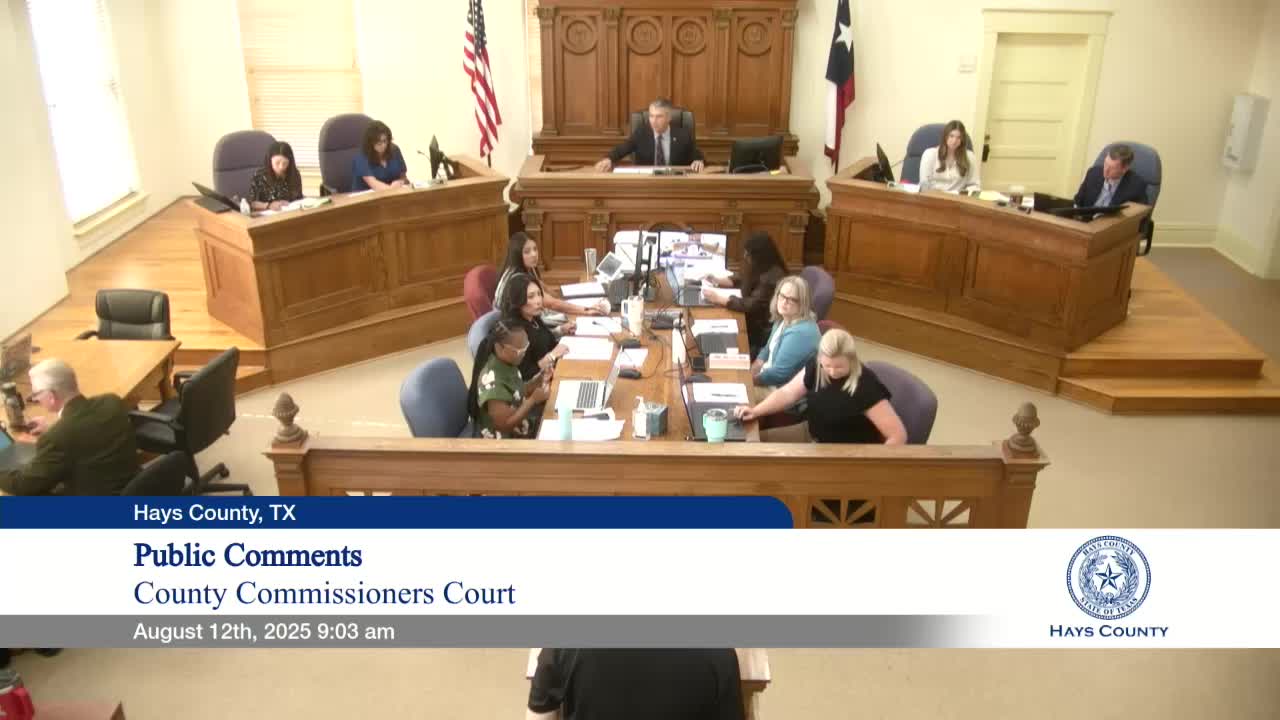
Scores of residents and community organizers addressed the Hays County Commissioners Court on Aug. 12, urging the court to halt the county's use and proposed expansion of Flock Safety automated license-plate readers and other automated license-plate reader (ALPR) systems.
Speakers said the cameras collect sensitive travel data on all motorists, make that data available to private companies and law enforcement agencies, and create opportunities for misuse and civil-rights violations. "The use of Flock cameras constitutes a civil liberties violation on multiple fronts," said Nathan Pino, a Texas State University criminologist and Hays County resident. "Data are stored for at least 30 days, which allows access to any entity, public or private, that Hays County allows," he said.
Other speakers described personal experiences they said illustrated the technology's risks. Miles Martin, a social-media organizer with Mano Amiga Action, described a 2019 arrest he said began after an officer used a vehicle description to identify him and urged the court not to let ALPRs expand that kind of surveillance. "Systems like these just as easily create the very criminals that are being removed through false suspicion, wrongful arrest and sometimes racial profiling," Martin said. Cyrus Gray, a reentry adviser with Mano Amiga, said the cameras do not address root causes of crime and urged commissioners to invest in housing, mental health and workforce development instead.
Several speakers linked the ALPR debate to the county's budget choices, urging commissioners to fund the public defender's office and eviction-defense programs rather than surveillance equipment. Eric Martinez of Mad Omega emphasized legal and data-ownership concerns and recommended fully funding the public defender's office request for $9 million.
Court members responded that several ALPR and Flock agenda items were being tabled to allow community engagement: Judge Becerra and Commissioner Smith told the public the court would allow another week for community input and that related items would return to the agenda next week for formal action. The court did not vote on any contract changes for ALPRs during the meeting.
Ending: Commissioners and staff repeatedly told speakers their comments were being recorded and would be added to the record when the agenda items return. The court's decision on any contract or expansion of ALPR systems was deferred to a later meeting to allow continued public input and to coordinate with scheduled public forums.