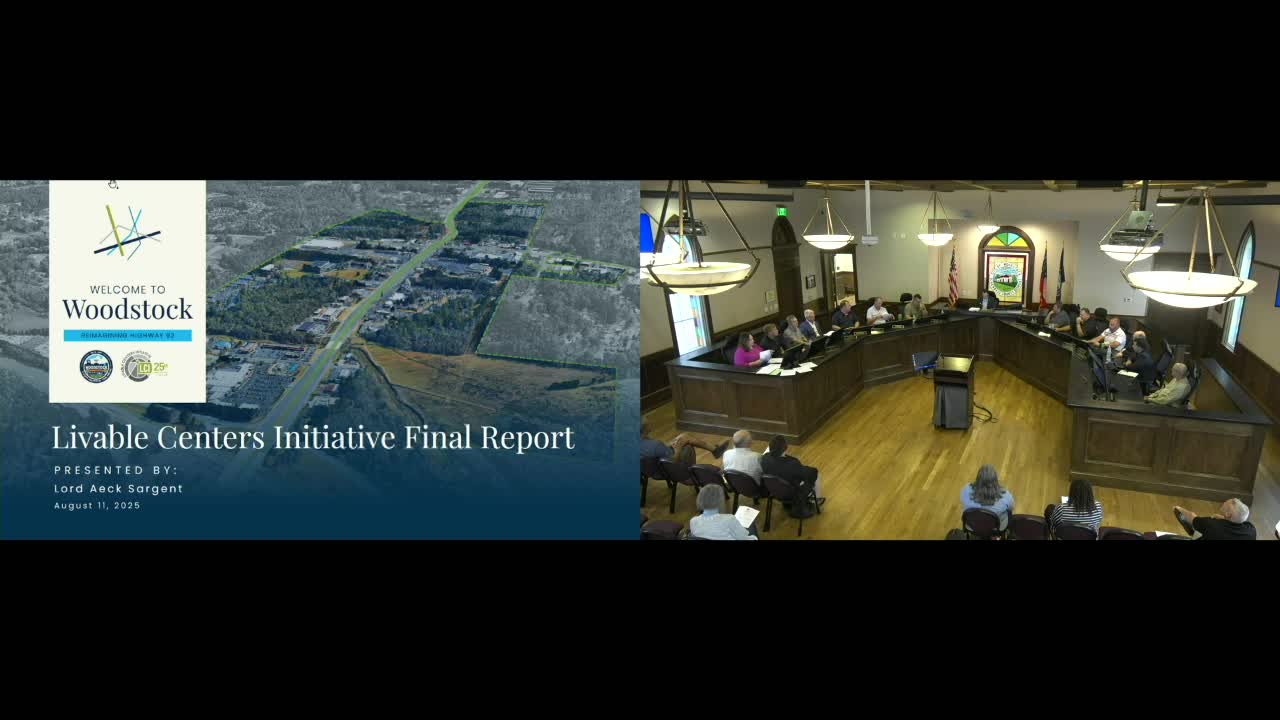
City and Planning Commission review Highway 92 design standards LCI; consultants propose flexible "plan development" approach
Loading...
Summary
Consultants presented a draft Highway 92 design standards package, developed through the Atlanta Regional Commission’s Livable Centers Initiative, recommending an opt‑in plan development process and eight visual design themes intended to guide redevelopment along the corridor.
Consultants presented a draft Highway 92 design standards package, developed through the Atlanta Regional Commission’s (ARC) Livable Centers Initiative (LCI), at the joint August 11 meeting of the Woodstock City Council and Planning Commission. The presentation described a 12–16 month study of the corridor and recommended a new “plan development” (similar to a planned unit development) process that would let property owners opt in with a master plan that responds to a set of visual design themes rather than strict, metric‑only standards.
The presentation was led by Bob Beagle of Lourdesk Sargent and project manager Quinn Pham; Deputy City Manager Cody Thigpen and project partners including KB Advisory and Content Consulting also participated. Beagle said the study area extends roughly 1,000–1,500 feet on either side of Highway 92 and that the team examined zoning, land values, storefront occupancy, demographic context and seven hypothetical redevelopment scenarios to test viability. Economic analysis by KB Advisory showed redevelopment generally requires substantially greater returns to be feasible — described in the report as a “rule of 3” (developers typically seeking roughly three times the value on redeveloped property to justify taking existing income offline).
The consultants said the corridor today is a functioning commercial area with relatively low vacancy and stable rents, and therefore redevelopment incentives and a more permissive base density may be needed to spur housing and mixed‑use projects. Rather than imposing precise numeric rules for every parcel, the draft recommends eight design themes — connectivity, walkability, pedestrian‑oriented streets, open space and placemaking, streetscaping, building orientation, building massing and parking — with about 66 subcomponents presented visually in the report.
Under the recommended process, applicants would first attend a pre‑submittal design conference with staff to align expectations. Applicants would then submit conceptual materials keyed to the design themes and a compliance checklist showing where the plan complies, partially complies or does not comply. Staff would review and the parties would iterate before a formal application and the standard public review process. The consultants recommended giving staff limited administrative flexibility (for example, allowing de‑minimis changes up to a defined percentage without returning to public hearings) and testing the approach on a pilot project to refine implementation.
Council and planning commissioners raised implementation questions. Councilmember Aick and others asked how to strike a balance between enough specificity to get predictable public outcomes and enough flexibility to encourage development. Commissioners and staff discussed whether base densities should be increased and whether the city should reduce the 5‑acre redevelopment minimum (the consultants suggested lowering it to about 2 acres to allow more creative, smaller scale redevelopment). The consultants also cautioned about drafting rules so permissive they become “open‑ended” for developers or so prescriptive they deter applicants.
Public comment: one resident asked whether the plan would produce attainable, mixed‑income housing, raise traffic and congestion, and whether “inclusive zoning” or public land trusts were part of the approach. The resident urged the council and commission to address affordable housing rather than producing development primarily for higher‑income households. The consultant and council stressed this presentation was informational (no vote was taken) and that the report is intended to inform code changes and future ordinance drafting with further public input.
Next steps and context: staff and the consultant said the LCI report is a plan document to guide code changes rather than the code itself; adoption will require follow‑up code drafting, legal review and public hearings. Staff highlighted that ARC provided a major share of the project funding and Renata from ARC attended the meeting. Councilmembers asked staff to prepare implementation language and to consider pilot projects before broad adoption. The consultant recommended monitoring early uses of the plan development approach and adjusting language if too many one‑off exceptions are requested.
Ending note: the presentation materials and final LCI report will be posted publicly; staff said additional public review and ordinance drafting will follow and invited public input as the city moves from plan to code.