Get Full Government Meeting Transcripts, Videos, & Alerts Forever!
Get email alerts on the County Budget topic
No spam. Unsubscribe anytime.
Alachua County reviews draft 2026 budget, millage and surtax outlook; commission approves agenda and a consent change order
Summary
At a special Aug. 5 meeting, Alachua County staff presented the manager’s recommended budget ($944 million), reviewed millage, assessments and surtax-funded projects (including a projected $30 million animal shelter debt), and the board approved procedural items including adoption of the meeting agenda and a contract change order on consent.
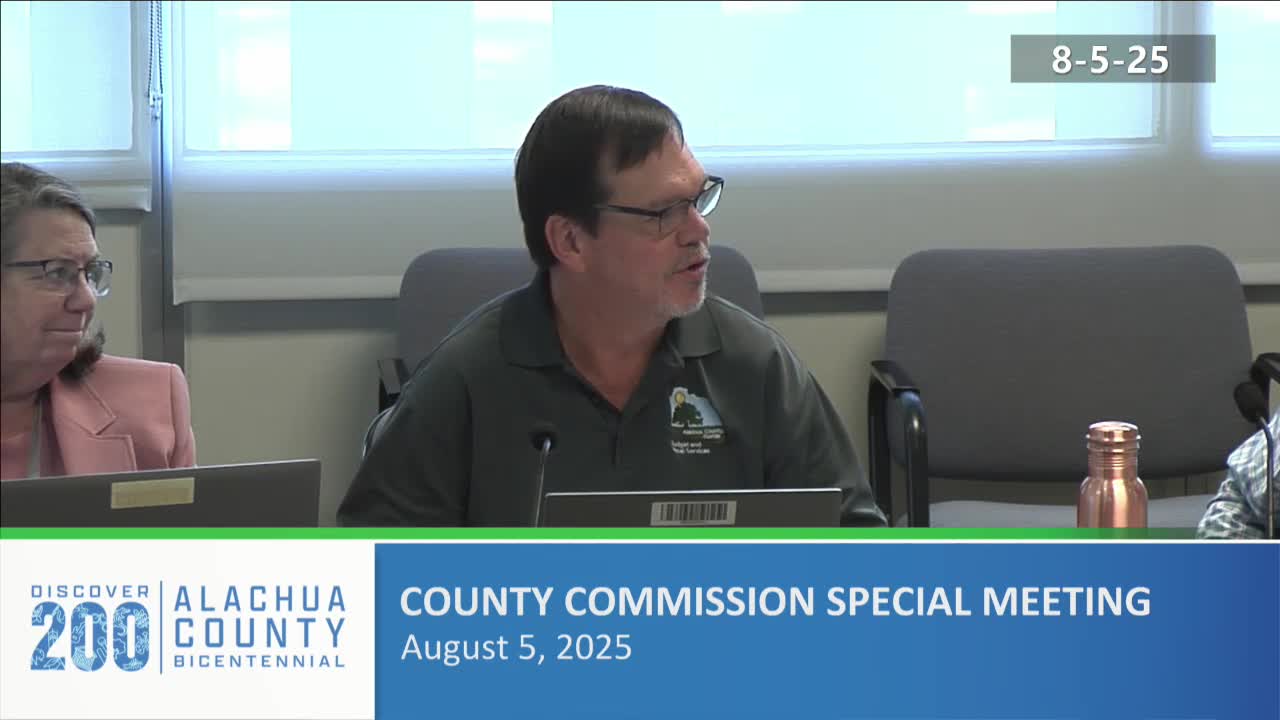
Alachua County staff presented a draft county manager budget and a series of tax and assessment updates at a special budget meeting on Aug. 5, outlining key assumptions for the coming fiscal year and flagging potential impacts from state-level tax changes.
County Manager Tommy said the recommended budget reflects a slightly reduced general‑fund millage and continued funding from the county’s 1 percent surtax. “The recommended millage has a reduction of 0.018 mills in the general fund,” Tommy told commissioners, and the manager’s recommended total county budget stood at $944,000,000. Staff reported a 6.85 percent increase in taxable value compared with the prior adopted budget — about $13.3 million in additional valuation — and the Municipal Service Taxing Unit (MSTU) for law enforcement would remain at 3.5678 mills.
Staff outlined the county’s revenue picture: $285 million in property taxes, $99 million in charges for services (largest item ambulance billing), $61 million in intergovernmental revenue largely from surtax allocations, and a $433 million draw from other sources including fund balance and debt proceeds. Capital outlays were higher than past years due to planned surtax projects and other capital programs. Staff also noted planned debt issuances to fund the courthouse and an anticipated roughly $30 million debt for a new animal-services facility, plus about $3 million already budgeted for planning and design work.
Staff briefed commissioners on several assessment changes: the county rebalanced fire assessments (Tier 1 increased from about $90.69 to $132.47; Tier 2 decreased), kept the stormwater assessment at $60, and maintained the tipping fee rate at $65 per ton. The presentation emphasized the use of surtax proceeds for major capital projects and noted an estimated adverse impact from a recently passed state bill reducing taxes on commercial leases; staff estimated the county could lose roughly $1.5–$2.0 million a year in surtax receipts over the remaining surtax term, with the precise figure pending Department of Revenue calculations.
Commissioners asked for follow-up information on a range of items including performance measures (staff said final performance measures will be provided with the September final budget), details on the proposed animal shelter financing and planning schedule, and how digital evidence and camera systems for enforcement personnel would be managed if enforcement transfers to the sheriff’s office. Staff said they were coordinating with the sheriff’s office on camera records retention and that the sheriff has existing capacity to store digital evidence.
The board handled two procedural actions during the meeting: adoption of the meeting agenda at the start of the session and a consent‑agenda change order later in the meeting. Both motions passed by voice vote; the consent change order was approved so staff could proceed with the work identified in the change order. The meeting also set the proposed and final budget hearing dates: the first public hearing is scheduled for Thursday, Sept. 11, at 5:01 p.m., and the final hearing is set for Tuesday, Sept. 23.
Ending Staff will continue budget work through August, return with final performance measures and updated packets in September, and bring proposed interlocal agreements or contract language back to the board where applicable (notably for the animal-enforcement proposal). Commissioners requested written follow-ups about projected impacts of state tax changes, animal shelter cost estimates and staffing details for planned programs.