Get Full Government Meeting Transcripts, Videos, & Alerts Forever!
Get email alerts on the Animal Enforcement Transfer topic
No spam. Unsubscribe anytime.
Alachua County commissioners direct staff to explore shifting animal enforcement to sheriff’s office; vote 4-1
Summary
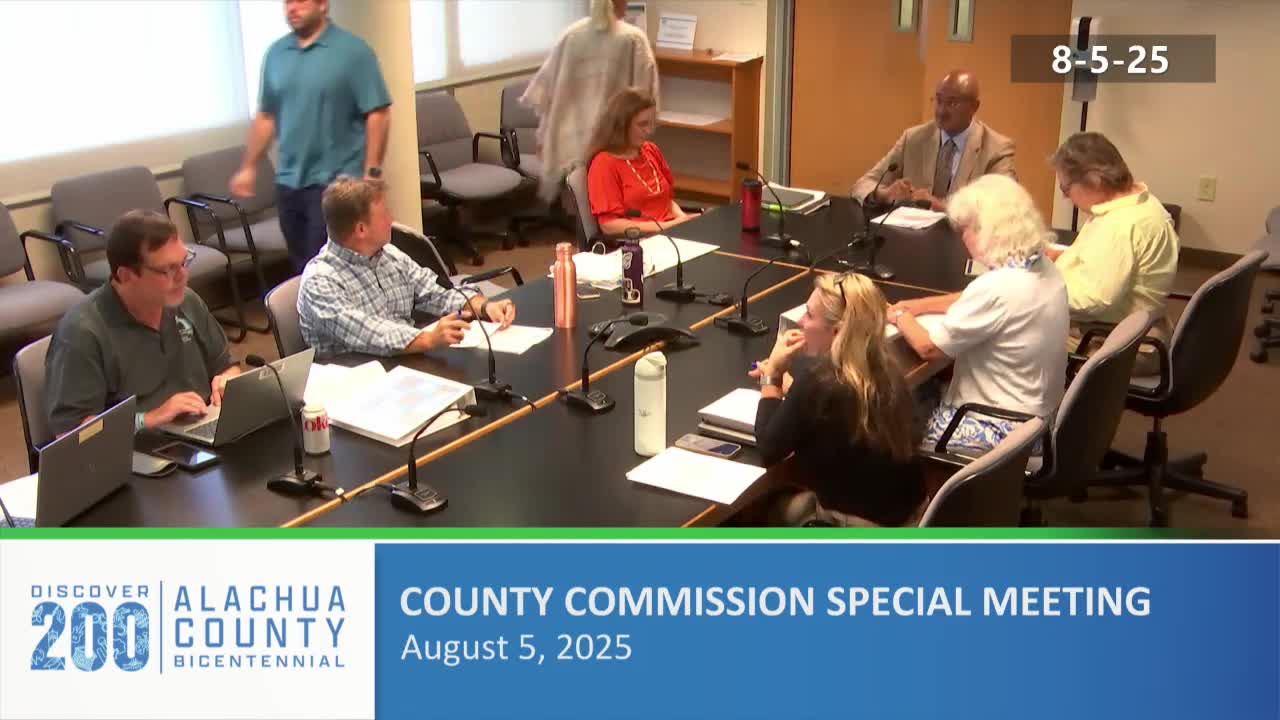
After hours of debate about officer safety, employee retention and shelter operations, the Alachua County Commission voted 4–1 to ask staff to negotiate an interlocal agreement for the sheriff to assume animal enforcement functions while the county retains shelter and rehoming services.
Alachua County commissioners voted 4–1 on Aug. 5 to direct staff to work with the sheriff’s office to develop an interlocal agreement for transferring the county’s animal enforcement functions to the Alachua County Sheriff’s Office, while keeping the animal shelter and adoption services under county management.
The commission’s direction asks staff to draft an agreement that preserves the county’s operational priorities and addresses employee transitions, staffing qualifications and program safeguards, then return to the board with the contract terms and any sticking points. The board did not adopt a finalized contract at the meeting; commissioners asked staff to pursue model agreements from other counties and to include an early review clause if the parties move forward.
Supporters said the transfer would improve safety and investigative capacity for enforcement officers. Gina Peebles, assistant county manager and chief of staff, told the board that putting enforcement under the sheriff would “enhance both officer safety and community service,” citing access to the county’s combined communications center, live GPS on radios and body-worn cameras as safety and evidence benefits. Peebles also said the sheriff’s office expects enforcement staff to pass pre-employment background screenings and that the office would not move forward unless a substantial portion of current enforcement personnel — the sheriff’s office used a 60 percent threshold as a reference point — opted to transfer and met qualification standards.
Julie Johnson, director of Alachua County Animal Resources, described widespread variation in how jurisdictions structure animal enforcement and the staff concerns that follow organizational change. “There is hesitation on a lot of parts because my officers have colleagues in different departments across the state and across the nation,” Johnson said, and emphasized the county would seek contract language to protect the shelter’s mission.
Opponents raised concerns that shifting enforcement to a law-enforcement agency would change public perception and potentially discourage reports from residents with mental-health or other sensitivity to police responses. One commissioner said they feared the move could lead to an “increased police presence” in responses that have historically been handled by specialized civilian animal staff and stressed the board must preserve the county’s “managed intake” and no-kill policies for the shelter.
County staff and the sheriff’s representatives said the sheriff’s proposal would keep current animal control officers as civilian, non‑sworn personnel employed by the sheriff’s office, not deputies, and would not change shelter oversight. Staff noted a plan request in the packet for one additional supervisor and that an existing lieutenant position would absorb bureau leadership responsibilities. Peebles and sheriff’s staff also highlighted that 23 other Florida sheriff’s offices already provide animal enforcement services as a reference.
The board directed staff to pursue an interlocal agreement and to return with proposed contract language, including provisions for review after a pilot period and protections for the county’s shelter policies. The motion passed by voice vote, recorded as 4 in favor and 1 opposed; the transcript did not record a roll-call naming each commissioner’s vote.
What’s next Staff will gather sample agreements from other counties, formalize the proposed staffing/qualification language, and draft an interlocal agreement for board consideration. The board asked staff to include a review clause (6–9 months suggested in discussion) and to identify any “sticking points” that would prevent an agreement from meeting the county’s shelter and animal-welfare objectives.
“We will look at how all the other sheriff’s offices that are doing it now are handling that, and we will pick from the best of those that we like,” Peebles told commissioners.
Ending Commissioners stressed the proposal could be reversed if the terms negotiated with the sheriff do not protect the shelter’s mission or staff and asked that employee feedback and transition plans be central to any future contract brought back to the board.