Get Full Government Meeting Transcripts, Videos, & Alerts Forever!
Get email alerts on the Historic Preservation topic
No spam. Unsubscribe anytime.
Preservation commission finds hundreds of potentially historic properties in Overman Park area
Summary
A reconnaissance survey of Cedar Falls’ Overman Park and Lawn City areas identified hundreds of properties that may qualify for the National Register of Historic Places; commissioners outlined next steps including intensive-level surveys, owner outreach and possible nomination work through the State Historic Preservation Office.
The Cedar Falls Historic Preservation Commission reported that a reconnaissance survey of neighborhoods around Overman Park identified 467 properties in the study area, including 283 the commission found potentially significant for the National Register of Historic Places.
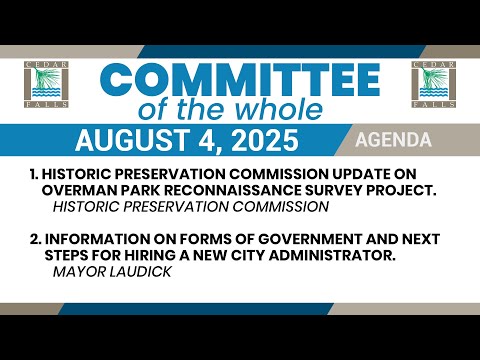
“Our goal was to identify properties eligible for listing on the National Register of Historic Places and identify any potential historic districts,” said Sally Claystemmer, chair of the Cedar Falls Historic Preservation Commission, during the committee of the whole meeting on Aug. 4. The commission conducted a reconnaissance-level survey from the street, documenting architectural materials and styles and photographing properties from public rights of way.
The reconnaissance-level work — a preliminary, exterior-only survey intended to cover a larger area than an intensive survey — found 184 properties that did not appear eligible individually or as part of a district, Claystemmer said. Three properties appear individually eligible for the National Register outside any district, and an additional 13 properties were identified as individually eligible or potentially so for inclusion within proposed districts.
Urbana Preservation and Planning analyzed the collected data and recommended dividing the surveyed area into two potential historic districts: an Overman Park Historic District and a Lawn City Historic District. The Overman Park candidate area (roughly First Street to Eighth Street, Clay to Main) contains 236 properties, of which the commission listed 126 as potential contributors and 110 as noncontributors; Lawn City (roughly Eighth to Twelfth, Main to Walnut) contains 221 properties, with 147 potential contributors and 74 noncontributors, Claystemmer said.
The commission said the reconnaissance survey flagged 27 Lawn City properties and several other houses that may be individually eligible but would require additional, intensive-level documentation to confirm. Claystemmer said intensive-level work would include more detailed archival research and interior documentation when necessary.
Owners of properties flagged as individually eligible may pursue individual National Register nominations, Claystemmer said. The commission would assist owners who wish to proceed and would work with the State Historic Preservation Office for formal review. She said the commission would also consider applying for another Certified Local Government (CLG) grant to fund intensive survey work and nominations.
Claystemmer said results of the reconnaissance survey have been added to the city’s GIS so residents can view parcel-level findings, build dates and the survey descriptions online. The commission also discussed adjusting the project boundary eastward to Olive Street to include additional architecturally similar properties and possibly expanding the Overman Park district to wrap into previously surveyed downtown areas.
Commissioners and council members asked how district listing would affect property owners. Claystemmer said the primary regulatory effect comes only when owners apply for state or federal historic-preservation tax credits; she described those credits as previously available to single-family homeowners but changed recently at the state level to limit eligibility to income-producing properties. Claystemmer said historically credits had covered roughly 20–25% of qualified work but cautioned the commission did not have current statewide rates at hand. She added that listing on the National Register itself would not prevent owners from making changes if they were not pursuing tax credits.
Next steps outlined by the commission include pursuing CLG grant funding for intensive-level surveys, conducting additional documentation of properties flagged for further study and building owner support for district nominations (Claystemmer noted district nominations typically require owner support from at least 50% of properties in a proposed district). The commission did not present any formal motions or votes during the meeting.
The commission thanked volunteers and a UNI intern who contributed more than 200 volunteer hours on the reconnaissance survey, which took place primarily in October. The commission said more-detailed maps and property lists are available through the city’s historic preservation web pages.