Get Full Government Meeting Transcripts, Videos, & Alerts Forever!
Get email alerts on the Budget topic
No spam. Unsubscribe anytime.
Largo presents FY26 proposed budget with millage options, utility rate hikes and $19.3M wastewater borrowing
Summary
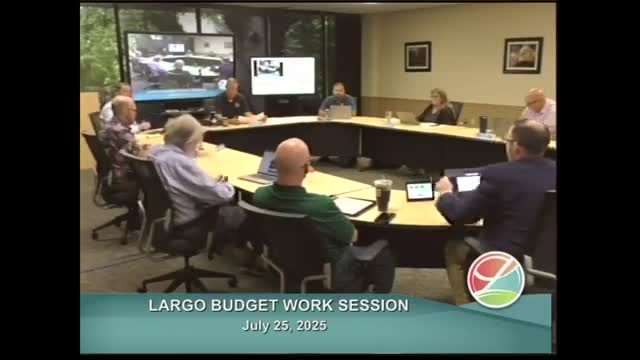
City staff presented the city manager—s proposed FY26 budget on July 25, laying out millage options that would raise between about $343,000 and $2.4 million, proposed utility rate increases, a planned $19.3 million deep-well borrowing for wastewater, and department staffing and capital priorities ahead of September adoption hearings.
City staff on July 25 presented the city manager—s proposed fiscal year 2026 budget for Largo, including a proposed millage rate that would raise about $2.4 million, utility rate increases for solid waste, stormwater and wastewater, and a planned borrowing of $19.3 million for a wastewater deep-well injection project.
"This is not the doomsday budget," staff member John said during the presentation, adding that while Largo is not facing immediate insolvency, slower property-value growth means the city may fall below its 10% minimum fund balance in future years if growth continues at the current pace.
Why it matters: The budget sets spending priorities for city services and funds several resilience and capital projects. Staff and commissioners debated whether to adopt the full proposed millage or a lower option and discussed targeted fee increases and staffing requests that would affect service delivery and long-term reserves.
Most important figures and choices
- Millage options: Finance staff presented a range of millage scenarios. The city manager—s proposed rate (the maximum shown on TRIM notices) would generate roughly $2.4 million more than FY25 and project a general fund ending balance of about 19.7% for FY26. A statutory rollback option would produce an additional roughly $343,000. Staff estimated the proposed budget raises the typical resident—s cost by about $9.57 per month (about $115 per year) under the manager—s recommendation.
- Utility rate increases: The FY26 proposal includes a 10% increase for solid waste, a 15% stormwater increase in FY26 and another 15% in FY27, and a 5% wastewater increase in FY26 (with 5% annual increases thereafter). Staff translated the first-year changes into approximate monthly household impacts: about $2.80 for solid waste, $2.31 for stormwater and $1.61 for wastewater (plus about $0.20 per 1,000 gallons).
- Wastewater borrowing: The wastewater forecast includes an estimated $19.3 million borrowing for a deep-well injection project in FY26, with recurring debt service estimated at about $1.3 million annually.
Budget drivers and fund highlights
- Personnel and benefits: Citywide personnel costs are budgeted to rise (personnel increases for the general fund were presented in the 4.8%–5.6% range for FY26 depending on the metric). Health insurance budgeting assumes a 5.5% increase for FY26; staff noted this is lower than recent projections and last year—s 9% rise. Pension contributions rose based on the actuarial report.
- Insurance and risk: Property insurance premiums have increased significantly after a recent property revaluation; staff said the city—s premium exposure rose from about $1.6 million to about $2.2 million under the initial renewal. The risk fund is budgeted at roughly $24 million for FY26, with a catastrophe reserve of about $1.3 million.
- Other funds: The West Bay Drive CRA is outpacing citywide value growth and is budgeted to deliver about $2.4 million in FY26; the golf course fund and other enterprise funds show planned capital and roof replacement work; solid waste and wastewater rates are also being adjusted in part to match county tipping fee increases or to support capital needs.
Department requests and policy choices discussed
- Police staffing: The police chief reported the department is authorized for 159 sworn officers but is often down about 20 officers; the department proposed over-hire positions as a mitigation strategy. Staff estimated the cost of the proposed over-hires at about $1.2 million (wages and benefits only) and said vehicles were not included in that number.
- Fire resources and stations: Fire Rescue described ongoing efforts to identify sites for future stations, noting Station 39 opened recently. The commission discussed property acquisition challenges and potential locations in the Ulmerton/Belcher corridor; a previously offered private price for one site was described as prohibitive by staff.
- Stormwater planning and projects: Staff flagged major stormwater work in the CIP, including projects to replace or line corrugated metal pipe and other conveyance improvements. The stormwater fund plan includes programmed rate increases to support system projects and a proposed vulnerability/resilience study that staff budgeted at roughly $250,000.
- Major capital timing: General fund capital spending was reduced about $2.3 million in FY26 versus FY25 because of project timing; enterprise funds show larger year-to-year capital swings tied to major projects.
Other notable items discussed
- Resilience investments and ARPA: Staff highlighted several resilience items, including a $500,000 ARPA-funded generator for the Highland Recreation Complex and relocation plans for two sewer lift stations to reduce future flooding risks.
- Downtown and economic development: Staff previewed the coming Horizon West Bay building and a downtown activation and parking study (CRA-funded) to address parking, pedestrian improvements and future development patterns.
- Community engagement and strategic plan: Staff emphasized that the FY26 budget aligns with priorities identified through the city—s strategic planning outreach and that a formal updated strategic plan will be adopted this fall.
What commissioners asked for and next steps
Commissioners asked the finance advisory board to review the proposed budget and the narrower option of trimming roughly $200,000 from the proposed rate and to advise whether that could be done without observable cuts to service levels. Staff noted that, alternatively, the commission could draw a one-time $200,000 from fund balance for FY26 without immediately cutting services, but that longer-term fund balance trends would need attention in future years. The commission will receive TRIM notices after the county mailing on Aug. 18; first and second readings and budget adoption are scheduled in September.
Ending
The city manager—s proposed FY26 budget frames a choice for commissioners between preserving near-term reserves while funding capital and resilience projects or pursuing smaller near-term tax/fee increases and asking staff and the finance advisory board to identify recurring reductions. The commission and advisory board will reconvene in August and September for formal readings and final adoption.