Get Full Government Meeting Transcripts, Videos, & Alerts Forever!
Get email alerts on the Public Comment Assessments topic
No spam. Unsubscribe anytime.
Residents press West Fargo officials on how special assessments are calculated, notices and street repairs
Summary
Property owners asked how assessments are allocated, how notice lists were compiled, where assessment money goes and who fixes installation defects; city staff described methodology, appeal steps and pavement-repair timing.
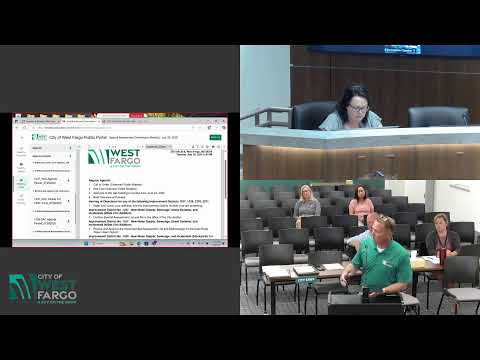
Multiple West Fargo property owners used the commission meeting to ask for explanations of how special-assessment amounts are calculated, how notice letters were mailed and who is responsible for fixing construction defects that leave standing water.
Jennifer Erickson, who lives at 1112 Legion Lane West, asked whether parcels that are vacant today but developed later would be assessed again. City Engineer Jerry Wallace replied, “we wouldn't be wanting to assess them twice for the same project because that's against Century Code.” Wallace explained that vacant tracts within a district are generally assigned equivalent units now—typically one equivalent unit per 10,000 square feet for non-single-family tracts—so future subdivision does not automatically trigger a second assessment for the same improvement.
Residents also sought clarity on how individual lot amounts are calculated. Wallace said single-family homes typically receive one equivalent unit and that staff uses front footage and square-footage-based approaches in different cases. For the water portion of Wilds 20 First, staff described a front-footage allocation method in the materials distributed to the commission.
Several residents raised questions about where special-assessment money goes and whether the city retains interest. One resident summarized an example they had tallied for their block and asked whether the city “makes money off of this.” City staff said the assessments fund the construction and debt service for the projects and that when the city bonds for the work there is interest associated with the bond. The city said it has in some instances refinanced bonds at lower rates and that West Fargo’s policy is to stop assessments once the underlying debt is retired; staff said they pass refinancing savings on to property owners when feasible.
Another caller, identifying himself as Jeremy Wendy, asked who is responsible for correcting drainage and curb installation issues after construction. Staff said the city typically holds contractors to construction standards and that, because of expected settlement over time in local soils, the city schedules pavement-management work (mill and overlay, curb-and-gutter repairs) before roughly the 15-year mark. Staff said these follow-up projects are handled as future public projects; if a repair is required outside normal policies and the city’s methodologies dictate otherwise, any additional costs could be addressed through a future assessment, but staff said such outcomes are considered on a case-by-case basis.
A resident who received a misaddressed notice asked how to have the parcel information corrected; staff apologized, acknowledged some mailed notices were returned and resent, and offered to follow up directly after the meeting to correct mailing lists and parcel numbers.
The discussion underscored recurring concerns from new and existing residents about special assessments’ size, notice accuracy and long-term maintenance planning. Staff committed to follow-up with owners who requested parcel-level methodology and with residents who reported construction defects.