Get Full Government Meeting Transcripts, Videos, & Alerts Forever!
Get email alerts on the Sustainability Framework topic
No spam. Unsubscribe anytime.
Committee reviews Simply Sustainable Framework update, asks for clearer public framing and alignment with other plans
Summary
Denton City staff presented a draft update to the 2020 Simply Sustainable Framework focused on two primary goals — municipal operations and community impact — and committee members asked for clearer public-facing language, alignment with other plans and clarification on unfinished risk and greenhouse-gas work.
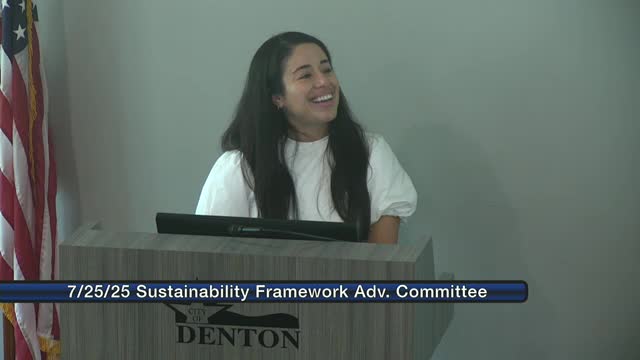
Julissa Amador, senior program coordinator in the Environmental Services and Sustainability Department, presented an update to Denton City’s Simply Sustainable Framework on July 25, outlining a draft that reduces the framework to two core goals and seeks alignment with plans adopted since 2020.
The committee was shown that goal 1 is focused on municipal operations — reducing the environmental footprint of city operations, assets and facilities — and goal 2 on community impact, reducing barriers so residents can adopt sustainable behaviors. Amador said the draft is a working document intended to guide planning for the next five years: “we're gonna review the draft that was aimed at backup and receive feedback and talk about next steps,” she said.
Committee members pressed staff to add clearer, public-facing context in the draft. One member asked for the supportive “preamble” language that appeared in the previous 2020 framework — short vision and principles that help a casual reader understand the motivations behind the update. Another member recommended adding language tying municipal and community strategies more explicitly to the Climate Action Plan and other master plans so readers can see why the update matters.
Members also asked for specific edits and additions to the draft strategies. Questions and suggestions raised during the discussion included:
- Adding property tax exemption incentives for residents who install renewable energy systems and explicitly listing battery storage under those incentives; staff said they would include community-side incentives as feedback.
- Clarifying how municipal pilots — such as Parks’ electric lawn equipment trials and landfill-gas-to-energy work presented earlier by Solarbase — will be reflected in the municipal operations strategies.
- Cross-referencing existing plans with their own metrics (for example the Urban Forest Master Plan, the 2040 Mobility Plan, parks and water plans) so the framework does not duplicate effort but aligns with departmental targets.
On technical and programmatic items, committee members asked whether a previously scheduled city risk and vulnerability assessment was completed. Amador and staff replied the 2020 assessment was only partially completed; staff said a preliminary report exists and can be shared: “we have a preliminary report that we could forward to you,” she said, adding that the original effort was not finished because staff groups could not be convened to complete the work.
Members also questioned whether the city would adopt updated building-energy codes. Katharine Barnett, sustainability manager, said she and building inspections are “looking at the newest International Energy Conservation Code and those amendments that are approved with COB to adopt that, and maybe the 2024 version, I believe.”
Committee members recommended including the greenhouse-gas inventory explicitly as a tracking measure in the framework. Staff responded that the inventory is a separate analytic product and that work on the 2023 inventory will begin soon; the inventory will inform the Climate Action Plan progress measures.
Staff asked for written feedback on the draft and said they would incorporate the committee’s suggested edits and return with a revised draft and next steps. No formal action was taken on the framework during the meeting.